Warburton, Nankana Sahib District, Punjab | 11 February 2023
He was already in police custody.
He had been accused of desecrating pages of the Quran.
A crowd gathered outside the police station.
The mob climbed the walls.
The station was overrun.
The accused man was dragged from his cell.
And Muhammad Waris was lynched before any court could hear the case against him. Reuters reported that police were overwhelmed because only a small number of officers were present at the station.
The killing became another stark example of a recurring problem:
Police custody should protect an accused person from mob violence. In Warburton, custody failed to protect him at all.
Who Was Muhammad Waris?
The victim was identified as Muhammad Waris, a Muslim man from the Nankana Sahib area.
Contemporary reports differed on his exact age. Reuters described him as a man in his early twenties, while Associated Press reporting described him more broadly as an adult man and other reports placed him in his thirties.
Because the reporting is inconsistent, the safest formulation is simply:
Muhammad Waris was a Muslim man accused of desecrating the Quran in Nankana Sahib District.
His Muslim identity matters.
Like Mashal Khan, Channi Goth and other cases in this archive, his death demonstrates that blasphemy-related mob violence can also target members of Pakistan’s majority religious community.
The Allegation
Police said Waris had been accused of desecrating pages of the Quran.
Associated Press reported allegations that he had attached photographs to pages of the Quran and scattered or displayed them in the area.
These were allegations.
They had not yet been tested before a court.
Police took Waris into custody.
At that point, the state had both:
authority over him,
and responsibility for his safety.
There Had Been an Earlier Blasphemy Case
Associated Press later reported that Waris had previously spent time in prison in connection with another blasphemy case and had been released in 2022.
That history may have influenced the reaction of people in the area.
But legally, it did not change the requirement of due process.
A previous accusation or conviction does not give a crowd the right to kill someone accused again.
Every new allegation still requires:
investigation,
evidence,
trial,
and lawful judgment.
The Crowd Gathered Around Warburton Police Station
After news of the allegation spread, hundreds of people reportedly surrounded the Warburton Police Station.
Reuters reported that the crowd demanded access to Waris.
Associated Press described hundreds of people descending on the station.
The situation should have triggered an immediate high-risk response.
An accused blasphemy suspect was inside.
A crowd was outside.
The danger was obvious.
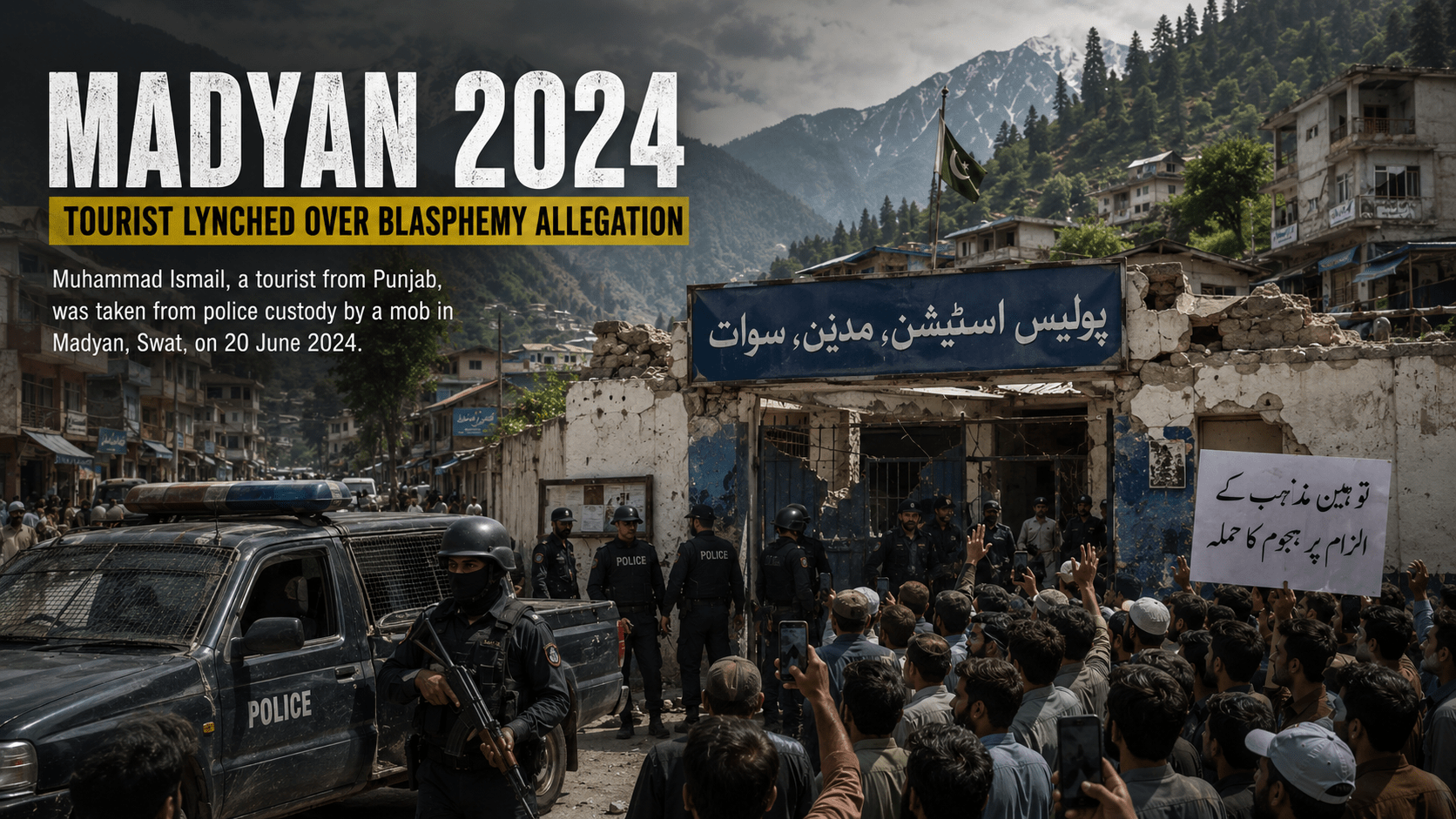
The Mob Climbed the Police Station Walls
Associated Press reported that some participants used a wooden ladder to climb over the police-station wall, after which the main gate was opened for the crowd.
This detail matters.
The police station did not merely fail to calm a protest.
Its physical security was breached.
The mob entered the premises and took control of a person who was legally in state custody.
That represents an especially serious breakdown of state authority.
The Police Station Was Overrun
Reuters reported that only a handful of officers were at the station and that they could not resist the crowd.
The mob ransacked the station and reached Waris.
By the time reinforcements arrived, it was too late.
This raises an obvious institutional question:
Why was a person facing a highly sensitive blasphemy allegation kept in a location that could not be adequately defended?
Waris Was Dragged From His Cell
The crowd removed Waris from police custody.
Videos verified by police showed him being dragged through the streets and attacked with sticks and metal rods. Reuters and Associated Press both reported the lynching.
For SFFP’s archive, the graphic details are unnecessary.
The essential fact is enough:
A man in police custody was taken by a mob and killed before any judicial determination of guilt.
The Mob Tried to Burn His Body
Police reported that members of the crowd attempted to set Waris’s body on fire.
Reinforcements and local intervention reportedly prevented the body from being burned.
This echoes other cases in our archive:
Channi Goth,
Priyantha Kumara,
Mashal Khan,
and Shama and Shahzad.
The pattern is disturbing.
Once a crowd assumes the authority to punish, violence can continue even after the victim is dead.
Police Custody Should Have Been the Safest Place
This is what distinguishes Nankana Sahib from many other cases.
Waris had already reached police custody.
He was no longer exposed in a marketplace or neighbourhood.
He was inside a state institution.
That should have meant:
protection,
controlled investigation,
legal access,
and physical security.
Instead, the station became the location from which he was taken.
Custodial Protection Is a State Responsibility
Once police detain someone, the person cannot protect themselves.
They cannot leave.
They cannot choose a safer location.
They cannot call private guards.
That is why state custody creates a heightened duty of care.
If a mob removes a detainee from a police station and kills him, the issue is not only mob violence.
It is also failure of custodial protection.
Senior Police Officers Were Suspended
The Punjab police leadership reacted quickly after the killing.
Dawn reported that Punjab Inspector General of Police Dr Usman Anwar suspended the district police officer responsible for the area and the Warburton station house officer for failing to prevent the lynching.
This is an important part of the story.
The police leadership itself recognized that the response had failed.
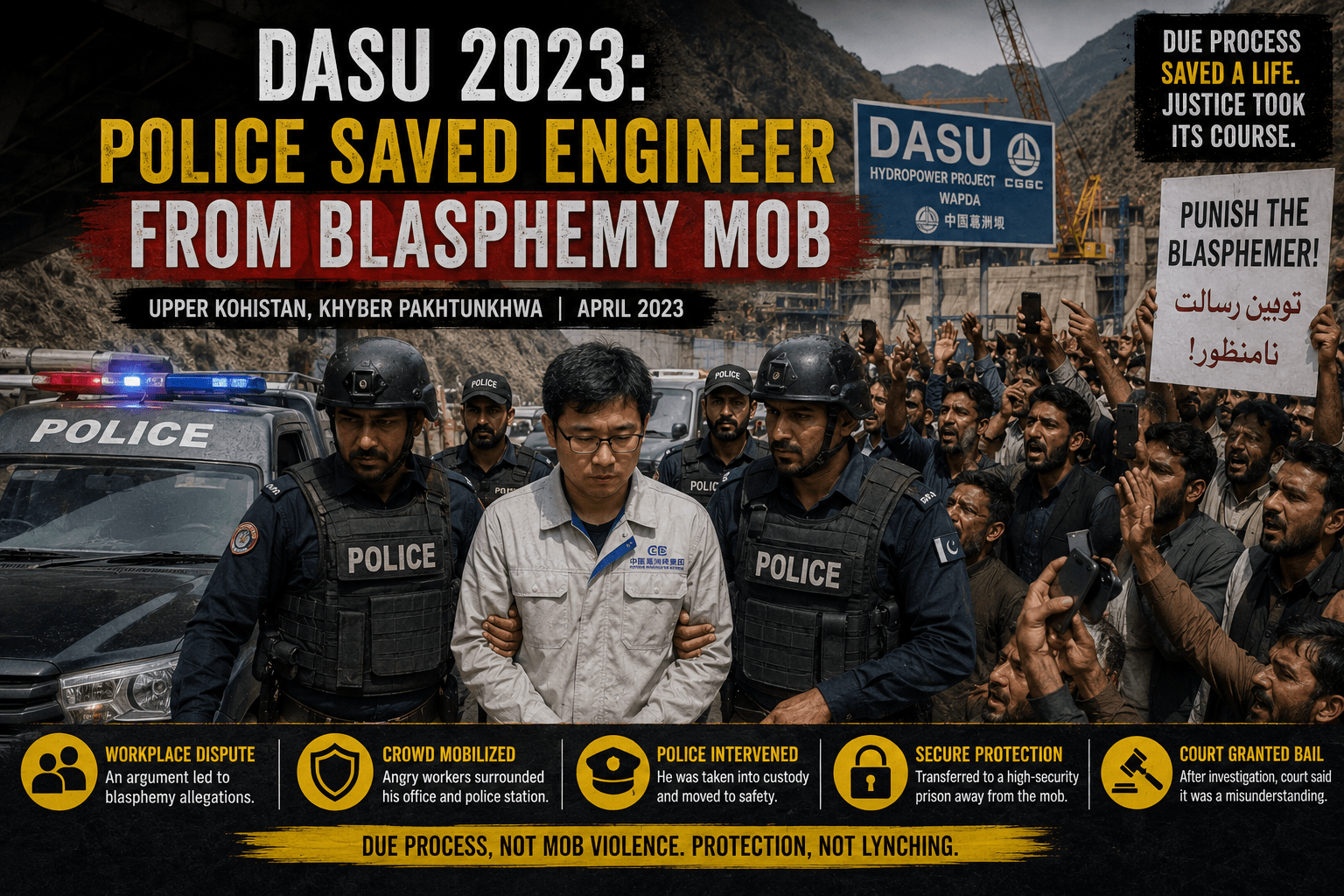
Prime Minister Shehbaz Sharif Condemned the Killing
Associated Press reported that Prime Minister Shehbaz Sharif condemned the lynching and ordered action against those responsible.
Again, this matters for balanced documentation.
The killing did not represent official state policy.
Senior state officials condemned it.
The question was whether institutional accountability afterward would be strong enough.
Dozens of Suspects Were Arrested
Police launched a large investigation.
Associated Press reported that at least 50 suspects were arrested within days of the lynching.
Video evidence and eyewitness accounts were used to identify people involved.
This is one of the advantages of modern mob-crime investigations.
Crowds can create anonymity.
Smartphones can also destroy that anonymity.
The Investigation Needed to Identify Individual Roles
Hundreds may surround a police station.
But not every person present necessarily commits the same crime.
Some may:
break the gate,
incite the crowd,
drag the prisoner,
strike the victim,
record the attack,
or simply remain nearby.
A lawful prosecution must distinguish between those roles.
That is the same principle we have emphasized throughout this archive:
The existence of a mob does not remove individual criminal responsibility.
Waris Was Muslim
This case again undermines any simplistic religious narrative.
Waris was not Christian.
He was not Hindu.
He was not Ahmadi.
He was Muslim.
Yet an accusation of blasphemy still placed his life in immediate danger.
The common factor was not minority identity.
It was:
the collapse of due process after a religious allegation.
Human Rights Protect the Accused, Not Just the Innocent
It is important to understand what defending Waris’s right to protection means.
It does not require us to declare that the allegation against him was false.
We do not have to determine that.
That was the job of investigators and courts.
The human-rights principle is more basic:
Even if an accusation is serious, the accused must remain alive long enough for the law to decide it.
The Rule of Law Must Survive Public Anger
A justice system is easiest to support when the accused person is popular.
Its real test comes when the allegation provokes anger.
That is when institutions must remain strongest.
Police cannot surrender an accused person because a crowd is large.
Courts cannot be replaced by streets.
Criminal punishment cannot be determined by whoever gathers outside the police station.
Police Stations Need Emergency Protocols for Blasphemy Cases
The Warburton incident provides a clear operational lesson.
When someone accused of blasphemy is taken into custody, police should immediately assess:
crowd risk,
station security,
available personnel,
possible transfer to a secure facility,
intelligence regarding mobilisation,
and emergency reinforcement.
A small rural station may simply not be safe enough.
The accused may need to be moved before the crowd arrives.
Prevention Has to Begin Before the Gate Breaks
Once hundreds of people surround a police station, control becomes much harder.
The critical period is earlier.
Authorities need to monitor:
religious announcements,
social media,
local mobilisation,
and threats.
The objective should be to prevent a crowd from reaching the station at all.
Religious Leaders Can Reduce the Risk
Local religious leaders also play an important role.
They can tell communities:
allow police to investigate,
do not interfere with custody,
do not punish the accused,
and do not attack state institutions.
In emotionally charged cases, respected community voices may reduce pressure before it becomes violence.
Attacking a Police Station Is Also an Attack on the Justice System
The mob did not only kill Waris.
It overpowered a police station.
That matters.
A police station symbolizes the state’s claim that disputes will be handled through institutions.
When a crowd breaks in and removes a prisoner, it is making a competing claim:
We—not the courts—will decide punishment.
That principle cannot coexist with rule of law.
The Universal Declaration of Human Rights
The Nankana Sahib lynching concerns several principles reflected in the Universal Declaration of Human Rights:
- the right to life and security of person;
- equality before the law;
- protection from arbitrary punishment;
- the right to a fair hearing;
- and the presumption of innocence.
These rights apply even to someone accused of a deeply offensive or serious crime.
Rights that disappear when an accusation becomes unpopular are not meaningful rights.
Human Rights Are Not a Defence of Blasphemy
This distinction is crucial.
Defending due process does not mean defending blasphemy.
A person may sincerely believe that blasphemy should remain a criminal offence.
That position still does not justify mob killing.
The legal question and the vigilante question are separate.
A law can exist.
A court can hear a case.
And a mob can still be prohibited from killing the accused.
This Is Why SFFP’s Archive Must Remain Universal
At Samaritan’s Fellowship Foundation, our Human Rights & Empowerment work cannot depend on whether we personally identify with the victim.
Waris was Muslim.
Priyantha was Buddhist.
Bhong involved Hindus.
Gujranwala involved Ahmadis.
Joseph Colony involved Christians.
The principle remains unchanged.
Every accused person deserves law before punishment.
Community Protection and Institutional Strength Belong Together
SFFP’s broader How We Work model is based on the idea that human rights require more than awareness.
Communities need functioning institutions.
Police need capacity.
Citizens need trust.
Local leaders need training.
And people need confidence that disputes can be resolved without violence.
Without those elements, even good laws can fail in practice.
What Should We Learn From Nankana Sahib?
High-risk blasphemy suspects should not remain in poorly defended police stations.
Crowd mobilisation should trigger immediate reinforcements.
Police leadership must be accountable when basic protection fails.
Video evidence should be preserved quickly.
Mob leaders and direct perpetrators should be distinguished in prosecution.
Religious leaders should actively oppose attacks on detainees.
And the state must make one principle unmistakable:
Police custody means protection from the mob.
Accountability Afterward Matters — Prevention Matters More
Officers were suspended.
Suspects were arrested.
Political leaders condemned the killing.
Those responses matter.
But they all came after Waris was dead.
The strongest response would have been:
a secure police station,
an early transfer,
sufficient reinforcements,
and a living accused person appearing before a court.
That is the standard institutions should aim for.
Help Us Advance Freedom, Dignity and Opportunity
Samaritan’s Fellowship Foundation builds integrated, community-led ecosystems that empower marginalized communities through human rights, healthcare, education, clean water, sustainable livelihoods and local leadership.
We believe every person in custody deserves protection and every allegation deserves lawful investigation.
If you believe police stations should protect accused people rather than become places from which mobs take them:
Support Our Mission →
Together, we can strengthen communities where disputes are resolved through evidence, law and accountable institutions—not mob violence.
Empowerment Beyond Aid — Advancing Freedom and Rights.
Editorial Note
Samaritan’s Fellowship Foundation documents publicly reported human-rights cases for education, historical record and awareness.
Muhammad Waris was accused of desecrating the Quran and was taken into police custody at Warburton Police Station in Nankana Sahib District on 11 February 2023.
He was killed by a mob before any court determined the allegation against him.
Contemporary reports differ regarding Waris’s exact age and some details of the alleged desecration. This article therefore avoids presenting uncertain biographical details as established fact.
Punjab police suspended senior local officers after the incident for failing to prevent the lynching, while Prime Minister Shehbaz Sharif publicly condemned the attack. Police subsequently arrested dozens of suspects.
SFFP does not attribute the conduct of the mob to Islam, Muslims generally, residents of Nankana Sahib generally or the people of Pakistan.
We support lawful investigation, custodial protection, due process, police accountability and equal human dignity for every accused person.
References
1. Reuters — Mob Storms Pakistani Police Station, Lynches Blasphemy Accused, 11 February 2023
Contemporary report documenting the mob attack on Warburton Police Station, the removal of Muhammad Waris from custody and his lynching.
2. Associated Press — Angry Mob Lynches Blasphemy Suspect in Pakistan, 11 February 2023
Detailed report on hundreds of people storming the station, use of a ladder to enter the compound, the allegation against Waris and the government response.
3. Associated Press — Pakistan Arrests 50 Men After Lynching, 13 February 2023
Follow-up reporting on arrests, Waris’s earlier blasphemy case and the suspension of police officials.
4. Dawn — Nankana Sahib DSP, SHO Suspended After Mob Lynching, 11 February 2023
Reports Punjab IGP Dr Usman Anwar’s suspension of senior police officers for failing to prevent the killing.
5. The Guardian — Mob Storms Pakistan Police Station and Lynches Man, 12 February 2023
International follow-up describing Muhammad Waris as a Muslim man accused of Quran desecration and killed after being removed from police custody.
6. Arab News — Man Accused of Blasphemy Lynched After Mob Storms Police Station, 11 February 2023
Reports the incident in Nankana Sahib and statements from police officials.
7. Wikipedia — List of Blasphemy Cases in Pakistan
Includes Muhammad Waris and the 2023 Nankana Sahib police-station lynching in its chronology.