Samaritan’s Fellowship Foundation Pakistan works with marginalized and minority communities to defend their rights, strengthen their voice, and create opportunities for lasting self-reliance.
Our work connects three pillars: Freedom, Rights & Empowerment; Economic Opportunity; and Peace & Fellowship.
We speak for the freedom of people from social differences, injustice, modern slavery, extremism, religious intolerance, persecution, and poverty.
Joseph Colony 2013: A Blasphemy Allegation, a Burned Christian Neighborhood, and an Acquittal Seven Years Later
March 6, 2013
Joseph Colony 2013: A Blasphemy Allegation, a Burned Christian Neighborhood, and an Acquittal Seven Years Later
Lahore, Punjab | 2013–2020
A quarrel between two men.
A blasphemy allegation.
A Christian neighborhood told to leave.
Thousands gathering.
Homes looted and burned.
Churches damaged.
Then the man whose accusation had triggered the violence was sentenced to death.
Seven years later, the Lahore High Court acquitted him.
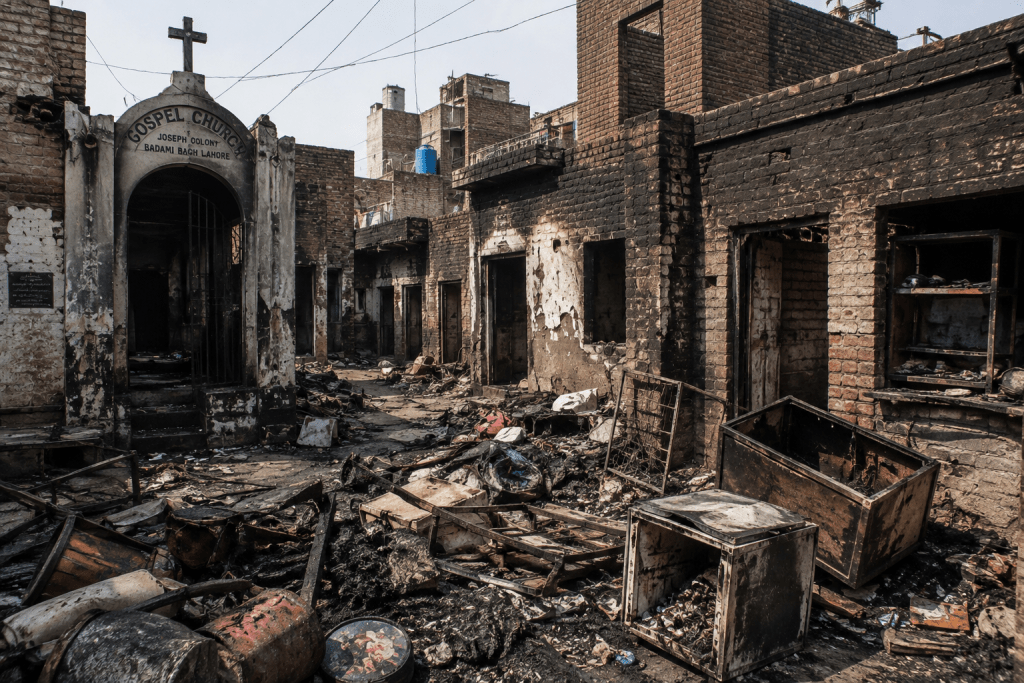
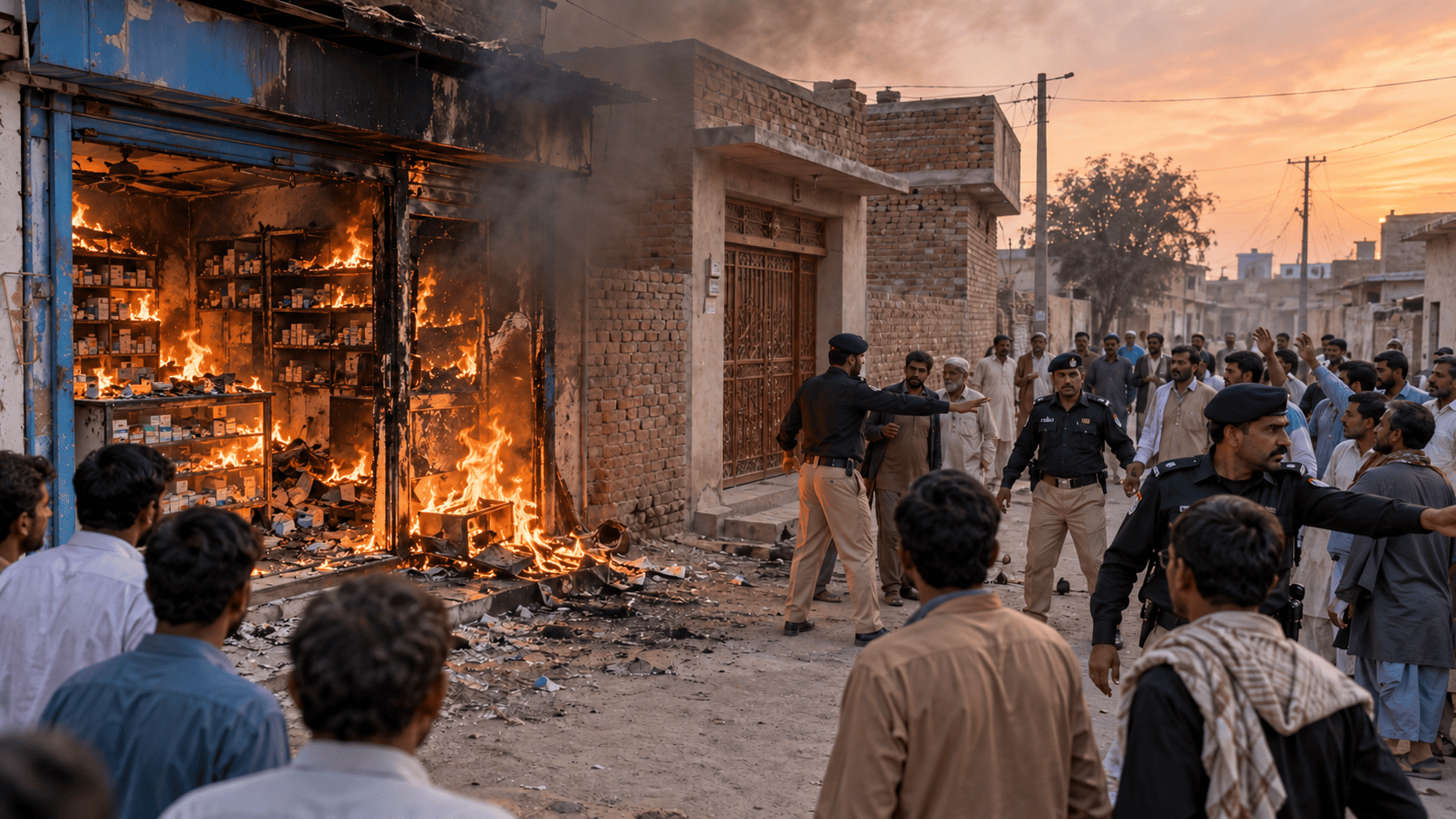
Symbolic image representing the March 2013 attack on Joseph Colony in Lahore, where more than 100 Christian homes were burned following a blasphemy allegation against Sawan Masih.
The Joseph Colony attack of March 2013 became one of Pakistan’s most widely documented episodes of anti-Christian mob violence linked to a blasphemy allegation. Reuters later reported that more than 125 homes were burned by a mob of more than 3,000 people. Amnesty International documented roughly 200 houses, at least 12 shops and two churches destroyed or burned.
The exact destruction figures differ across sources.
The underlying reality does not:
An accusation against one Christian man became punishment for an entire Christian neighborhood.
Joseph Colony Before the Attack
Joseph Colony is a predominantly Christian settlement in Lahore’s Badami Bagh area.
Many residents were poor working families, including sanitation workers and daily-wage labourers. Amnesty International described the settlement as a largely Christian neighbourhood owned by the Lahore Municipal Corporation.
The community was compact.
Homes stood close together.
Families knew one another.
That concentration would make the neighbourhood especially vulnerable when violence came.
The Dispute Involved Sawan Masih
The events began with a dispute involving Sawan Masih, also known in some accounts as Sawan or Savan Masih.
Human Rights Commission of Pakistan’s investigation reported that a quarrel occurred between Sawan Masih and local barber Shahid Imran while the two were drinking together.
Imran later accused Sawan of making blasphemous remarks.
Sawan denied the allegation.
What had initially been a personal dispute now carried one of the most serious accusations possible in Pakistan.
An FIR Was Registered
Police registered a blasphemy case against Sawan Masih.
He left the area amid growing tensions and was later arrested.
But the criminal case against him was only one part of what followed.
By then, word of the accusation had spread.
Crowds began gathering around Joseph Colony.
Residents understood that the danger was no longer limited to Sawan.
Christian Families Were Warned to Leave
One of the most disturbing features of the Joseph Colony case was that residents received warnings before the major attack.
Human-rights investigations later concluded that authorities knew tensions were rising and that violence was possible. HRCP specifically criticized the police and district administration for failing to protect the community adequately despite signs of impending trouble.
Many Christian residents left their homes.
That may have saved lives.
But it also meant the neighbourhood was largely empty when the mob arrived.
9 March 2013
On 9 March 2013, thousands of people entered Joseph Colony.
Reuters later described a mob of more than 3,000 people.
Homes were ransacked.
Furniture and household possessions were dragged outside.
Buildings were set on fire.
Churches and shops were attacked.
The violence transformed an ordinary working-class neighbourhood into a burned landscape within hours.
How Many Homes Were Destroyed?
Historical reports use different numbers.
Reuters reported more than 125 homes burned.
The Guardian reported around 100 Christian homes torched.
HRCP reported more than 200 houses attacked, looted and burned.
Amnesty International later documented about 200 houses, at least 12 shops and two churches burned.
Because these counts differ, SFFP should not present one number as undisputed.
The safest formulation is:
More than 100 Christian homes—and according to some investigations approximately 200—were attacked or burned, together with shops and churches.
Remarkably, No Mass Casualty Event Occurred
Despite the enormous destruction, the attack did not produce the kind of death toll seen in Gojra.
Residents had largely evacuated before the mob arrived.
That matters.
A neighbourhood was destroyed.
But advance flight appears to have prevented an even greater human tragedy.
This should also remind us that evacuation is not the same as protection.
Families survived by abandoning their homes.
Homes Were Looted Before They Were Burned
HRCP’s investigation documented extensive looting as well as arson.
For poor families, that distinction is significant.
Fire destroys a structure.
Looting can remove everything needed to rebuild:
cash,
jewelry,
documents,
tools,
appliances,
clothing,
schoolbooks,
and household goods.
A family may escape physically unharmed and still lose its entire economic foundation.
Churches Were Also Attacked
Amnesty documented two churches among the properties burned during the violence.
Attacking a church carries a meaning beyond damage to a building.
For a minority community, a church is often simultaneously:
a place of worship,
a community centre,
a support network,
and a symbol of belonging.
Destroying it communicates that the community itself is unwanted.
Why Did Police Not Stop the Attack?
This question became central afterward.
HRCP investigated Joseph Colony and concluded that police and administration bore responsibility for failing to protect residents and property adequately.
The Express Tribune also documented indications that police had early warning of trouble yet failed to prevent the destruction.
This is one of the most important lessons from Joseph Colony:
There was time between the initial allegation and the full-scale attack.
That window should have been used to:
secure the neighborhood,
prevent crowd formation,
deploy adequate police strength,
protect churches and homes,
and control inflammatory mobilisation.
The Government Condemned the Attack
Government officials condemned the violence and announced compensation and reconstruction for affected families.
The attack also drew national outrage and strong criticism from political leaders and civil-society organisations.
This matters for balanced documentation.
Joseph Colony was not an officially sanctioned attack.
The question was whether authorities had acted early enough to prevent it and whether the criminal justice process later delivered accountability.
Sawan Masih Remained in Custody
While Joseph Colony was being rebuilt, the blasphemy prosecution against Sawan Masih continued.
His case was heard under heavy security.
On 27 March 2014, a Lahore court convicted him of blasphemy and sentenced him to death.
Amnesty International reported that he was also fined 200,000 Pakistani rupees.
The Guardian also reported the death sentence and noted that his lawyers planned to appeal.
Sawan continued to deny the allegation.
From Joseph Colony to Death Row
There is an unsettling imbalance in the chronology.
Hundreds of homes had been attacked.
Yet Sawan Masih—the man accused of making the original remarks—was the person who received a death sentence.
The people charged over the mass attack faced a separate prosecution.
This would later produce a radically different outcome.
The Joseph Colony Attack Trial Ended in Mass Acquittals
In January 2017, a Pakistani anti-terrorism court acquitted more than 100 people accused of participating in the Joseph Colony attack.
Reuters reported the acquittal of 112 suspects.
Other reports listed slightly different totals—CSW reported 115 accused, while UCA News reported 106.
The difference likely reflects procedural variation in which defendants were before the court at particular stages.
What matters is that the overwhelming majority of defendants were acquitted.
Why Were So Many Acquitted?
The Joseph Colony attack demonstrates a familiar problem in mob-violence prosecutions:
individual responsibility is difficult to prove.
Thousands may be present.
Videos may show crowds.
Hundreds may be arrested.
But courts still require evidence connecting specific defendants to specific offences.
Witnesses may also become unwilling or unable to identify attackers years later.
Dawn criticized the Joseph Colony acquittals as a failure of justice and accountability.
This reinforces why prevention is often more effective than trying to prosecute a mass crowd afterward.
Seven Years Later, Sawan Masih’s Case Changed
The blasphemy case continued separately.
Sawan remained imprisoned for years under the death sentence.
Then, in October 2020, the Lahore High Court overturned his conviction.
USCIRF records that Sawan Masih was acquitted on 6 October 2020 and released days later.
Al Jazeera likewise reported that the Lahore High Court acquitted him after he had spent about six years on death row.
The case that had helped trigger one of Lahore’s largest anti-Christian attacks had ended in acquittal.
Why Did the Lahore High Court Acquit Him?
Reports on the judgment state that the High Court identified serious weaknesses in the prosecution case.
Questions included:
contradictions in witness evidence,
delay in lodging the complaint,
and doubts surrounding the circumstances of the original dispute.
Fides reported that the court concluded Sawan had been falsely implicated and referenced concerns about ulterior motives, including land interests.
The precise judgment should remain the strongest source where available, but the central legal outcome is indisputable:
the Lahore High Court set aside Sawan Masih’s conviction and acquitted him.
Seven Years Cannot Be Returned
Sawan was accused in 2013.
He was sentenced to death in 2014.
He was acquitted in 2020.
That is approximately seven years from accusation to acquittal.
The court could restore his legal freedom.
It could not return those years.
Nor could it reverse the destruction already inflicted on Joseph Colony.
An Acquittal Did Not Automatically Mean Safety
Reports after Sawan’s release indicated that he and his family still faced security concerns.
USCIRF records that he was released on 15 October 2020.
Other reports said he went to a secret location for protection.
Once again, the distinction appears:
legal freedom does not always equal physical safety.
The Most Troubling Contradiction
Joseph Colony leaves us with a difficult contrast.
One man was accused.
An entire neighborhood was destroyed.
The man was sentenced to death.
More than 100 alleged rioters were acquitted.
Then the man himself was eventually acquitted too.
The result was a community with destroyed homes and limited accountability—and an accused person who lost years of his life before his conviction was overturned.
No side of that equation looks like effective justice.
Why Collective Punishment Is Always Wrong
Even if Sawan Masih had eventually been convicted, destroying Joseph Colony would still have been unlawful.
A person’s alleged words do not create criminal responsibility for:
Many Joseph Colony residents were economically marginalized.
When a wealthy family loses property, it may have savings, insurance, another home or powerful networks.
A daily-wage worker may have none of those things.
One fire can destroy:
the home,
the savings,
the tools used for work,
the children’s school materials,
and the family’s ability to recover.
That is why rights and economic empowerment cannot be separated.
From Crisis to Independence
Through StartFish, SFFP helps marginalized families develop sustainable livelihoods and greater economic independence.
Through Set Them Free, families affected by bonded labour and exploitation pursue pathways toward freedom and reintegration.
And through How We Work, SFFP connects protection, recovery, sustainable development, economic empowerment and community leadership.
A family recovering from persecution needs more than sympathy.
It needs the capacity to rebuild.
What Should We Learn From Joseph Colony?
The warning signs before communal violence matter.
Police must act before crowds grow.
An accused person’s family and neighbourhood must be protected.
Religious allegations must be investigated before they are amplified publicly.
Witness evidence must be tested carefully.
Mob prosecutions need better evidence collection from the beginning.
And when courts later acquit a blasphemy accused, society should understand what that means:
the allegation was never a substitute for proof.
A Stronger System Protects Everyone
Better procedure would have protected everyone in Joseph Colony.
It would have protected Christian residents.
It would have protected Sawan Masih.
It would have protected police from being overwhelmed.
It would have protected religious harmony.
And it would have made later prosecutions more credible.
Human rights are not a zero-sum competition.
Good institutions protect the majority and minorities at the same time.
Help Us Advance Freedom, Dignity and Opportunity
Samaritan’s Fellowship Foundation builds integrated, community-led ecosystems that empower marginalized communities through human rights, healthcare, education, clean water, sustainable livelihoods and local leadership.
We believe no family should lose its home because of someone else’s accusation—and no accused person should lose years of freedom without reliable evidence.
If you believe rights should protect people before violence becomes irreversible:
Together, we can help communities move from vulnerability to resilience, from exclusion to participation, and from dependence to opportunity.
Empowerment Beyond Aid — Advancing Freedom and Rights.
Editorial Note
Samaritan’s Fellowship Foundation documents publicly reported human-rights cases for education, historical record and awareness.
Historical sources differ on the exact number of houses destroyed at Joseph Colony. Reuters reported more than 125 homes burned; HRCP and Amnesty documented approximately 200 houses attacked or burned. This article therefore attributes specific figures and uses “more than 100” as the minimum clearly documented scale.
Sawan Masih is described as accused of blasphemy because the Lahore High Court ultimately overturned his conviction and acquitted him in October 2020.
Reports concerning the underlying motive for the allegation—including claims of personal or property-related motives—are attributed where relevant rather than presented as undisputed fact.
SFFP does not attribute the actions of a mob or individual accusers to Islam, Muslims generally or the people of Pakistan.
We support peaceful coexistence, due process, accountability and equal human dignity for all citizens.
References
1. Human Rights Commission of Pakistan — Joseph Colony Incident: HRCP Holds Police, Administration Responsible Detailed HRCP investigation into the attack, the initial quarrel involving Sawan Masih and Shahid Imran, destruction of more than 200 houses, and failures of police and administration.
2. Reuters — Pakistan Acquits 112 in Case of Torching Christian Homes Over Blasphemy Rumour, 29 January 2017 Reuters reports that more than 125 homes were burned by a mob of more than 3,000 people following allegations against Sawan Masih and documents the later acquittal of 112 riot suspects.
3. Amnesty International — Pakistan: Christian Man Sentenced to Death Under Blasphemy Law, 27 March 2014 Documents Sawan Masih’s death sentence and fine following his blasphemy conviction.
4. Amnesty International — As Good as Dead: The Impact of the Blasphemy Laws in Pakistan Documents a mob of around 3,000 burning approximately 200 houses, at least 12 shops and two churches in Joseph Colony.
5. Dawn — Blasphemy: Christian Sentenced to Death in Joseph Colony, 27 March 2014 Pakistani contemporary reporting on Sawan Masih’s conviction and death sentence.
https://www.dawn.com/news/1095974
6. The Guardian — Pakistan Court Sentences Christian Man to Death for Blasphemy, 27 March 2014 Reports the death sentence and recalls that approximately 100 Christian homes were torched after the allegation.
7. The Express Tribune — Joseph Colony Tragedy: Police Failed to Act on First Signs of Trouble, 13 March 2013 Detailed reporting on warnings before the riot, police response and the original allegation.
8. Dawn — Joseph Colony Acquittals, 1 February 2017 Editorial response to the acquittal of defendants charged in connection with the attack.
https://www.dawn.com/news/1311888
9. USCIRF — Sawan Masih: Freedom of Religion or Belief Victims Database Records Sawan Masih’s conviction, death sentence, Lahore High Court acquittal in October 2020 and subsequent release.
10. Al Jazeera — Pakistani Court Acquits Christian Man on Death Row for Blasphemy, 7 October 2020 Reports Lahore High Court’s decision to acquit Sawan Masih after years on death row.
11. Agenzia Fides — Pakistani Christian Acquitted After Seven Years, 7 October 2020 Reports Sawan Masih’s acquittal and discussion of possible ulterior motives behind the original accusation.