Samaritan’s Fellowship Foundation Pakistan works with marginalized and minority communities to defend their rights, strengthen their voice, and create opportunities for lasting self-reliance.
Our work connects three pillars: Freedom, Rights & Empowerment; Economic Opportunity; and Peace & Fellowship.
We speak for the freedom of people from social differences, injustice, modern slavery, extremism, religious intolerance, persecution, and poverty.
Bhong 2021: Eight-Year-Old Accused, Hindu Temple Attacked
August 4, 2021
Bhong 2021: Eight-Year-Old Accused, Hindu Temple Attacked
Bhong, Rahim Yar Khan District, Punjab | July–August 2021
He was eight years old.
A Hindu child.
He was accused of intentionally urinating on a carpet inside the library of a madrassa where religious books were kept.
Police arrested him under Pakistan’s blasphemy law.
A court later granted him bail.
Then anger shifted from one child to an entire religious community.
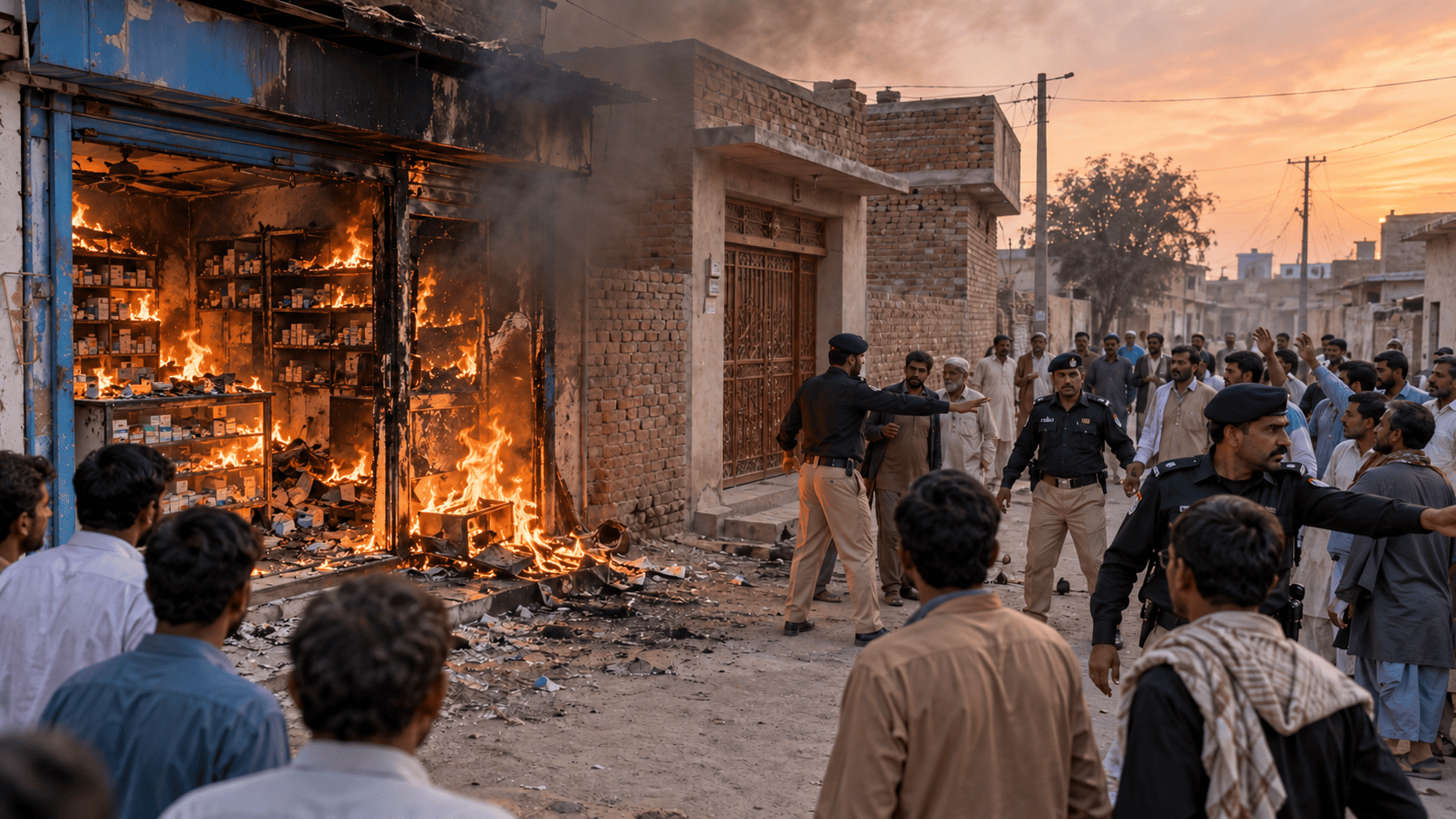
On 4 August 2021, a mob attacked the Hindu temple in Bhong, vandalized religious objects, damaged the building and set parts of it on fire. Reuters reported that paramilitary forces were subsequently deployed to contain the unrest.
The case became internationally significant for two reasons.
First, the accused was reportedly only eight years old, making him one of the youngest people ever publicly reported as facing a blasphemy accusation in Pakistan.
Second, Pakistan’s institutions responded unusually strongly after the temple attack: the Supreme Court took notice, the National Assembly unanimously condemned the violence, the government ordered the temple repaired, arrests followed, and 22 people were later sentenced to prison for participating in the attack.
This makes Bhong an important story not only of persecution.
It is also a story about how the state can respond after communal violence—and why that response needs to come before the attack whenever possible.
Who Was the Child?
The boy’s name should not be published.
He was a Hindu child from Bhong, a town in Rahim Yar Khan District in southern Punjab.
The Guardian reported that he was eight years old and that his family’s identity was withheld for security reasons.
Amnesty International likewise described him as an eight-year-old Hindu boy.
For SFFP’s website, protecting his identity is the correct approach.
He was a minor.
His name adds nothing necessary to the public-interest value of the story.
The Alleged Incident Took Place at a Madrassa
The allegation was that the boy had urinated on a carpet inside the library of a local madrassa where religious books were kept.
The Guardian reported that authorities accused him of doing so intentionally.
The distinction between an accident and deliberate desecration was therefore central.
But the accused was eight.
That alone should have required extreme caution before attributing criminal religious intent.
Children at that age may not understand:
the religious significance of a place,
the consequences of their behaviour,
the meaning of criminal intent,
or the legal implications of an accusation.
Police Registered a Blasphemy Case
Dawn reported that a case was registered against the child in late July 2021 under Pakistan’s blasphemy provisions.
He was arrested.
The Guardian noted that the accusation theoretically exposed him to extremely severe criminal consequences under Pakistan’s blasphemy framework.
The fact that such a young child entered the criminal system at all generated national and international concern.
An Eight-Year-Old and Criminal Intent
This case raises a deeper legal question.
A serious criminal offence generally requires more than the physical act itself.
Intent matters.
Capacity matters.
Age matters.
An eight-year-old child does not process consequences in the same way an adult does.
Amnesty International described the charge as “ludicrous” and called for it to be dropped.
Whether one supports Pakistan’s blasphemy laws or not, prosecuting a child of this age should raise an obvious question:
Could he meaningfully form the criminal intent being attributed to him?
The Court Granted Him Bail
The boy was eventually granted bail.
Al Jazeera reported that the temple attack occurred after a court released him on bail.
This should have represented a movement back toward legal process.
Instead, it triggered wider public anger.
The issue shifted from:
What did one child allegedly do?
to:
Why was he released?
That shift proved dangerous.
A Crowd Gathered in Bhong
Following the bail decision, large numbers of people gathered.
Dawn reported that protesters closed the local market and that the situation escalated toward Hindu properties.
The allegation had now moved far beyond the child.
Hindu families in the area became concerned for their safety.
And the local temple became a target.
4 August 2021: The Temple Was Attacked
On 4 August 2021, a mob entered the Hindu temple in Bhong.
Reuters reported that the crowd ransacked and set fire to the temple.
Al Jazeera reported that statues were damaged and that the temple’s main door was burned.
Video footage of the attack circulated widely online.
The images showed people entering the temple, smashing religious objects and damaging the interior.
The attack had turned an accusation against one child into collective retaliation against a place of worship used by an entire community.
The Temple Had Nothing to Do With the Alleged Act
This is the central human-rights principle in the Bhong case.
Even if the accusation against the child had eventually been proven—which should have been determined through lawful investigation—the temple itself bore no criminal responsibility.
A place of worship cannot commit a crime.
Its worshippers cannot inherit the alleged responsibility of one child.
A religious community cannot be punished collectively because one member is accused.
That principle should apply equally to:
a mosque,
a church,
a temple,
a gurdwara,
or any other place of worship.
Hindu Homes Were Also Reportedly Threatened
Dawn reported that after attacking the temple, members of the mob also attempted to move toward homes belonging to the Hindu community.
This demonstrates how quickly attacks on religious buildings can escalate.
First comes the allegation.
Then the religious institution.
Then residential areas.
If authorities fail to stop that progression early, a temple attack can become a community-wide riot.
Paramilitary Forces Were Deployed
Pakistan deployed Rangers and other security personnel after the violence.
Reuters reported that paramilitary forces were sent to Bhong to prevent further communal unrest.
This intervention helped stabilize the situation.
But it also raises an important question:
Could sufficient security have been deployed before the temple was attacked?
Authorities already knew:
a child had been accused,
the case was religiously sensitive,
the boy had received bail,
and public anger was growing.
Those were warning signs.
Prime Minister Imran Khan Condemned the Attack
The federal government responded publicly.
Prime Minister Imran Khan condemned the attack and promised action against those responsible.
Contemporary reporting also documented government commitments to restore the damaged temple.
This is important for balanced documentation.
The attack was not presented as legitimate by the Pakistani state.
Senior authorities condemned it.
The National Assembly Unanimously Condemned the Violence
On 6 August 2021, Pakistan’s National Assembly passed a resolution strongly condemning the attack on the Bhong temple.
This is one of the strongest institutional responses in the cases we have documented so far.
Parliament did not defend the mob.
It condemned the destruction of the temple.
That should be clearly recorded.
A responsible human-rights archive must show not only where institutions failed, but also where institutions defended minority rights.
Pakistan’s Supreme Court Took Notice
The response also reached the country’s highest court.
Chief Justice of Pakistan Gulzar Ahmed took notice of the attack and summoned senior officials.
The Supreme Court criticized the failure to protect the temple and called for immediate action against those involved.
This matters because protecting minority places of worship was being treated as a constitutional and rule-of-law responsibility, not merely a private religious dispute.
The Court Ordered Arrests
Following the Supreme Court intervention, authorities accelerated arrests.
The Court ordered immediate action against perpetrators identified through video footage and other evidence.
Dozens of people were subsequently detained.
This demonstrated something important:
Mob violence is difficult to prosecute, but modern video evidence can make individual identification possible.
Video Became Evidence
The Bhong attack was recorded extensively.
People filmed the mob.
Videos circulated on social media.
That made the same technology responsible for spreading outrage capable of assisting law enforcement afterward.
Police could identify:
faces,
actions,
locations,
and specific participants.
As with Mashal Khan’s case, digital evidence became a critical tool of accountability.
The Temple Was Repaired Quickly
The government moved rapidly to restore the temple.
Al Jazeera reported that the damaged temple was repaired and returned to the Hindu community within days.
This was a constructive response.
Restoring a damaged place of worship communicates that the state rejects the idea that mobs can permanently remove a minority community’s presence.
Reconstruction cannot erase the fear produced by an attack.
But it matters.
Restoration Was More Than Construction
Rebuilding a temple is not simply repairing walls.
A place of worship represents:
identity,
belonging,
community memory,
religious practice,
and equal citizenship.
By restoring the temple and handing it back to its community, the state affirmed that Hindus had a legitimate place in Bhong.
That is an important message.
The Boy and His Family Went Into Hiding
The legal and security consequences continued for the child.
The Guardian reported that the boy and his family went into hiding because of fears for their safety.
This shows the familiar gap between:
legal status
and
physical safety.
Even when a court grants bail, a blasphemy accusation can make returning home dangerous.
For a child, the consequences can include:
loss of schooling,
loss of friends,
loss of home,
fear,
and long-term psychological trauma.
Amnesty Called for the Charge to Be Dropped
Amnesty International publicly called on Pakistani authorities to drop the blasphemy charge against the eight-year-old child and protect religious minorities.
The organization emphasized the absurdity of applying such a grave criminal allegation to a child of that age.
The case became symbolic internationally because it pushed the question of criminal capacity to an extreme.
Reports Later Said the Charge Was Dropped
Subsequent reporting indicated that the charge against the boy was eventually dropped following the national and international controversy.
Because the strongest primary legal documentation of the final disposal is less readily accessible than the original case reporting, the safest website wording is:
“Later reports stated that the case against the boy was dropped.”
We should not overstate the procedural details without the final court record in hand.
2022: Twenty-Two Men Were Convicted
The temple-attack prosecution continued.
On 11 May 2022, an anti-terrorism court in Bahawalpur convicted 22 men for participating in the attack.
Dawn reported that each received five years’ imprisonment and a fine.
Another 62 defendants were acquitted because the prosecution failed to prove the charges against them.
Again, the due-process principle operated in both directions.
The attack happened.
But each defendant’s individual responsibility still had to be proven.
Convictions Matter
The Bhong case stands out because the violence produced significant criminal convictions.
This is important.
Across our archive, many mob cases resulted in:
weak prosecutions,
witnesses withdrawing,
mass acquittals,
or convictions later collapsing.
Bhong demonstrates that stronger evidence—especially video footage—can improve accountability.
Acquittals Matter Too
Sixty-two defendants were reportedly acquitted because sufficient evidence was not established against them.
That does not diminish the attack.
It demonstrates the difference between:
knowing a crime happened
and
proving that a particular individual committed it.
Human rights require both:
accountability for violence,
and evidence before conviction.
This Case Is About Hindu Rights
Our archive already includes Christians, Muslims and Ahmadis.
Bhong adds another major community:
Pakistan’s Hindus.
Hindus are part of Pakistan’s history and society, particularly in Sindh and parts of southern Punjab.
Their temples are Pakistani religious heritage.
Their children are Pakistani children.
Their right to worship safely is a Pakistani constitutional issue.
Minority Rights Are Not Foreign Rights
It is easy for minority-rights issues to be framed as something imposed by foreign governments or international organizations.
Bhong demonstrates why that framing is incomplete.
Pakistan’s own:
Prime Minister,
National Assembly,
Supreme Court,
Punjab government,
and
criminal courts
all responded against the attack.
The institutional principle was Pakistani:
a mob does not have the right to destroy a minority community’s place of worship.
We cannot credibly advocate Christian rights and ignore Hindu rights.
We cannot defend minority children while ignoring Muslim children.
The principle has to remain:
Freedom, dignity and equal protection for everyone.
Development and Rights Are Connected
When minority families flee communal violence, they may also lose:
income,
businesses,
school access,
housing,
and community networks.
This is why SFFP’s broader How We Work model connects human rights with sustainable development and local resilience.
Through StartFish, marginalized families can build sustainable livelihoods and economic independence.
Through Set Them Free, families trapped in exploitation can pursue freedom and reintegration.
Protection is strongest when communities also have the capacity to rebuild.
What Should We Learn From Bhong?
Children should not be treated like adults.
Blasphemy allegations require careful investigation before public conclusions.
Minority places of worship should receive immediate security when tensions rise.
Courts must remain the place where accusations are tested.
Police should preserve video and digital evidence.
Mob participants must face individual accountability.
And when institutions respond correctly, that response should also be documented.
Bhong contains both:
a serious failure of protection
and
a meaningful state response afterward.
The challenge is moving that response earlier.
The Strongest Success Would Have Been No Attack
The temple was repaired.
Parliament condemned the violence.
The Supreme Court intervened.
People were arrested.
Twenty-two men were convicted.
Those actions matter.
But the strongest outcome would have been simpler:
the temple was never attacked in the first place.
That is where prevention must aim.
Help Us Advance Freedom, Dignity and Opportunity
Samaritan’s Fellowship Foundation builds integrated, community-led ecosystems that empower marginalized communities through human rights, healthcare, education, clean water, sustainable livelihoods and local leadership.
We believe every child deserves protection.
Every religious community deserves security.
And every allegation should be handled through evidence and law—not collective punishment.
If you believe no child’s accusation should become an excuse to attack an entire community:
Together, we can strengthen communities where freedom, dignity, religious diversity and equal citizenship are protected in practice.
Empowerment Beyond Aid — Advancing Freedom and Rights.
Editorial Note
Samaritan’s Fellowship Foundation documents publicly reported human-rights cases for education, historical record and awareness.
The eight-year-old Hindu boy in this case is not named because he was a minor and because contemporary reporting withheld his identity for security reasons.
The allegation against him is described as an allegation. Contemporary reports stated that he was accused of intentionally urinating on a carpet in a madrassa library containing religious material. Amnesty International called for the blasphemy charge to be dropped, and later reporting stated that the case was withdrawn.
The attack on the Bhong temple was publicly condemned by Pakistan’s federal government, National Assembly and Supreme Court. The temple was repaired and returned to the Hindu community.
In May 2022, an anti-terrorism court sentenced 22 men to five years in prison for participating in the attack while other defendants were acquitted for insufficient evidence.
SFFP does not attribute the actions of the mob to Islam, Muslims generally or the people of Pakistan.
We support child protection, freedom of religion, lawful investigation, due process, institutional accountability and equal dignity for every citizen.
References
1. Reuters — Pakistan Deploys Paramilitary Forces After Hindu Temple Attacked by Mob, 5 August 2021
Contemporary Reuters report documenting the attack on the temple, arson, communal tensions and deployment of paramilitary forces.