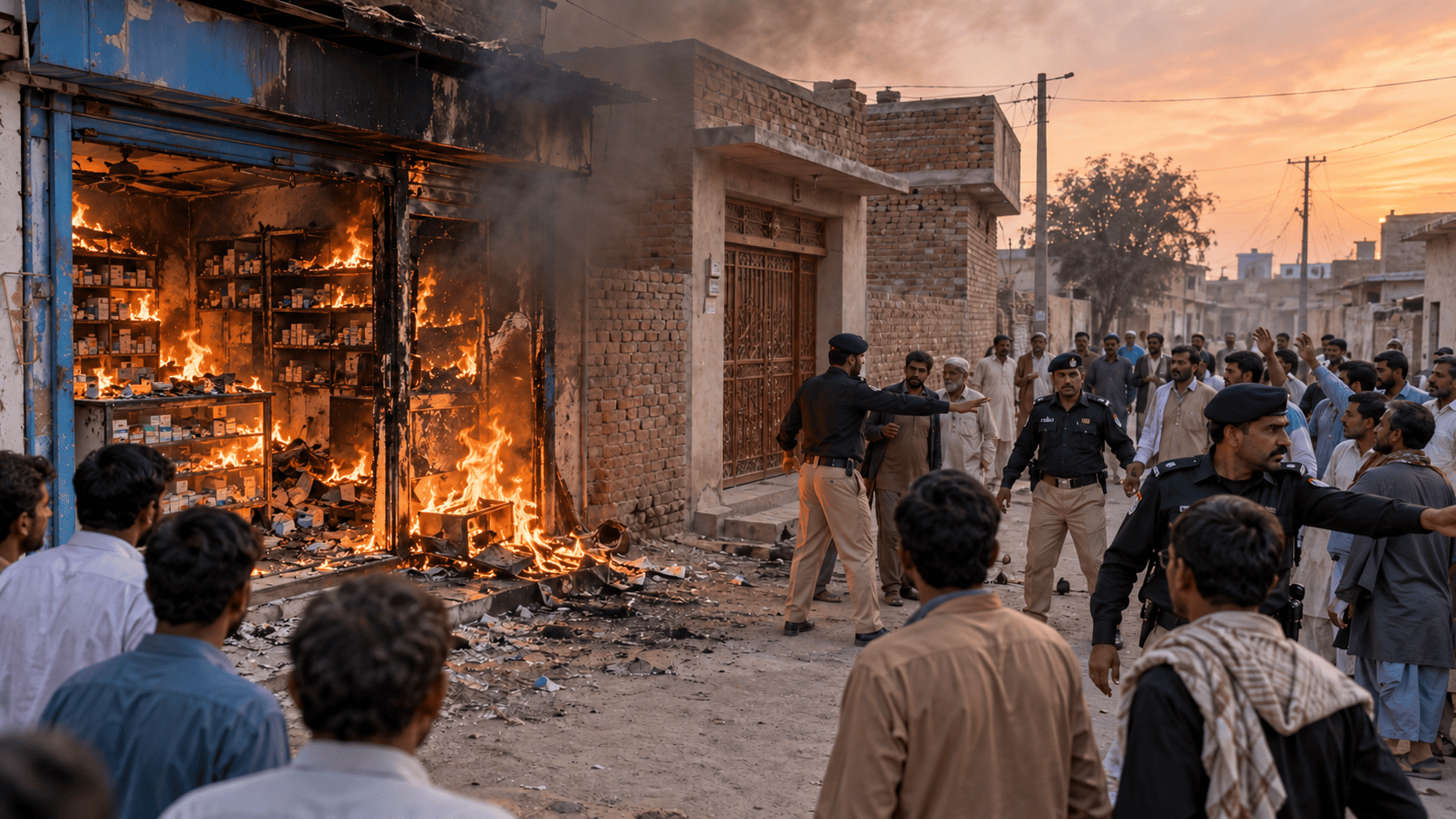
Islamabad, Pakistan | 2 March 2011
He knew he was being threatened. He knew his work for religious minorities had made him a target. He knew that another senior Pakistani politician, Punjab Governor Salmaan Taseer, had already been murdered after speaking about the same issue.
Yet Shahbaz Bhatti continued.
He remained Pakistan’s Federal Minister for Minorities Affairs. He continued advocating for religious freedom. He continued supporting Asia Bibi. He continued calling for reform of Pakistan’s blasphemy laws. And on 2 March 2011, gunmen attacked his vehicle in Islamabad and killed him.
Reuters reported that Bhatti had called for changes to the blasphemy law and had received death threats before his assassination. The United Nations human-rights chief condemned the killing the same day and linked his murder to his advocacy for minority rights and reform.
His death represented more than the murder of one politician. It was an attempt to silence one of Pakistan’s most prominent voices for religious minorities, interfaith harmony and equal citizenship.
Who Was Shahbaz Bhatti?
Clement Shahbaz Bhatti was born in 1968 and became one of Pakistan’s most prominent Christian political leaders. He founded and led the All Pakistan Minorities Alliance (APMA) and later joined the Pakistan Peoples Party. In 2008, he became Federal Minister for Minorities Affairs. Dawn described him as the first Christian parliamentarian to take oath as a federal minister for minorities affairs at cabinet level.
His political identity was explicitly connected to minority empowerment. But his work was not limited to protecting Christians. He advocated for a Pakistan in which people belonging to different religions could participate as equal citizens.
He Believed Minorities Should Fight Through the System
One detail from Dawn’s profile of Bhatti is particularly important. Bhatti encouraged minorities to pursue their rights through Pakistan’s political and legal system rather than through violence. That makes his story especially relevant to the philosophy of human-rights work. His approach was not separatist. It was institutional.
- Participate
- Vote
- Organize
- Engage government
- Seek reform
- Build interfaith relationships
- Use constitutional and democratic mechanisms.
In other words: strengthen citizenship rather than abandon it.
His Work Went Beyond Blasphemy Law
Shahbaz Bhatti is often remembered almost exclusively for his position on blasphemy legislation. That understates his work. Dawn documented a much broader agenda during his time as minister, including efforts connected to:
- a five per cent government-employment quota for minorities;
- reserved minority representation in the Senate;
- recognition of religious festivals;
- promotion of August 11 as Minorities Day;
- interfaith-harmony initiatives;
- proposed measures against hate speech and hate literature;
- protection of minority religious sites;
- and greater support for minorities facing violence.
This was not simply opposition to one law. It was an attempt to build a wider framework for minority participation and equal citizenship.
Interfaith Harmony Was Central to His Approach
Bhatti also promoted dialogue between religious communities. Dawn records that he launched a national campaign to promote interfaith harmony through seminars, awareness initiatives and workshops. This is important because his advocacy was not built on the idea that one religious community must defeat another. His approach was essentially the opposite.
- Minorities should be protected.
- Extremism should be challenged.
- But coexistence should be strengthened.
That distinction matters.
Then Came the Asia Bibi Case
In 2010, Christian farm worker Asia Bibi was sentenced to death following a blasphemy conviction. Her case became one of Pakistan’s most controversial legal and political issues.
Bhatti supported her and called for her release. Reuters later noted that he was murdered after advocating changes to the blasphemy law, while subsequent reporting on Asia Bibi’s case repeatedly linked Bhatti’s assassination to his support for her. He was not the only senior Pakistani politician taking that position.
Punjab Governor Salmaan Taseer also publicly supported Asia Bibi and criticized misuse of the law. On 4 January 2011, Taseer was assassinated. Shahbaz Bhatti understood the warning. He continued speaking.
Death Threats Were Already Known
Bhatti had reportedly received repeated threats from extremist groups. Dawn later remembered him as having continued his advocacy despite multiple death threats. USCIRF likewise states that he faced threats because of his advocacy for religious freedom and opposition to misuse of the blasphemy framework. His danger was therefore not hidden. It was known. This raises an unavoidable institutional question: Was enough done to protect a federal minister whose life was already publicly under threat?
2 March 2011
On the morning of 2 March 2011, Shahbaz Bhatti visited his mother in Islamabad’s Sector I-8. As his vehicle left the area, gunmen intercepted it. Dawn reported that four attackers opened fire on the vehicle, killing Bhatti. Reuters reported that he was killed while travelling to work and identified him as Pakistan’s minorities minister and a prominent advocate for reform. The Guardian reported that the attackers left pamphlets claiming responsibility in the name of extremist groups and explicitly connected the killing to Bhatti’s position on blasphemy laws. He was 42.
The Attack Was Deliberate
This was not random street violence. Bhatti was a known target. His vehicle was intercepted. He was repeatedly shot. And material left at the scene connected the assassination to extremist opposition to his public positions.
The United Nations human-rights chief described the assassination as particularly shocking because Bhatti had worked to protect minorities and had openly campaigned for reform. The purpose appeared clear: silence the advocate.
Pakistan Lost Its Most Prominent Christian Cabinet Voice
At the time of his death, Bhatti was the only Christian member of Pakistan’s federal cabinet. That made the assassination symbolically enormous. A religious-minority community had lost not only an activist. It had lost a representative sitting inside the federal government. For minorities already concerned about political influence and protection, his killing sent a powerful message about how dangerous public advocacy could become.
But Bhatti Was Also a Pakistani State Official
There is another equally important way to understand the event. Shahbaz Bhatti was not operating outside Pakistan’s institutions. He was part of them. He was a federal minister. He sought reform through legislation. He worked through Parliament and government. He advocated employment quotas, Senate representation, interfaith initiatives and institutional protections. His story therefore challenges the idea that minority-rights advocacy is somehow anti-state. Bhatti’s entire career demonstrated the opposite: he sought to advance minority rights through the Pakistani state.
Salmaan Taseer and Shahbaz Bhatti — Two Deaths in 57 Days
The timing made the assassination even more disturbing. Salmaan Taseer was killed on 4 January 2011. Shahbaz Bhatti was killed on 2 March 2011. Two nationally prominent voices connected to the Asia Bibi case and blasphemy-law debate were dead within weeks.
One was Muslim. One was Christian.
This is why blasphemy-related vigilantism cannot be understood solely as a minority issue. It can threaten anyone who enters the debate.
Why Shahbaz Bhatti Belongs at the Center of a Minority-Rights Archive
Some stories in this series concern victims who had little institutional power. Bhatti’s story is different. He was a minister. That difference shows why representation alone is not enough. A minority community needs representatives. But representatives must also be able to speak safely.
Political inclusion means little if an elected or appointed minority leader cannot advocate for his constituents without risking assassination. Real participation therefore requires representation, security, freedom of expression, institutional access, and the ability to influence policy.
His Murder Investigation Became Complicated
The investigation into Shahbaz Bhatti’s assassination later became controversial and difficult.
Dawn reported in January 2012 that authorities had offered conflicting accounts about who was responsible. At different points, police officials attributed the murder to the Tehrik-i-Taliban Pakistan, while another official account pointed toward Sipah-i-Sahaba Pakistan.
Later criminal proceedings were also disrupted by threats. Dawn reported in 2014 that extremist threats were hampering the murder trial. In 2015, the case was moved to a military court. This is another reminder that high-profile extremist violence creates challenges not only at the moment of attack but throughout the justice process.
A Suspect Was Acquitted When Evidence Was Insufficient
One accused man was acquitted by an anti-terrorism court in 2012 after the court found insufficient evidence linking him to Bhatti’s murder. That point should also be included in a fair historical account. A serious assassination requires accountability. But accountability still requires evidence. Even in emotionally charged cases, prosecution must be based on proof rather than association or pressure. That principle is exactly the same due-process standard this archive seeks to defend for blasphemy accused persons.
Due Process Must Work Both Ways
This is an important principle. If we demand reliable evidence before someone accused of blasphemy is convicted, we must also demand reliable evidence before someone accused of terrorism or murder is convicted.
Human rights cannot depend on whether we sympathize with the accused. Due process is a system. Either we believe in it for everyone, or eventually it protects no one.
The United Nations Condemned His Assassination
On the day Bhatti was murdered, the UN High Commissioner for Human Rights publicly condemned the killing. The UN highlighted Bhatti’s role in defending minorities and called attention to concerns surrounding Pakistan’s blasphemy framework.
The killing was therefore not viewed internationally as an isolated criminal event. It was seen as part of a broader struggle over:
- religious freedom,
- minority protection,
- political participation,
- and extremist intimidation.
His Work Was More Than Christian Advocacy
Bhatti’s Christian faith was central to his personal identity. But reducing his political legacy to Christian advocacy alone would be inaccurate.
- He promoted interfaith harmony.
- He worked for minority representation.
- He sought protection against hate speech.
- He encouraged minorities to participate through democratic institutions.
- And he spoke about marginalized citizens more broadly.
- The wider principle was equal citizenship.
Minority Rights Are Pakistani Rights
This is one of the clearest stories through which to explain SFFP’s own positioning. Minority-rights advocacy does not require hostility toward Pakistan. Shahbaz Bhatti himself served in Pakistan’s federal cabinet while promoting minority rights.
He admired Pakistan’s founding vision and sought to strengthen minority participation through the country’s own political institutions. Dawn described him as a patriot who encouraged minority communities to work through the system. That is precisely why the message should remain: Minority rights are Pakistani rights.
The Universal Declaration of Human Rights
Shahbaz Bhatti’s life and assassination engage several principles reflected in the Universal Declaration of Human Rights:
- freedom of thought, conscience and religion;
- freedom of opinion and expression;
- equality before the law;
- the right to participate in government;
- and the right to life and personal security.
A democracy cannot function if representatives of minorities are present in government but cannot safely speak. Participation requires both a seat at the table and the freedom to use one’s voice.
Representation Must Lead to Empowerment
At Samaritan’s Fellowship Foundation, this principle goes directly to our Human Rights & Empowerment work. We believe communities should not remain permanent recipients of protection.
- They should become participants.
- Leaders.
- Advocates.
- Decision-makers.
This is why our work increasingly connects:
- human-rights awareness,
- democratic participation,
- local leadership,
- economic independence,
- and community organization.
Shahbaz Bhatti’s life demonstrated what minority leadership can look like at the national level.
Rights Become Stronger When Communities Become Stronger
Political representation is one layer of empowerment. Economic independence is another. Through StartFish, marginalized families can build sustainable livelihoods and greater independence. Through Set Them Free, families affected by bonded labour and exploitation pursue pathways toward freedom and reintegration. And through our broader How We Work model, we connect protection, development, opportunity and leadership.
Because a community that has education, income, organization, leadership, and institutional access is better positioned to participate in society as an equal stakeholder.
What Should We Learn From Shahbaz Bhatti?
His story offers a different lesson from many other cases in this archive.
- It is not only about protecting vulnerable people after an allegation.
- It is also about protecting the people who speak for them.
- Human-rights defenders must be able to work.
- Ministers must be able to propose reforms.
- Minority representatives must be able to advocate.
- Journalists must be able to report.
- Lawyers must be able to defend.
- Religious leaders must be able to promote tolerance.
- And citizens must be able to disagree with all of them without resorting to violence.
- If advocates are silenced, communities lose their voice.
His Assassination Could Not Erase His Work
Shahbaz Bhatti’s killers ended his life. They could not erase the political questions he raised. Pakistan continues to debate:
- minority representation,
- religious freedom,
- interfaith harmony,
- hate speech,
- equal citizenship,
- and protection from extremist violence.
The work continues because the underlying questions continue. The strongest response to political violence is therefore not merely remembrance. It is ensuring that democratic participation survives the person who was targeted.
Help Us Advance Freedom, Dignity and Opportunity
Samaritan’s Fellowship Foundation builds integrated, community-led ecosystems that empower marginalized communities through human rights, healthcare, education, clean water, sustainable livelihoods and local leadership.
- We believe minorities should not only be protected.
- They should be heard.
- They should participate.
- They should lead.
- And they should have the economic and institutional strength to shape their own future.
If you believe every Pakistani—regardless of faith—should be able to live, participate and lead with dignity:
Together, we can help build communities where rights move beyond promises and become pathways to participation, resilience and opportunity. Empowerment Beyond Aid — Advancing Freedom and Rights.
Editorial Note
Samaritan’s Fellowship Foundation documents publicly reported human-rights cases for education, historical record and awareness.
Contemporary reporting and extremist material left at the scene linked Shahbaz Bhatti’s assassination to his advocacy on religious-minority rights and Pakistan’s blasphemy laws. Subsequent investigations produced differing official accounts regarding the precise organizational responsibility for the killing.
This article therefore distinguishes between what is firmly established—the assassination, Bhatti’s public positions, his prior threats, and the extremist claims surrounding the attack—and later investigative claims whose details have at times been contested.
SFFP does not attribute the actions of extremist organizations or individual attackers to Islam, Muslims generally or the people of Pakistan.
We support peaceful coexistence, constitutional participation, due process, institutional accountability and equal human dignity for all citizens.
References
- Reuters — Christian Pakistani Minister Shot Dead in Islamabad, 2 March 2011 Contemporary reporting on Shahbaz Bhatti’s assassination, his position as minorities minister, his advocacy on the blasphemy law and threats received before his death. https://www.reuters.com/article/us-pakistan-minister-idUSTRE72119220110302/
- United Nations Office of the High Commissioner for Human Rights — UN Human Rights Chief Condemns Pakistan Assassination, 2 March 2011 Official UN condemnation of Bhatti’s killing and discussion of his work for religious minorities and reform of blasphemy legislation. https://www.ohchr.org/en/press-releases/2011/03/un-human-rights-chief-condemns-pakistan-assassination-urges-reform-blasphemy/
- Dawn — Profile: Shahbaz Bhatti, 2 March 2011 Detailed Pakistani profile covering Bhatti’s political career, All Pakistan Minorities Alliance, federal ministry, interfaith-harmony campaign, minority employment quota, Senate representation and other initiatives. https://www.dawn.com/2011/03/02/profile-shahbaz-bhatti/
- Dawn — Minorities Minister Shahbaz Bhatti Assassinated in Islamabad, 2 March 2011 Contemporary Pakistani report on his assassination. https://www.dawn.com/2011/03/02/minorities-minister-attacked-in-islamabad/
- The Guardian — Pakistan Minister Shahbaz Bhatti Shot Dead in Islamabad, 2 March 2011 Reports the attack and the extremist pamphlets left at the scene linking the assassination to Bhatti’s position on blasphemy laws. https://www.theguardian.com/world/2011/mar/02/pakistan-minister-shot-dead-islamabad/
- USCIRF — 10th Anniversary of Shahbaz Bhatti Assassination, 2 March 2021 USCIRF retrospective on Bhatti’s advocacy, assassination and connection to the Asia Bibi and Salmaan Taseer cases. https://www.uscirf.gov/news-room/releases-statements/uscirf-marks-10th-anniversary-shahbaz-bhatti-assassination/
- Dawn — Shahbaz Bhatti Murder Probe Is More an Enigma, 13 January 2012 Detailed examination of conflicting official accounts regarding responsibility for Bhatti’s assassination and difficulties in the subsequent investigation. https://www.dawn.com/news/687943/shahbaz-bhattis-murder-probe-is-more-an-enigma-2/
- Dawn — Extremist Threats Hamper Shahbaz Bhatti’s Murder Trial, 8 February 2014 Documents threats affecting the murder proceedings and witnesses. https://www.dawn.com/news/1085703/
- Dawn — Shahbaz Bhatti Murder Case Moved to Military Court, 15 January 2015 Reports the later transfer of the murder case to a military court and notes Bhatti’s opposition to the blasphemy law. https://www.dawn.com/news/1157196/
- Dawn — Shahbaz Bhatti Murder Case Disposed of, Suspect Acquitted, 5 May 2012 Records the acquittal of one suspect after insufficient evidence was found linking him to the assassination. https://www.dawn.com/2012/05/05/shahbaz-bhatti-murder-case-disposed-of-suspect-acquitted/
- Wikipedia — Shahbaz Bhatti Dedicated biographical article covering his political career, minority-rights advocacy, federal ministry, assassination and legacy. https://en.wikipedia.org/wiki/Shahbaz_Bhatti/