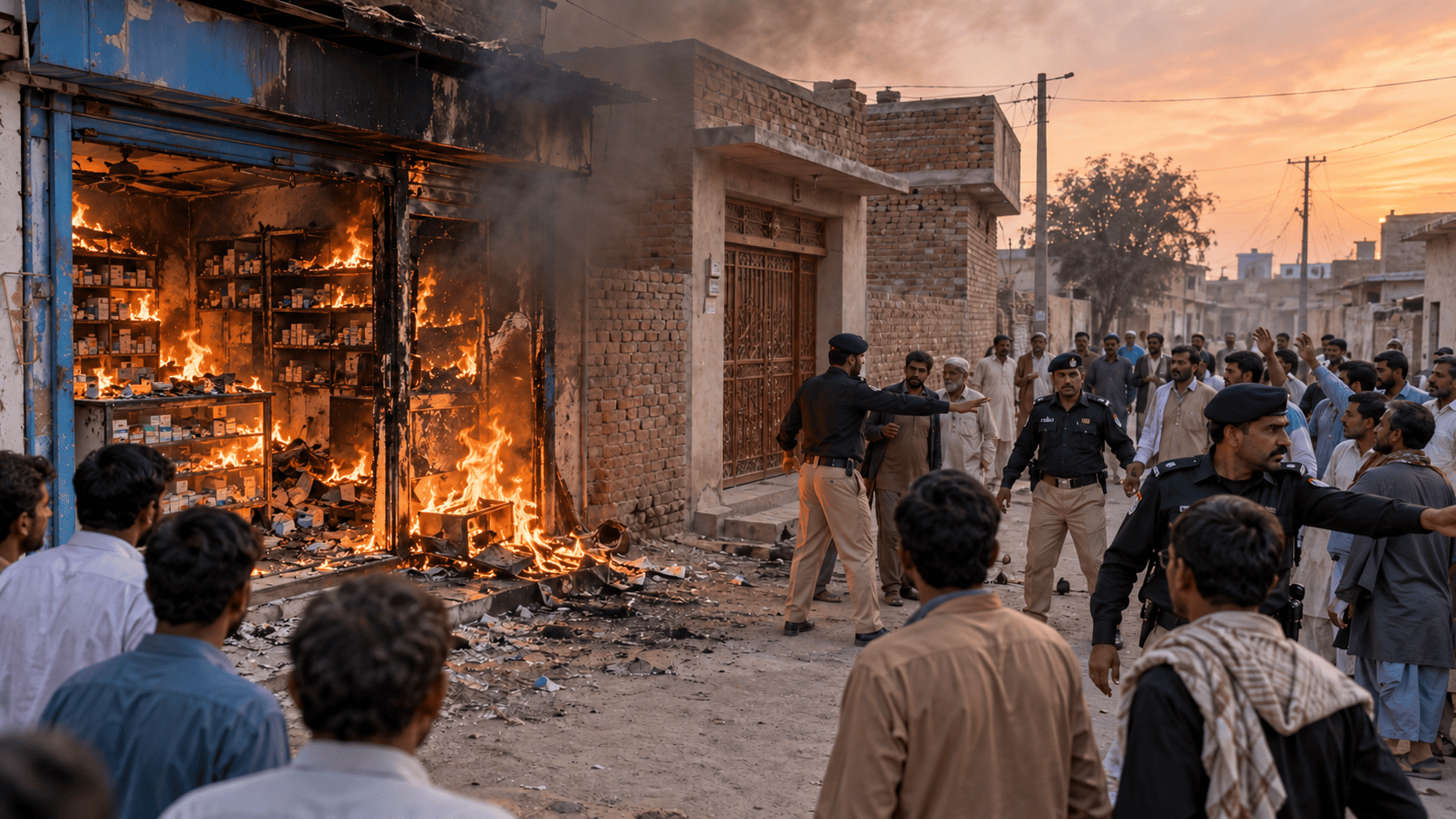
Islamabad, Pakistan | 4 January 2011
He was the Governor of Punjab. He was Muslim. He was one of Pakistan’s most prominent political figures. And he publicly stood beside a poor Christian woman sentenced to death for blasphemy.
Weeks later, Salmaan Taseer was shot dead by one of the police guards assigned to protect him. His assassination became one of the defining moments in Pakistan’s modern debate over blasphemy, religious freedom and the limits of public discussion.
Taseer had openly supported Asia Bibi, questioned her conviction and criticized misuse of Pakistan’s blasphemy law. His killer, Malik Mumtaz Hussain Qadri, later said that Taseer’s public position on the law motivated the murder.
This was no longer a story only about the person accused of blasphemy. It had become a story about whether someone could safely defend an accused person at all.
Who Was Salmaan Taseer?
Salmaan Taseer was a Pakistani businessman, politician and senior member of the Pakistan Peoples Party. He became Governor of Punjab in 2008 and remained in office until his assassination in January 2011. He was known for speaking publicly and forcefully on political and social issues.
In late 2010, one issue increasingly dominated attention around him: the case of Asia Bibi, a Christian farm worker who had been sentenced to death after a blasphemy conviction. Taseer chose to intervene publicly.
He Visited Asia Bibi in Prison
Asia Bibi had been sentenced to death in November 2010. Salmaan Taseer visited her in prison and publicly supported her request for clemency. He said he would take her mercy petition to Pakistan’s president. Dawn contemporaneously reported that religious parties were already threatening protests over Taseer’s intervention and his criticism of the law.
His position was controversial. But supporting a prisoner’s legal right to seek clemency was not an act of private violence or vigilantism. It was participation in a legal and political debate.
The Phrase That Became Politically Explosive
Taseer publicly criticized the blasphemy law and referred to it as a “black law.” That phrase became central to the controversy surrounding him.
Religious groups accused him of attacking or insulting the law’s religious foundations, while Taseer maintained his criticism of its application and publicly defended Asia Bibi.
The distinction is important. Criticizing a law is not the same as committing the offence that law is designed to punish. That question would later become central in the criminal proceedings against his killer.
Public Pressure Was Already Building
By late November 2010, religious parties were openly warning the government against intervening in Asia Bibi’s case. Dawn reported demonstrations in Lahore where speakers criticized Salmaan Taseer and threatened wider protests if a presidential pardon were pursued. Taseer nevertheless continued speaking. His position made him increasingly visible in one of Pakistan’s most emotionally charged debates.
4 January 2011
On 4 January 2011, Salmaan Taseer visited Islamabad’s Kohsar Market. As he returned toward his vehicle after lunch, one of the armed police officers assigned to his security detail opened fire. The attacker was Mumtaz Qadri, a member of Punjab’s Elite Force.
The Guardian reported that Taseer was shot dead at the market by his own bodyguard. Reuters likewise documented that the killer was a member of his security detail. Qadri surrendered after the shooting. He did not deny killing the governor.
Why Did Mumtaz Qadri Say He Killed Him?
Qadri’s stated motive was directly connected to Taseer’s position on the blasphemy law. Reuters later summarized the case by stating that Qadri killed Taseer because of the governor’s opposition to the law and his support for Asia Bibi. A later legal analysis from LUMS describes Qadri’s defence as relying heavily on Taseer’s description of the blasphemy law as a “black law” while advocating for Asia Bibi.
The murder therefore became a crucial legal question: Can disagreement with someone’s views on blasphemy law justify killing them?
Pakistan’s courts ultimately answered no.
A Police Protector Became the Killer
Like the Samuel Masih case, the identity of the attacker made the killing particularly disturbing. Qadri was not an outsider who forced his way through security. He was security. Taseer was killed by someone whose job was to protect him.
That creates a profound institutional problem. A public official must be able to rely on state security regardless of the personal religious or political views of individual officers. If police officers begin deciding who deserves protection based on personal belief, the rule of law collapses.
The Murder Shocked Pakistan
Taseer’s assassination immediately became a national crisis. The Guardian described the killing as throwing Pakistan into fresh turmoil, while Reuters reported the sharply divided public reaction that followed. Political leaders condemned the assassination. A period of national mourning followed. But another reaction also emerged. Some religious activists publicly celebrated Qadri. That response became almost as significant as the murder itself.
The Killer Was Celebrated by Some Supporters
When Mumtaz Qadri appeared in court, supporters showered him with flowers. His defence attracted substantial public support from some religious groups. This created a disturbing social divide: one side saw a murdered governor. Another celebrated the man who admitted killing him.
Reuters later described how Taseer’s assassination highlighted the intensity of feeling around blasphemy law in Pakistan. The issue had moved beyond legal disagreement. It had become a question about whether private violence could be morally celebrated.
Pakistan’s Courts Rejected Qadri’s Justification
Qadri was prosecuted for murder and terrorism-related offences. The trial court sentenced him to death. The Islamabad High Court later modified part of the judgment but maintained his murder conviction. The case then reached Pakistan’s Supreme Court.
In October 2015, the Supreme Court upheld Qadri’s death sentence. Reuters reported that the Court rejected the attempt to justify the assassination on religious grounds. This judicial outcome is central to the story. Pakistan’s highest court made clear that a private individual cannot lawfully kill someone merely because he believes that person has expressed a blasphemous view.
Criticizing a Law Was Not Legal Permission to Kill
The Supreme Court proceedings addressed the distinction between criticizing blasphemy law and committing blasphemy. Legal analysis of the judgment notes that the Court rejected the proposition that Taseer’s criticism of the law automatically constituted a lawful justification for murder.
That distinction is fundamental in any constitutional society. Citizens must be able to discuss laws. Politicians must be able to propose reform. Lawyers must be able to debate interpretation. Judges must be able to review convictions. If disagreement itself becomes punishable by private violence, democratic participation becomes impossible.
Mumtaz Qadri Was Executed in 2016
After exhausting his legal appeals, Mumtaz Qadri was executed by the Pakistani state in February 2016. His execution again triggered large protests and demonstrated how deeply polarized public opinion remained around the case. Whatever one’s view of capital punishment, the legal significance is clear: the Pakistani state treated Salmaan Taseer’s assassination as murder, not as lawful religious punishment.
Why Salmaan Taseer Belongs in This Archive
Salmaan Taseer was not a Christian victim. He was not accused because he belonged to a religious minority. He was a Muslim governor of Pakistan’s largest province. His presence in this archive therefore matters. It demonstrates that blasphemy-related vigilantism can threaten minorities, lawyers, judges, politicians, police officers, activists, academics, and ordinary Muslims as well. That is why this archive should be understood as a human-rights archive, not merely a Christian persecution archive.
Asia Bibi’s Case Continued After His Death
The woman Taseer had defended remained in prison for years after his assassination. Asia Bibi’s conviction was eventually overturned by the Supreme Court of Pakistan in October 2018.
Her acquittal confirmed why appeals and legal advocacy matter. Taseer did not live to see that judgment. You can read the broader case in our story on Asia Bibi and explore the principles involved through the Universal Declaration of Human Rights.
Shahbaz Bhatti Would Be Killed Two Months Later
Taseer’s assassination was not the end of this period of violence. On 2 March 2011, Federal Minister for Minorities Affairs Shahbaz Bhatti—a Christian who also advocated reform and had spoken in support of Asia Bibi—was assassinated in Islamabad.
Within two months, Pakistan had lost a Muslim governor and a Christian federal minister who had both spoken publicly about the same issue.
The implication was chilling: the danger extended beyond religious identity. It reached anyone willing to challenge intimidation.
Free Expression Does Not Mean Freedom From Criticism
Defending Salmaan Taseer’s right to speak does not require agreeing with everything he said. That is exactly the point. Human rights do not guarantee that speech will be popular. They guarantee that disagreement should be answered through speech, law, debate, elections, courts, and peaceful democratic processes. Not assassination.
A society becomes stronger when people can disagree without believing that violence is the final argument.
The Universal Declaration of Human Rights
Salmaan Taseer’s assassination concerns several principles reflected in the Universal Declaration of Human Rights:
- the right to life and personal security;
- freedom of thought and conscience;
- freedom of opinion and expression;
- equality before the law;
- and the right to participate in public affairs.
A public official cannot perform his democratic role if expressing a policy position can become a death sentence imposed by a private individual.
Human Rights Protect Muslims Too
This story is particularly important for the philosophy of Samaritan’s Fellowship Foundation. Human rights cannot be selective. If we defend only Christian victims, we are defending a community. If we defend the rights of Christians, Muslims, Hindus, Sikhs, Ahmadis and every other citizen, we are defending a principle. Through our Human Rights & Empowerment work, our objective is not to place communities against one another. It is to strengthen peaceful participation, equal citizenship, rights awareness and the rule of law.
Strong Institutions Are the Answer
Salmaan Taseer’s murder does not prove that Pakistan’s institutions are incapable of justice. The subsequent prosecution demonstrates the opposite side of the story.
Qadri was arrested. He received a trial. He appealed. The case reached the Supreme Court. And the Court upheld his conviction. That institutional pathway matters. The appropriate response to vigilantism is not more vigilantism. It is stronger institutions.
From Protection to Participation
At SFFP, we believe resilient communities need more than protection from immediate violence. They need rights awareness, education, economic opportunity, access to institutions, and the confidence to participate in society. This is why our How We Work approach integrates human rights with sustainable development and community leadership. Through StartFish, marginalized families pursue economic independence. Through Set Them Free, families affected by exploitation and bonded labour pursue pathways toward freedom and reintegration. Because freedom is stronger when people can also shape their own future.
What Should We Learn from Salmaan Taseer?
- A politician must be able to discuss a law.
- A lawyer must be able to defend an accused person.
- A governor must be able to recommend clemency.
- A judge must be able to overturn a conviction.
- A citizen must be able to disagree with all of them.
- But no one should be able to turn disagreement into private execution.
Salmaan Taseer’s killing demonstrated what happens when political debate crosses that line. Pakistan’s Supreme Court later reaffirmed where the legal line actually stands.
Help Us Advance Freedom, Dignity and Opportunity
Samaritan’s Fellowship Foundation builds integrated, community-led ecosystems that empower marginalized communities through human rights, healthcare, education, clean water, sustainable livelihoods and local leadership.
We believe a strong society is one where people can practice their faith, defend their rights, discuss public policy and resolve disagreement without violence.
If you believe that human rights and the rule of law must protect every Pakistani—minority or majority:
Together, we can strengthen communities where freedom, dignity and peaceful participation belong to everyone. Empowerment Beyond Aid — Advancing Freedom and Rights.
Editorial Note
Samaritan’s Fellowship Foundation documents publicly reported human-rights cases for education, historical record and awareness.
Salmaan Taseer’s assassination is included in this series because his killer explicitly connected the murder to Taseer’s public position on Pakistan’s blasphemy law and his advocacy in the Asia Bibi case.
SFFP does not equate disagreement with blasphemy and does not attribute Mumtaz Qadri’s actions or the views of his supporters to Islam, Muslims generally or the people of Pakistan. Pakistan’s courts prosecuted Qadri, and the Supreme Court ultimately upheld his conviction and death sentence.
SFFP supports peaceful coexistence, constitutional debate, due process, freedom of conscience and equal human dignity for all.
References
- Reuters — Pakistan’s Top Court Upholds Death Sentence for Punjab Governor’s Killer, 7 October 2015
Reports that Pakistan’s Supreme Court upheld Mumtaz Qadri’s death sentence and identifies Taseer’s opposition to blasphemy-law misuse and support for Asia Bibi as the motive cited by his killer. https://www.reuters.com/article/world/pakistans-top-court-upholds-death-sentence-for-punjab-governors-killer-idUSKCN0S110J/
- Reuters — Pakistani Governor’s Killing Stirs Mixed Emotions, 5 January 2011 Contemporary Reuters reporting on Taseer’s assassination, Qadri’s stated motivation and the sharply divided reaction inside Pakistan. https://www.reuters.com/article/idUSTRE7042ZZ/
- The Guardian — Salmaan Taseer Murder Throws Pakistan into Fresh Crisis, 4 January 2011 Contemporary report describing Taseer’s killing at Kohsar Market by one of his own police guards and the political context surrounding his criticism of the blasphemy law. https://www.theguardian.com/world/2011/jan/04/punjab-governor-murder-pakistan
- Dawn — Religious Parties Threaten Protest in Blasphemy Case, 24 November 2010 Contemporary Pakistani reporting documenting threats of protest after Taseer supported Asia Bibi’s clemency petition and publicly criticized the blasphemy law. https://www.dawn.com/news/585070/religious-parties-threaten-protest
- LUMS SAHSOL — Demystifying Sacrilege: The Mumtaz Qadri Case Legal analysis of the Supreme Court proceedings, including Qadri’s attempt to justify the killing through Taseer’s criticism of the blasphemy law. https://sahsol.lums.edu.pk/node/12819/
- Christian Solidarity Worldwide — Pakistan Supreme Court Upholds Mumtaz Qadri Conviction, 9 October 2015 Summarizes the assassination, Taseer’s advocacy for Asia Bibi and the Supreme Court decision. https://www.csw.org.uk/2015/10/09/press/2801/article.htm/
- Dawn — Why Blasphemy Remains Unpardonable in Pakistan Later legal-historical analysis discussing Taseer’s assassination, his support for clemency for Asia Bibi and the wider political consequences of the killing. https://www.dawn.com/news/1163596/
- Wikipedia — Salman Taseer Dedicated biographical page covering his political career, advocacy around Asia Bibi, assassination, Qadri’s prosecution and aftermath. https://en.wikipedia.org/wiki/Salman_Taseer/
- Wikipedia — Asia Bibi Blasphemy Case Documents Taseer’s advocacy for Asia Bibi and the connection between the case and his assassination. https://en.wikipedia.org/wiki/Asia_Bibi_blasphemy_case/