Samaritan’s Fellowship Foundation Pakistan works with marginalized and minority communities to defend their rights, strengthen their voice, and create opportunities for lasting self-reliance.
Our work connects three pillars: Freedom, Rights & Empowerment; Economic Opportunity; and Peace & Fellowship.
We speak for the freedom of people from social differences, injustice, modern slavery, extremism, religious intolerance, persecution, and poverty.
Explore answers to common questions about Samaritan’s Fellowship Foundation Pakistan (SFFP), our mission, programs, human rights and community empowerment approach, governance, transparency, and ways to support our work. Learn how we operate, measure our impact, and work toward lasting freedom, dignity, and opportunity for marginalized communities.
Samaritan’s Fellowship Foundation Pakistan (SFFP) is an independent, non-partisan Pakistani nonprofit organization advancing human rights, fundamental freedoms, social justice and sustainable development. We work with marginalized and underserved communities to address exploitation, discrimination, poverty and barriers to opportunity.
Our approach connects immediate humanitarian assistance with access to justice, education, healthcare, clean water, sustainable livelihoods and peaceful civic participation. We operate in accordance with Pakistan’s Constitution and laws, with respect for national unity, religious diversity and the dignity of every person.
The story of Samaritan’s Fellowship Foundation began in 2012, during a visit to a rural community near Kunri in Sindh. Our founders, Faisal Yaqoob and Afshan Faisal, were there for a friend’s wedding; it was not a planned humanitarian visit. During their stay, a young pregnant woman became critically ill. There was no nearby hospital, ambulance or emergency service available, so they tried to take her to medical care in their own vehicle. Tragically, she died on the way.
That experience raised a basic question: why should poverty, geography or social exclusion determine whether someone has access to help when they need it most?
As engagement with communities deepened, it became clear that the tragedy was not an isolated medical problem. Families were facing interconnected challenges—lack of healthcare, unsafe water, poverty, limited access to education, discrimination, exploitation and very few opportunities to improve their circumstances. Our initial response was simple charity. We provided food, medical assistance and emergency support, often using our own resources and help from friends. But over time we saw the limitations of that approach. Food eventually runs out. Medicine may treat an illness, but if the family continues drinking contaminated water, the problem returns. A person may learn a skill, but without tools, equipment, or start-up capital, that skill may never become an income.
That realization changed the direction of our work. We moved from asking only, “What immediate assistance does this family need?” to also asking, “What will prevent this family from facing the same crisis again?” That experience developed into a broader model connecting protection, healthcare, clean water, education, skills, sustainable livelihoods, human-rights awareness and community participation.
The name Samaritan’s Fellowship reflects the principle that inspired us from the beginning: compassion should lead to action, and people should be willing to help others simply because another human being is in need. Today, our purpose goes beyond providing immediate assistance. It is to walk alongside people until they are better able to stand independently, make their own choices, and eventually contribute to the well-being of others.
For us, Empowerment Beyond Aid means that assistance should solve more than the immediate problem in front of us. We do not see poverty, poor health, unsafe water, lack of education, unemployment, exploitation, and weak civic participation as separate issues. Within a vulnerable household, one problem frequently creates another.
A child may miss school because a family cannot meet basic expenses. A parent may become sick because of unsafe drinking water. Medical costs can increase debt. Debt can increase vulnerability to exploitation. Lack of skills or employment can then keep the household trapped in the same cycle. That is why our model begins with the family or community’s most urgent need but does not necessarily end there.
If the immediate problem is health, we may enter through the Mobile Medical Mission. If it is unsafe water, we begin with a practical water solution. If a family is affected by bonded labour, protection and lawful intervention come first. If the primary barrier is unemployment, we may begin with skills development or sustainable-livelihood support. From there, we connect people with the next opportunities they need. Healthcare helps people recover and remain productive. Clean water reduces health risks and daily hardship. Education gives children a better chance of breaking intergenerational poverty. Skills and small businesses help adults develop sustainable income. Economic stability reduces dependence and vulnerability to harmful debt. Human-rights education helps people understand their legal protections, responsibilities and available institutions. Community participation enables people to contribute to decisions and solutions affecting their own lives.
We therefore do not want beneficiaries to remain permanent recipients of assistance. Our objective is to create a pathway from crisis to stability, stability to economic independence, and independence to participation and leadership. Different programmes provide different entry points, but the long-term objective remains the same: freedom, dignity and opportunity.
Our volunteer network has developed organically through years of community engagement. Every programme creates relationships. Community members assist with activities, professionals contribute their expertise, and sometimes people whose circumstances have improved through our programmes choose to remain connected and help others. Not every volunteer is a former beneficiary, and not every volunteer performs the same function. Training is therefore role-specific rather than one-size-fits-all. Volunteers receive the orientation, instructions and programme-specific guidance necessary for the responsibilities they undertake.
Local volunteers primarily help SFFP remain connected with communities. They can provide information about emerging needs, support beneficiary identification, assist field coordination, communicate changing local circumstances and help programmes operate with stronger local knowledge. However, an important accountability boundary exists.
Our volunteer network is separate from SFFP’s formal financial and governance functions. Being a volunteer does not give someone authority over organizational funds, expenditure approval or institutional governance. Financial decisions, programme approvals, documentation and institutional accountability remain within SFFP’s authorized management and governance structure. This allows us to combine two important strengths: local knowledge and centralized accountability. A central office can provide systems and standards, but it can never replace the knowledge of people who actually live within the communities being served.
SFFP’s accountability operates at multiple levels: internal financial controls, statutory compliance, professional audit, government oversight, formal banking channels, programme documentation and external due diligence by donors and institutional partners.
The question is not only “Where was the money spent?” but also “What happened because it was spent?” Depending on the programme, evidence may therefore include beneficiary records, field reports, photographs, implementation documentation, progress reporting and longer-term monitoring. Our principle is straightforward: funds entrusted to SFFP should move through legitimate channels, be properly authorized and documented, comply with applicable requirements and remain traceable to the programme for which they were intended.
SFFP primarily implements humanitarian, human-rights and sustainable development initiatives through its own programs, field teams, volunteers, and relevant partnerships. Opportunities for collaboration or financial assistance, where available, depend on the specific initiative, available resources, eligibility requirements, and applicable organizational procedures. SFFP does not guarantee grants or financial assistance through general inquiries. Organizations interested in collaboration may contact SFFP through its official communication channels for information about current opportunities.
We document these stories to preserve memory, promote due process and defend the dignity of every person.
Help us protect vulnerable communities and create lasting opportunities.
Make a DonationU.S. donations made through Every.org are 100% tax-deductible to the extent allowed by U.S. law. Samaritan’s Fellowship Foundation’s American Friends Fund is hosted by Myriad USA, a U.S.-registered 501(c)(3) public charity.
Bonded labour cannot be addressed sustainably by treating it simply as a financial debt problem. Where coercion, inherited or manipulated debt, restriction of movement, intergenerational exploitation or other indicators of bonded labour are present, the issue becomes one of rights, protection, and the rule of law.
Cases may be identified through SFFP field teams, community volunteers, local contacts, referrals, partner networks and reports from affected communities. Our current approach prioritizes lawful intervention and institutional coordination. Where circumstances indicate bonded labour, SFFP seeks to work through appropriate legal and administrative mechanisms, including District Vigilance Committees, labour authorities, district administration, law-enforcement institutions and legal support where required. We do not believe human freedom should be reduced to a transaction in which an exploitative employer is simply paid to release a worker.
But release itself is only the beginning. A family leaving exploitation without another source of income, education for its children, knowledge of its rights or a safe place to rebuild its life can remain vulnerable to exploitation again. Depending on the family’s circumstances, post-release support can therefore include immediate humanitarian assistance, healthcare, safe relocation where necessary, school enrolment and educational support for children, skills development for adults and tools, equipment or small-business assistance through sustainable-livelihood programmes such as StartFish. Our objective is not simply to remove a family from one brick kiln or workplace. It is to address the conditions that made exploitation possible. For SFFP, meaningful freedom requires both legal protection and economic independence.
Our results are measured through programme documentation, field monitoring, financial accountability and continued engagement with the communities we serve. Each intervention generates its own evidence.
Water projects can be documented by location, type of intervention, implementation evidence and communities served. Medical missions maintain beneficiary registrations, consultations, treatment information, medicine distribution records and referrals where required. Sustainable-livelihood programmes document participating families, the livelihood or business selected, productive assets or equipment provided and subsequent progress. Depending on the intervention, these records may be supported by field reports, photographs, receipts, beneficiary stories and other implementation documentation.
Financial expenditure is subject to SFFP’s applicable audit and regulatory-reporting requirements, while internationally supported projects may also be subject to the documentation, reporting and due-diligence requirements of donors and partner platforms. Where independent verification is required by a donor, regulator or institutional partner, supporting records can be made available for that process. But we do not believe impact can be measured only through activity counts. Distributing a water filter is an output. The more important question is whether access to safer water improved. Training someone is an output. The more important question is whether that person subsequently earns a sustainable income. Enrolling a child is an output. The longer-term question is whether the child remains connected to education.
Our teams therefore remain connected with communities through field visits, communication and subsequent programmes wherever practical. Ultimately, one of the strongest indications of sustainable impact is when someone who once needed assistance becomes independent, engaged and eventually capable of helping someone else.
The most important outcome has been practical: making everyday life safer, healthier, and less difficult for communities where obtaining drinking water or basic healthcare can itself be a major challenge.
Our clean-water work has shown us that different communities can face very different problems. In some areas, water exists but families—particularly women and girls—must travel several kilometres to collect it. Carrying heavy containers over long distances consumes time and creates significant physical strain. Practical interventions such as rolling water containers can allow families to transport larger quantities while reducing the burden of carrying water on their heads. In some desert communities, there may be no reliable nearby source at all. Depending on groundwater conditions, technical feasibility and available resources, interventions may include wells, hand pumps or community water systems. Elsewhere, the primary problem is quality. Communities may depend on open ponds or other unprotected sources shared with animals. Cloth can remove visible particles but cannot make microbiologically contaminated water safe. Appropriate non-electric filtration can therefore be particularly valuable in remote areas without reliable infrastructure.
The Mobile Medical Mission addresses another barrier: access. Our medical teams provide basic consultations, medicines, health guidance and referrals for people who might otherwise delay or miss treatment because of poverty, distance or limited services. The programme also supports preventive health awareness, including hygiene and maternal and child health. We therefore measure these programmes not simply by filters, wells or consultations, but by what changes in people’s lives: safer drinking water, reduced physical hardship, improved access to healthcare, earlier identification of medical problems and greater health awareness.
There is no single livelihood that works for every family. The strongest opportunities generally combine three factors: the person’s aptitude or existing skills, genuine local-market demand, and a business model that can operate with manageable start-up and running costs. For this reason, livelihood interventions may include tailoring, barbering, mobile-phone repair, electrical work, plumbing, AC and refrigeration services, food and vegetable stalls, poultry and dairy livelihoods, shoe repair, transport-related work and other locally viable activities.
We also avoid unnecessarily duplicating existing training infrastructure. If a government vocational institute, technical centre or partner organization already provides suitable training, connecting participants with that institution can be more efficient than creating a parallel programme. Training, however, is only part of the solution. A trained tailor without a sewing machine, an electrician without tools or a barber without equipment may still be unable to generate income. Through StartFish — Relief to Revenue, we therefore seek to bridge the gap between acquiring a skill and actually earning from it through appropriate tools, equipment or modest business-startup support.
We do not consider a livelihood successful simply because someone completed a course or received an asset. Follow-up considers whether the skill is being practised, whether the business remains operational, whether regular income is being generated, whether the household can increasingly meet essential expenses, and whether dependence on emergency assistance or harmful debt is declining. For us, genuine economic independence means that a family has a sustainable means of earning, greater control over its choices and a declining need for continuing outside assistance.
Our primary goal for the next five years can be expressed in one word: FREEDOM. Freedom from exploitation, coercion, hatred, extremism, bonded labour, poverty and unemployment—and the freedom that comes when people possess the knowledge, skills, opportunities and economic security to make meaningful decisions about their own lives.
Our first priority is to strengthen an increasingly sustainable development ecosystem connecting immediate assistance with healthcare, education, protection, skills, livelihoods, human-rights awareness and community participation. A second priority is evidence.
As our work expands, we want better data to understand community needs, identify patterns, measure outcomes over longer periods, allocate resources intelligently and determine which interventions produce the strongest results. Technology will support this process. Digital systems and responsible use of artificial intelligence can strengthen documentation, data analysis, programme monitoring, financial controls, reporting and organizational efficiency. Technology cannot replace human judgment or relationships with communities, but it can improve accuracy, traceability and accountability.
Institutional development is equally important. Sustainable organizations cannot remain dependent on one or two individuals. SFFP must continue attracting capable professionals, developing new leadership and building systems that can outlast individual founders or executives.
We also want deeper cooperation with government institutions and like-minded organizations rather than unnecessarily reinventing existing systems. Government can provide legal authority, public infrastructure and technical expertise. Businesses can contribute skills, technology, apprenticeships, employment pathways and market access. Universities can contribute research, evaluation, innovation and data analysis. Development partners can provide technical knowledge, institutional capacity and resources. Responsible media can bring neglected communities and difficult issues into informed public discussion.
Over the next five years, we do not simply want SFFP to become bigger. We want it to become stronger, smarter, more accountable, more connected and more capable of producing lasting change.
We document these stories to preserve memory, promote due process and defend the dignity of every person.
Help us protect vulnerable communities and create lasting opportunities.
Make a DonationU.S. donations made through Every.org are 100% tax-deductible to the extent allowed by U.S. law. Samaritan’s Fellowship Foundation’s American Friends Fund is hosted by Myriad USA, a U.S.-registered 501(c)(3) public charity.
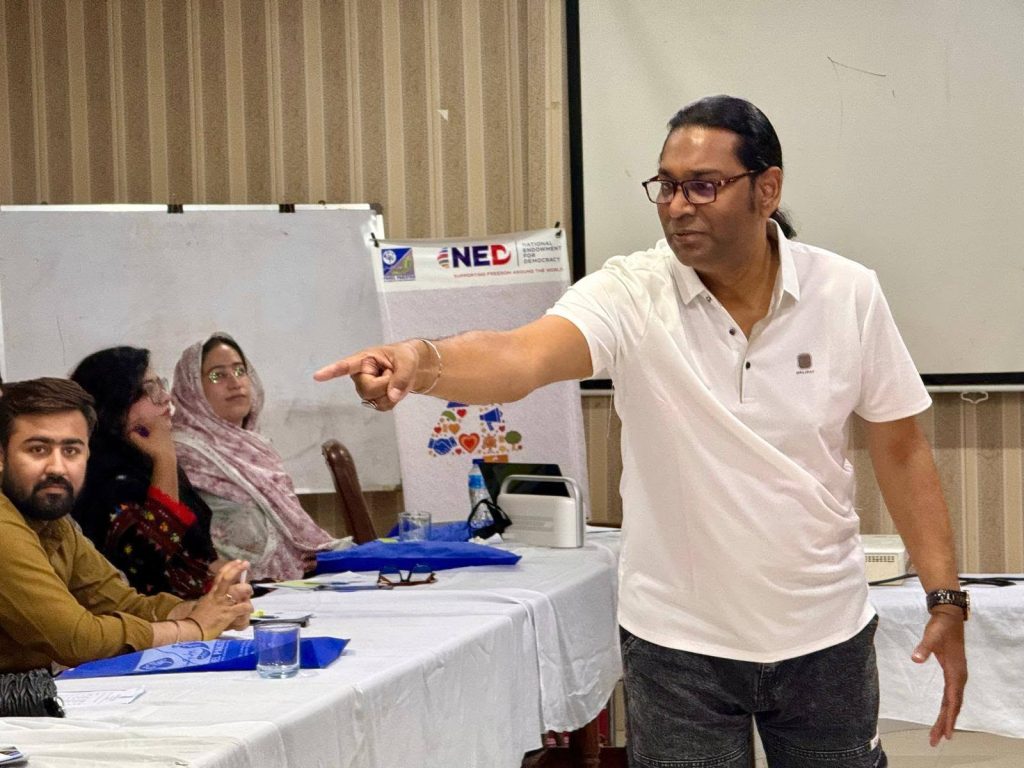
For SFFP, human-rights work cannot end with statements, seminars, or awareness campaigns. Awareness matters, but a person facing an actual violation needs to know what can be done, which institution has jurisdiction, where legal assistance may be available, and how the issue can be pursued without creating additional danger.
Our approach therefore connects rights education with practical pathways. Depending on the circumstances, this can involve helping people understand their legal options, documenting relevant information, facilitating referrals to appropriate legal or specialist support, connecting communities with institutions and supporting peaceful engagement with authorities. We also recognize that human-rights vulnerability frequently has an economic dimension. A person with no savings, livelihood or alternative housing may find it far harder to leave an exploitative environment. A family dependent on a powerful employer may hesitate to assert its rights. A child excluded from education may enter adulthood with fewer opportunities and less ability to navigate institutions. This is why our human-rights work connects with livelihoods, education and community empowerment.
Our approach also encourages meaningful community participation and constructive engagement with public institutions, helping ensure that the concerns of marginalized communities inform practical solutions and institutional improvements.
Our objective is not simply to tell vulnerable people that they have rights. It is to help create circumstances in which they are increasingly capable of understanding, exercising and defending those rights through lawful means.
This distinction is fundamental to responsible human-rights work. SFFP is not a police force, court, prosecution service or government authority. A civil-society organization should never pretend to possess powers that belong to state institutions. Our role can include identifying and documenting concerns, helping affected people understand available options, connecting them with legal or specialist assistance, facilitating communication, providing humanitarian or protection-oriented support where appropriate, raising legitimate concerns and helping communities engage institutions peacefully. But criminal investigation, prosecution, judicial determination and enforcement belong to the institutions legally authorized to perform those functions.
This is why SFFP seeks constructive institutional engagement rather than replacing or confronting the state. Where institutions are inaccessible, or communities lack confidence in them, civil society can help bridge that gap. Where systems fail, civil society can document problems and advocate for improvement. But sustainable justice ultimately requires functioning institutions and the rule of law. Our position is therefore: Justice through law, never justice through violence.
Strengthening access to justice should mean helping institutions work better for vulnerable citizens—not creating parallel systems of justice outside them.
Our starting principle is that an allegation is not a judicial finding. No person or crowd should replace investigation, evidence, due process, and a competent court. This principle is especially important where allegations involve religion or other highly sensitive issues because misinformation, fear, and public emotion can escalate rapidly and place lives at risk.
SFFP supports the right of every person to seek legal protection and the responsibility of state institutions to investigate alleged wrongdoing impartially. At the same time, protecting due process does not mean dismissing legitimate concerns. It means ensuring that those concerns are handled by institutions authorized to establish facts and administer justice.
Vigilantism undermines that process. It can punish innocent people, expose entire families or communities to retaliation, and weaken public confidence in the institutions responsible for maintaining justice. Our response therefore emphasizes de-escalation, lawful intervention, protection of human dignity and confidence in institutional justice. A society committed to the rule of law must be capable of holding two principles simultaneously: legitimate allegations should be investigated seriously, and no individual should be punished merely because an accusation has been made.
These cases require exceptional care because they can involve religion, family relationships, age, consent, personal liberty, safeguarding, and criminal-law questions simultaneously. SFFP does not believe complex cases should be decided through public pressure, communal confrontation, or assumptions about the people involved. The central questions must include whether the individual is safe, whether coercion or threats are present, whether applicable protections for children are being observed, whether consent can lawfully and genuinely be established, and whether the person has access to independent legal protection and due process.
Where SFFP becomes involved, our appropriate role is to support access to lawful protection and specialist assistance rather than attempting to determine contested facts ourselves. Particularly where a child is involved, safeguarding must take priority over political or communal narratives. The broader objective is not to create hostility between religious communities. It is to strengthen a system in which every person—regardless of religion, gender or social background—can expect their safety, dignity and legal rights to be taken seriously.
We reject the assumption that protecting the rights of one community requires hostility toward another. Religious freedom is strongest when it is understood as a universal principle. A Christian should be able to practise Christianity without fear. A Muslim should be able to practise Islam without fear. The same principle of dignity and legal protection should extend to people of other faiths and beliefs.
Our concern with minority rights comes from the reality that marginalized communities can face particular vulnerabilities, not from a belief that Pakistan’s religious communities should be placed in opposition to one another. SFFP therefore combines rights advocacy with pluralism, dialogue and peaceful coexistence. We seek opportunities for people from different backgrounds to work together around shared concerns—education, healthcare, clean water, livelihoods, justice, safety and community development.
This matters because prejudice is difficult to overcome through slogans alone. Relationships and shared problem-solving can create forms of trust that abstract dialogue cannot always achieve. Our vision is not a society without religious differences. It is a society in which those differences do not prevent people from living as equal citizens, respecting one another’s dignity and cooperating for the common good.
SFFP respects all religions, holy prophets, sacred scriptures, and religious traditions. We uphold religious freedom, equality, human dignity and peaceful coexistence, recognizing that every person deserves security and equal protection under the law, regardless of religion, ethnicity, gender or background. SFFP does not engage in religious conversion activities or pursue religious or political agendas. Our human-rights work promotes mutual respect, constructive dialogue, constitutional protections and peaceful cooperation among communities.
We document these stories to preserve memory, promote due process and defend the dignity of every person.
Help us protect vulnerable communities and create lasting opportunities.
Make a DonationU.S. donations made through Every.org are 100% tax-deductible to the extent allowed by U.S. law. Samaritan’s Fellowship Foundation’s American Friends Fund is hosted by Myriad USA, a U.S.-registered 501(c)(3) public charity.
Our non-partisan approach begins with a simple principle: we help people understand their rights, responsibilities and lawful avenues for participation, but we do not tell them which political party, candidate or ideology to support.
SFFP’s human-rights and civic work is grounded in constitutional and legal protections, due process, equal citizenship, religious freedom and recognized human-rights principles. If a right is violated, we believe the response should come through lawful institutions, investigation, courts and peaceful civic engagement—not violence, vigilantism or intimidation. Our role is therefore educational and enabling. We help communities better understand what protections exist, how institutions function, where legitimate concerns can be raised, how assistance can be sought and how citizens can participate responsibly in community and democratic life. We encourage constructive engagement with government departments, local administration, law-enforcement institutions, elected representatives and other legitimate institutions.
Pluralism and peaceful coexistence are equally important. Human rights should not become a contest between religious or social communities. Protecting the rights of a minority does not require hostility toward the majority, just as strengthening the rights of one community should strengthen respect for equal citizenship generally. SFFP does not campaign for political parties or candidates. For us, empowerment means that people should know their rights, understand the law, know where to seek help, be able to express legitimate concerns peacefully, and remain completely free to make their own political choices.
Rights are difficult to exercise when a person has no practical alternatives. A worker may understand that exploitation is unlawful but still feel unable to leave if doing so means their children will have nothing to eat. A woman may understand her rights but have no independent income, safe accommodation or access to assistance. A family trapped in harmful debt may accept working conditions that someone with greater economic security could refuse. This does not mean poverty causes every human-rights violation. It means economic vulnerability can reduce a person’s ability to resist exploitation and recover from it.
That is why SFFP connects human-rights empowerment with sustainable livelihoods. Legal awareness can help people understand what should not happen to them. Economic opportunity can give them greater ability to act on that knowledge. Education can strengthen the next generation’s choices. Community participation can give people greater confidence to engage institutions. These elements reinforce one another. For us, economic freedom is therefore not separate from human dignity. It is one of the conditions that can make meaningful choice possible.
Voting is an important democratic right, but democratic participation does not begin and end at the ballot box. A citizen should also understand how institutions work, how to approach public authorities, how to raise a legitimate community concern, how to communicate with elected representatives, how to participate peacefully in public life, and how to seek accountability through lawful channels.
For marginalized communities, these capabilities can be particularly important. People who have historically experienced exclusion may assume that institutions are inaccessible to them or that their concerns will never be heard. Sustainable democratic empowerment therefore requires more than information; it requires confidence, practical experience, and opportunities to participate. SFFP’s role is not to manufacture political activists or direct people’s political choices.
Our objective is to strengthen informed citizenship. We want people to be capable of identifying problems, discussing solutions, engaging relevant institutions, participating constructively in community decisions, and peacefully advocating for their legitimate interests. A strong democracy requires citizens who can think independently and institutions capable of hearing them. Our role is to strengthen that relationship while leaving political choice where it belongs: with the individual citizen.
Scale matters, but scale alone is not our definition of success. An organization can distribute more goods, conduct more activities, and report larger beneficiary numbers without necessarily changing the conditions that created vulnerability. Our ambition is different.
Success is when a person who needed protection understands how to exercise their rights. It is when a family previously dependent on assistance develops a sustainable income. It is when a child remains connected to education. It is when a worker leaves exploitation and does not have to return because poverty left no alternative. It is when a community that once waited for someone else to solve its problems can identify priorities, engage institutions and contribute to solutions itself. And perhaps one of the strongest indications of success is when someone who once received help begins helping someone else. That transformation changes the relationship completely.
The person is no longer simply a beneficiary. They become an economic participant, a community member with greater agency and potentially a contributor to the progress of others. SFFP therefore does not aspire to create permanent dependence on SFFP. Our ultimate objective is the opposite. We enter through urgent needs, but we walk with families toward freedom. If our work succeeds, people should gradually need less assistance—not more. That is what Empowerment Beyond Aid ultimately means.
SFFP promotes responsible documentation, public awareness, access to justice and peaceful advocacy in response to discrimination, exploitation and other human-rights concerns. Where appropriate, we support affected communities in understanding available legal protections and accessing relevant institutions and services. We reject mob violence, vigilantism, intimidation and collective punishment. We believe allegations must be addressed through lawful investigation, due process and the courts. Our approach seeks accountability through the rule of law while respecting Pakistan’s Constitution, institutions and religious diversity.
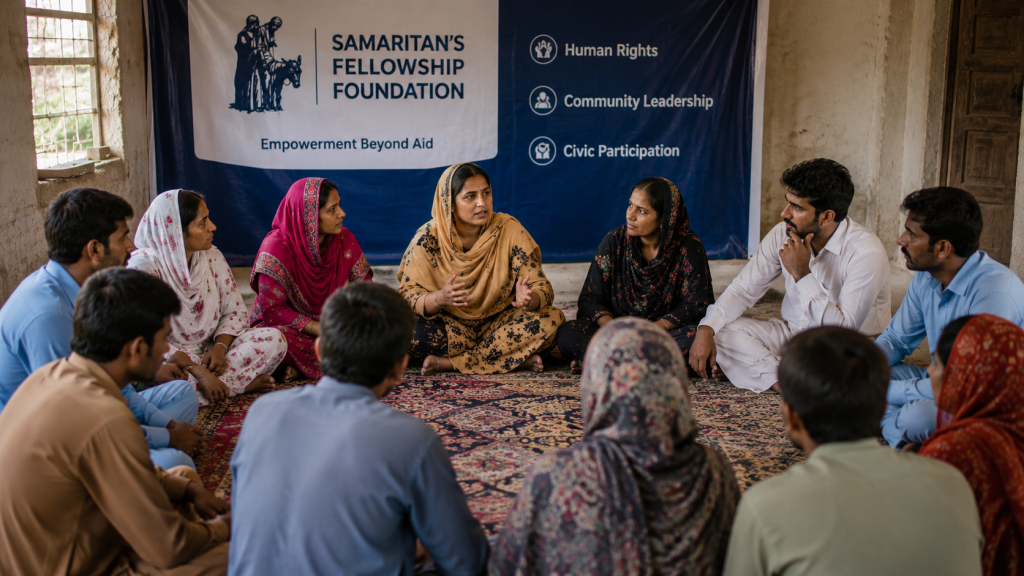
SFFP encourages communities to identify shared challenges, understand their legal rights, document relevant concerns and engage constructively with responsible public institutions. Through community consultations, civic education, institutional referrals, dialogue and evidence-based recommendations, we seek to connect local problems with practical solutions.
Our approach emphasizes peaceful participation, institutional accountability and community leadership. Rather than speaking on behalf of communities indefinitely, we aim to strengthen their ability to raise concerns, participate in decisions and contribute to lasting improvements in their own lives.
We document these stories to preserve memory, promote due process and defend the dignity of every person.
Help us protect vulnerable communities and create lasting opportunities.
Make a DonationU.S. donations made through Every.org are 100% tax-deductible to the extent allowed by U.S. law. Samaritan’s Fellowship Foundation’s American Friends Fund is hosted by Myriad USA, a U.S.-registered 501(c)(3) public charity.
You can support Samaritan’s Fellowship Foundation Pakistan (SFFP) through the donation options available on our official website. International supporters may contribute through our supported giving platforms, while U.S. donors can explore tax-deductible giving options through our American Friends Fund hosted by Myriad USA.
Visit our Donate page to explore available payment methods and choose the program you wish to support. U.S. donors may make tax-deductible contributions through eligible giving arrangements, including SFFP’s American Friends Fund hosted by Myriad USA, a U.S. 501(c)(3) public charity. Tax deductibility is subject to applicable U.S. law and the requirements of the receiving charitable organization.
Tax treatment for donors in other countries depends on local laws and the giving method used. Donors should consult their tax advisers regarding their individual circumstances. Donations support SFFP’s charitable mission and the implementation of its programs, including human rights and community empowerment, education, healthcare, clean water, protection from exploitation and sustainable livelihoods.
Contributions designated for a specific project are managed in accordance with the applicable project terms and donor restrictions. Unrestricted donations help support organizational priorities, program delivery and essential operating costs. SFFP maintains financial documentation and accountability procedures to support responsible use of funds. Yes. Donors can support specific SFFP programs through designated fundraising campaigns where available, including Set Them Free, End Water Crisis, Mobile Medical Mission and StartFish.
Support for an individual family or particular intervention may be possible through an approved arrangement, subject to eligibility, safeguarding, privacy considerations and operational feasibility. We encourage donors to contact SFFP before making a contribution intended for a specific individual or purpose. SFFP is a legally registered nonprofit organization in Pakistan, incorporated under Section 42 of the Companies Act, 2017, and registered with the Punjab Charities Commission.
Our Accountability and Transparency page provides information about organizational registrations, available certifications, institutional relationships and financial reporting documents. Donors and institutional partners may review these materials and contact us with reasonable due-diligence inquiries before contributing. Donation acknowledgments and receipts depend on the payment channel used. Contributions made through third-party giving platforms are generally acknowledged by the receiving platform or charitable organization according to its procedures.
For contributions through SFFP’s American Friends Fund, the U.S. charitable recipient is responsible for issuing applicable donation acknowledgments. Donors who need assistance locating their contribution records may contact us with the transaction details. SFFP documents its work through program records, field monitoring, beneficiary information, implementation evidence, and available impact reports.
We seek to measure not only the assistance delivered but also the longer-term changes it supports, such as improved access to essential services, children's education, sustainable income and community participation. Donors can explore our website for program updates, impact information and published reports. Reporting for specific contributions may depend on the project and giving arrangement. Yes. SFFP welcomes opportunities to collaborate with businesses, philanthropic foundations, nonprofit organizations, academic institutions and other mission-aligned partners.
Potential collaboration may include project funding, technical assistance, research, employee engagement, capacity building, community development and in-kind support. Partnerships are considered according to shared objectives, legal and regulatory requirements, safeguarding standards and the needs of the communities we serve.
Organizations interested in collaboration are welcome to contact SFFP to discuss potential opportunities. We document these stories to preserve memory, promote due process and defend the dignity of every person.
Help us protect vulnerable communities and create lasting opportunities.
Make a DonationU.S. donations made through Every.org are 100% tax-deductible to the extent allowed by U.S. law. Samaritan’s Fellowship Foundation’s American Friends Fund is hosted by Myriad USA, a U.S.-registered 501(c)(3) public charity.
Support our mission to rescue families trapped in bonded labour. Create your own fundraiser and help change lives.