Samaritan’s Fellowship Foundation Pakistan works with marginalized and minority communities to defend their rights, strengthen their voice, and create opportunities for lasting self-reliance.
Our work connects three pillars: Freedom, Rights & Empowerment; Economic Opportunity; and Peace & Fellowship.
We speak for the freedom of people from social differences, injustice, modern slavery, extremism, religious intolerance, persecution, and poverty.
Rimsha Masih: A Christian Child Accused of Blasphemy, Then Cleared by Islamabad High Court
August 16, 2012
Rimsha Masih: A Christian Child Accused of Blasphemy, Then Cleared by Islamabad High Court
Islamabad, Pakistan | August–November 2012
She was a child.
She could not properly read or write.
Medical assessment found that her mental development was below what would normally be expected for her age.
Yet in August 2012, Rimsha Masih, a Christian girl living in a poor settlement on the outskirts of Islamabad, was arrested after being accused of burning pages containing Quranic verses.
She spent approximately three weeks in an adult prison.
Her family went into hiding.
Christian families fled the neighbourhood.
Then the case changed dramatically.
A witness alleged that the local cleric who had accused Rimsha had himself added religious pages to the material recovered from her.
The cleric was arrested.
Police told the court that the case against Rimsha could not be sustained.
And on 20 November 2012, the Islamabad High Court quashed the criminal case against her.
Rimsha’s story became internationally significant because it exposed how vulnerable a poor child could become once a blasphemy allegation was made—and also showed how Pakistani courts, police investigators, Muslim religious leaders and civil-society actors could intervene to stop an injustice.
Who Was Rimsha Masih?
Rimsha Masih was a Christian girl living with her family in Mehrabad, a poor settlement near Islamabad.
Her exact age was initially disputed.
Contemporary reports variously described her as being between 11 and 16 years old. A medical board later estimated her age at approximately 14, making her legally a minor, and found that her mental development was below the level normally expected for someone of that age.
Amnesty International later described Rimsha as a 14-year-old Christian girl with a learning disability.
Because early media sometimes reported that she had Down syndrome while other sources used broader descriptions such as learning disability or reduced mental capacity, the safest wording is:
Rimsha was a minor with documented learning difficulties.
16 August 2012: The Accusation
Rimsha was arrested on 16 August 2012.
She was accused of burning pages from the Quran or from a religious text containing Quranic verses.
Accounts differ slightly regarding precisely what material was found.
According to Reuters and other contemporary sources, burned papers were brought to the local mosque and presented as evidence against her.
The accusation quickly spread through the neighbourhood.
An allegation involving one child became a threat to an entire community.
A Crowd Gathered Around Her Home
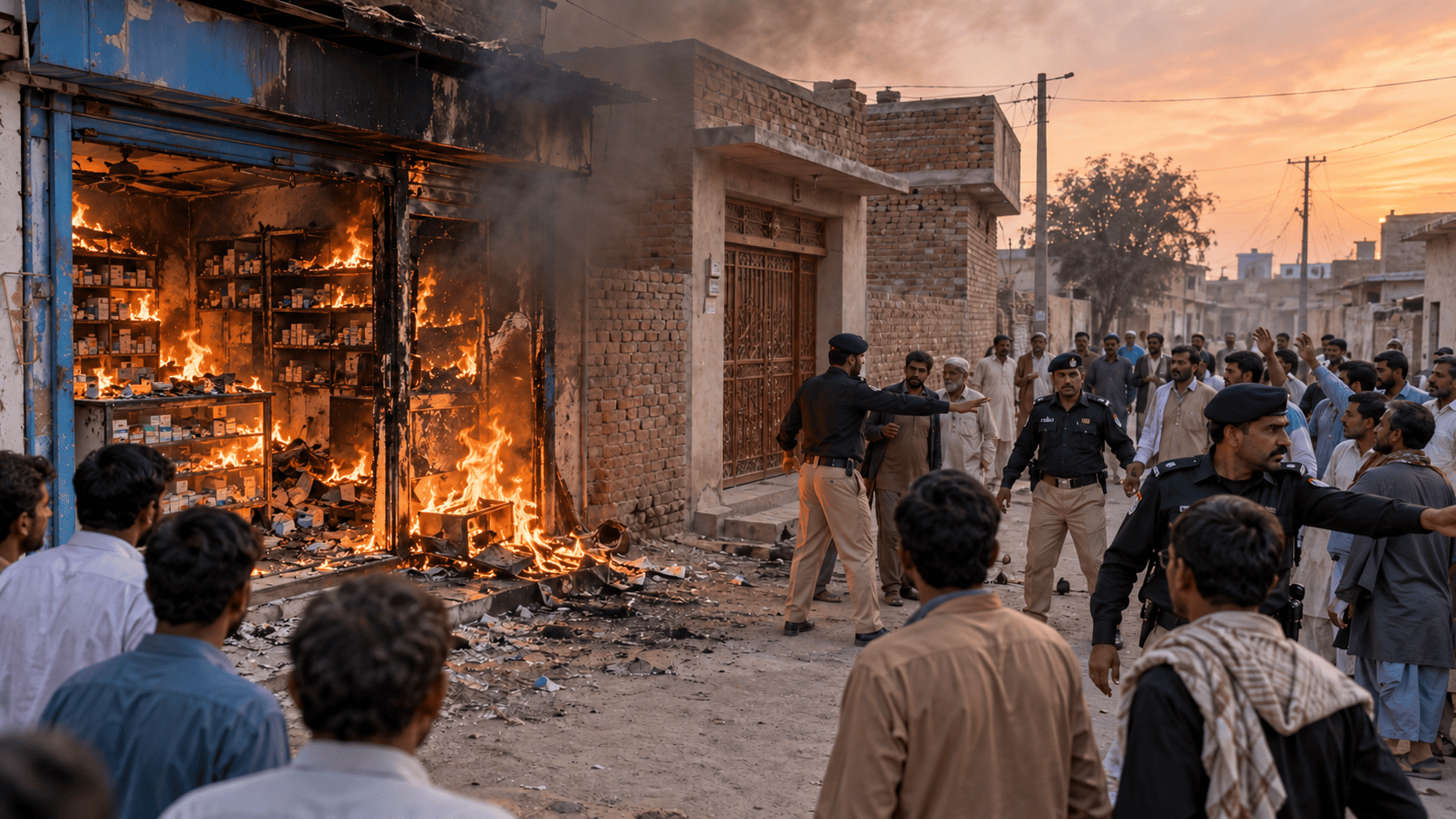
Reports indicate that angry residents gathered near Rimsha’s home after the accusation circulated.
Her family feared violence.
Other Christian residents feared that they too could become targets.
Reuters and later case histories documented that hundreds of Christian families fled the area or temporarily abandoned their homes as tensions increased.
This is one of the recurring patterns in blasphemy-related cases:
the allegation may name one person,
but fear spreads through an entire minority neighbourhood.
She Was Taken Into Custody
Police arrested Rimsha.
The decision may have prevented an immediate mob attack against her, but it created another serious problem:
a vulnerable child was placed inside an adult jail.
Dawn later reported that she spent about three weeks in an adult prison following her arrest.
The case generated immediate concern inside Pakistan and internationally.
Human-rights groups questioned whether a child with learning difficulties should have been detained in such conditions at all.
A Child in an Adult Prison
Rimsha was reportedly held at Adiala Jail.
The Human Rights Commission of Pakistan documented the case and raised concerns about the manner in which she had been arrested, incarcerated and exposed to danger.
The issue was larger than her religion.
Children accused of crimes have particular vulnerabilities.
They may not fully understand:
the accusation,
police questioning,
legal proceedings,
or the consequences of statements made under pressure.
When disability or learning difficulties are added, those vulnerabilities become even more serious.
Her Age and Mental Capacity Became Central
A medical board was constituted to assess Rimsha.
The medical assessment concluded that she was approximately 14 years old and that her mental development was below that expected for her age.
That finding was important for two reasons.
First, it confirmed that she was a minor.
Second, it strengthened concerns that she may not have had the cognitive capacity normally expected of an adult defendant.
Her lawyers argued that these factors had to be considered in both her detention and the allegation itself.
Then the Case Took a Dramatic Turn
About two weeks after Rimsha’s arrest, evidence emerged that changed the direction of the investigation.
A witness reportedly told police that local imam Hafiz Mohammed Khalid Chishti had added pages containing Quranic material to the burned papers recovered from Rimsha.
The allegation was that evidence had been deliberately altered or planted to strengthen the case against her.
Police arrested the cleric.
For a case that had begun with a Christian child accused of desecrating religious material, this development was extraordinary.
The credibility of the original evidence was now itself under criminal scrutiny.
Why Would Evidence Be Planted?
Contemporary reporting raised the possibility that hostility toward the local Christian community played a role.
Reuters reported that the cleric was detained on suspicion of planting evidence in order to stir resentment against Christians.
Other accounts reported claims that the aim may have been to pressure Christians to leave the neighbourhood.
Because motive was contested and the cleric was later acquitted in his own criminal proceedings, this point must be described carefully.
What is established is:
a witness accused the cleric of tampering with the evidence, police arrested him, and the allegation seriously weakened the case against Rimsha.
Muslim Religious Leaders Spoke in Her Defence
One of the most important and often overlooked parts of the Rimsha case was the response of Muslim religious leaders inside Pakistan.
Members of the All Pakistan Ulema Council publicly called for fairness in the case and warned against misuse of blasphemy allegations.
The Guardian reported that Muslim clerics joined Christian leaders in supporting Rimsha and called for an impartial investigation.
This matters enormously.
The story was not:
Christians versus Muslims.
Some of the people speaking most publicly for a Christian child were Muslim religious scholars.
That is exactly the kind of detail a responsible human-rights archive should preserve.
President Asif Ali Zardari Ordered an Inquiry
The case also reached Pakistan’s highest political levels.
President Asif Ali Zardari ordered an investigation into Rimsha’s arrest and the circumstances surrounding the accusation.
Again, this is important for balanced documentation.
The Pakistani state was not monolithic.
While one part of the system had arrested Rimsha, other state actors were questioning whether the case had been handled properly.
Institutional safeguards began to activate.
September 2012: Rimsha Was Granted Bail
On 7 September 2012, a Pakistani court granted Rimsha bail.
Amnesty International welcomed the decision but warned that she and her family remained at risk even outside prison.
The bail amount was reportedly set at one million Pakistani rupees, with sureties provided.
On release, extraordinary security precautions were taken.
She was transported away from the prison under heavy protection to an undisclosed location.
Legally, she was out of jail.
Practically, she still could not simply go home.
Freedom on Bail Did Not Mean Safety
Rimsha and her family remained in hiding.
The allegation had already created a security problem that could not be erased by opening a prison gate.
Dawn reported that she and her family remained concealed for their protection after her release.
This demonstrates another recurring feature of blasphemy cases:
legal relief and physical safety are not always the same thing.
A court may grant bail.
A court may acquit.
But rumours and hostility may continue outside the courtroom.
Police Began Questioning the Case Itself
As the investigation continued, the prosecution against Rimsha weakened further.
Police reportedly told the courts that the available evidence did not establish her guilt and that the allegations concerning fabricated evidence required investigation.
The focus had shifted dramatically.
The child who had initially been treated as the accused was increasingly being viewed as someone who may herself have been framed.
20 November 2012: Islamabad High Court Quashed the Case
On 20 November 2012, the Islamabad High Court ordered the case against Rimsha Masih to be dismissed.
Reuters reported that the court threw out the blasphemy case.
Dawn reported that the Islamabad High Court ordered the FIR against Rimsha removed, while her lawyer said the court had declared her innocent.
The Guardian similarly reported that the blasphemy charges had been dropped.
For Rimsha, the legal ordeal was finally over.
She had been accused in August.
Three months later, the High Court removed the case.
The Court’s Decision Was Highly Significant
Blasphemy cases in Pakistan can be extraordinarily difficult to resolve once an accusation is made.
Rimsha’s case was therefore unusual.
A Pakistani High Court intervened at an early stage and stopped the prosecution rather than allowing it to continue for years.
Amnesty International later cited her case as a prominent example of how false or questionable accusations can affect particularly vulnerable defendants.
The case demonstrated what judicial review can accomplish when courts act before irreversible harm occurs.
What Happened to the Cleric Accused of Planting Evidence?
The story did not end with Rimsha’s case being dismissed.
The cleric accused of tampering with the evidence, Khalid Jadoon Chishti, faced criminal proceedings.
However, in August 2013, a Pakistani court acquitted him after the prosecution failed to provide sufficient evidence to sustain the case.
This fact must be included.
Just as Rimsha deserved the presumption of innocence, so did the cleric accused of framing her.
The accusation against him was serious.
But he too was entitled to due process.
The court ultimately found the evidence insufficient for conviction.
Due Process Must Apply to Everyone
This is one of the most useful lessons from the Rimsha Masih case.
Human rights cannot work selectively.
We cannot say:
Rimsha deserved evidence before conviction,
and then ignore the same principle when another person is accused of framing her.
Both were entitled to lawful process.
Rimsha’s case was quashed.
The cleric was later acquitted.
A justice system must decide each case according to the evidence available—not according to which side society prefers.
Her Family Could Not Safely Resume Their Old Life
Even after the criminal case against Rimsha ended, her family’s security concerns remained.
They lived in hiding for months.
Eventually, in 2013, Rimsha and members of her family left Pakistan and settled in Canada.
The Guardian reported that Canadian authorities provided the family refuge after a complicated effort to remove them safely from Pakistan.
The legal case had been dismissed.
The social consequences had not disappeared.
A Child Lost Her Home Because of an Allegation
This is perhaps the part of the story that legal summaries cannot fully capture.
Rimsha survived.
She was not convicted.
She was not sentenced to death.
The High Court cleared her case.
But she still lost:
her neighbourhood,
her normal childhood,
her privacy,
and ultimately her ability to remain safely in her own country.
That is why wrongful or unproven accusations can cause harm even when courts eventually correct the legal record.
Hundreds of Other Families Were Also Affected
Rimsha’s family was not the only one affected.
Christian residents reportedly fled Mehrabad after tensions surrounding the allegation escalated.
This reflects the same danger seen in Shanti Nagar, Sangla Hill and Gojra:
an accusation against one person can become insecurity for an entire community.
Collective fear is itself a form of social harm.
Why Rimsha’s Case Also Gives Reason for Hope
Many stories in this archive end primarily in tragedy.
Rimsha’s is different.
There was fear.
There was imprisonment.
There was displacement.
But several Pakistani institutions and individuals ultimately acted in ways that protected her:
Doctors evaluated her age and mental capacity.
Police investigated the evidence.
Muslim clerics publicly defended fairness.
The president ordered an inquiry.
A court granted bail.
The Islamabad High Court quashed the case.
That does not erase what happened.
But it demonstrates that institutional intervention can stop an allegation from becoming a death sentence.
Protect the Accused Before the Mob Forms
One practical lesson from Rimsha’s case is the importance of early intervention.
Once a blasphemy allegation begins circulating publicly, authorities may have only hours to:
secure the accused,
protect the family,
separate evidence from rumour,
control public communication,
and prevent collective retaliation.
Rimsha survived in part because institutions eventually intervened.
Other accused people in this archive did not receive that chance.
Children Need Special Protection
The case also raises a basic child-rights principle.
A minor should never be processed exactly like an adult.
Age matters.
Mental capacity matters.
Understanding matters.
Vulnerability matters.
Children accused of serious offences require:
appropriate detention arrangements,
legal representation,
medical and psychological assessment,
family support,
and protection from public exposure.
Rimsha’s incarceration in an adult prison demonstrated how damaging it can be when those safeguards fail.
It is built on strengthening the systems and communities that can make constitutional and human rights meaningful in everyday life.
Dialogue Matters
Rimsha’s case also demonstrated why interfaith relationships matter before a crisis occurs.
Muslim religious leaders who supported a fair investigation helped change the public narrative.
That type of intervention can save lives.
When respected leaders from the majority community speak against vigilantism and false accusations, their voice may reach people who would not listen to an outside critic.
Human-rights protection therefore cannot depend only on courts.
It also requires community leadership.
Why Empowerment Goes Beyond Legal Protection
A poor family facing a crisis may need more than a lawyer.
They may lose:
housing,
employment,
education,
social networks,
and physical safety.
This is why SFFP works through an integrated model.
Through StartFish, marginalized families can build sustainable livelihoods and greater independence.
Through Set Them Free, vulnerable families facing bonded labour and exploitation pursue pathways toward freedom and reintegration.
And through How We Work, human rights, development, economic opportunity and local leadership are connected within one ecosystem.
Because protection becomes stronger when people are also economically and socially resilient.
What Should We Learn From Rimsha Masih?
Do not assume that an accusation is evidence.
Protect the accused before crowds form.
Treat children as children.
Assess disability and mental capacity properly.
Investigate evidence independently.
Allow religious leaders to become voices for restraint.
Protect minority neighbourhoods from collective retaliation.
And ensure courts can intervene early.
Rimsha’s life could have followed a very different path.
Instead, the legal system ultimately stopped the case.
That is worth remembering.
Help Us Advance Freedom, Dignity and Opportunity
Samaritan’s Fellowship Foundation builds integrated, community-led ecosystems that empower marginalized communities through human rights, healthcare, education, clean water, sustainable livelihoods and local leadership.
We believe every child deserves safety.
Every accused person deserves due process.
And every community deserves the opportunity to live without fear because of its religious identity.
If you believe human rights should protect the most vulnerable before an allegation becomes irreversible:
Together, we can strengthen communities where freedom, dignity and opportunity become realities—not simply promises.
Empowerment Beyond Aid — Advancing Freedom and Rights.
Editorial Note
Samaritan’s Fellowship Foundation documents publicly reported human-rights cases for education, historical record and awareness.
Historical reporting differed regarding Rimsha Masih’s exact age and medical diagnosis. A medical board estimated her age at approximately 14 and reported reduced mental development for her age; Amnesty International describes her as a child with a learning disability.
The allegation that cleric Khalid Jadoon Chishti planted evidence was investigated and resulted in his arrest. However, he was subsequently acquitted after a court found insufficient evidence to convict him. This article therefore presents the evidence-tampering allegation as an allegation rather than an established criminal fact.
The Islamabad High Court quashed the case against Rimsha Masih on 20 November 2012.
SFFP does not attribute the conduct of individual accusers, officials or groups to Islam, Muslims generally or the people of Pakistan.
We support child protection, peaceful coexistence, due process, interfaith cooperation and equal human dignity for all.
References
1. Reuters — Pakistan Dismisses Blasphemy Case Against Christian Girl, 20 November 2012 Contemporary Reuters report on the dismissal of the case, Rimsha’s age, bail, and the arrest of a cleric suspected of planting evidence.
2. Islamabad High Court / Dawn — IHC Quashes Rimsha ‘Blasphemy’ Case, 20 November 2012 Pakistani reporting on the Islamabad High Court’s order quashing the FIR and ending proceedings against Rimsha.
3. Human Rights Commission of Pakistan — The Rimsha Case: Is Anyone Listening? HRCP’s detailed review of Rimsha’s arrest, detention, vulnerability, community tensions and the wider human-rights implications of the case.
4. Amnesty International — Pakistan: How the Blasphemy Laws Enable Abuse Amnesty identifies Rimsha as a 14-year-old Christian girl with a learning disability and discusses the case as an example of a false or abusive accusation.
5. Amnesty International — As Good as Dead: The Impact of the Blasphemy Laws in Pakistan Detailed later report covering Rimsha’s accusation, disability, prosecution and successful High Court petition.
6. Amnesty International USA — Pakistani Girl Accused of Blasphemy Still in Danger Despite Bail, 7 September 2012 Amnesty’s response to Rimsha being granted bail, while emphasizing continuing security risks to her and her family.
7. Dawn — Imam in Rimsha Masih Blasphemy Case Released, 12 October 2012 Reports that Rimsha spent three weeks in an adult jail, the medical finding that she was approximately 14, and subsequent proceedings involving the cleric.
8. The Guardian — Pakistan Drops Blasphemy Case Against Christian Girl, 20 November 2012 Contemporary reporting on the Islamabad High Court decision dismissing the case.
9. The Guardian — Rimsha Masih Finds Refuge in Canada, 30 June 2013 Reports that Rimsha and her family eventually relocated to Canada following months in hiding.
10. Christian Solidarity Worldwide — Rimsha Masih Case Thrown Out by High Court, 20 November 2012 Contemporary report on the High Court decision and arguments concerning Rimsha’s age and learning difficulties.
11. Christian Solidarity Worldwide — Acquittal of Cleric in Rimsha Masih Blasphemy Case, 19 August 2013 Documents the later acquittal of the cleric accused of fabricating evidence because the prosecution did not establish the case against him.
13. Wikipedia — Rimsha Masih Blasphemy Case Dedicated case page covering her arrest, age and disability dispute, alleged evidence fabrication, bail, High Court decision and eventual relocation to Canada.