Samaritan’s Fellowship Foundation Pakistan works with marginalized and minority communities to defend their rights, strengthen their voice, and create opportunities for lasting self-reliance.
Our work connects three pillars: Freedom, Rights & Empowerment; Economic Opportunity; and Peace & Fellowship.
We speak for the freedom of people from social differences, injustice, modern slavery, extremism, religious intolerance, persecution, and poverty.
Maulana Nigar Alam: Lynched After Blasphemy Allegation
May 7, 2023
Maulana Nigar Alam: Lynched After Blasphemy Allegation
Sawaldher, Mardan District, Khyber Pakhtunkhwa | 6 May 2023
He was not a member of a religious minority.
He was not a foreign worker.
He was not an activist campaigning against religion.
He was a Muslim cleric.
Maulana Nigar Alam had been invited to participate in a political gathering in Sawaldher, Mardan.
The rally was coming to an end.
He offered a concluding prayer.
Then some people in the crowd interpreted part of what he said as blasphemous.
Within minutes, anger spread.
Police tried to move him away from the crowd.
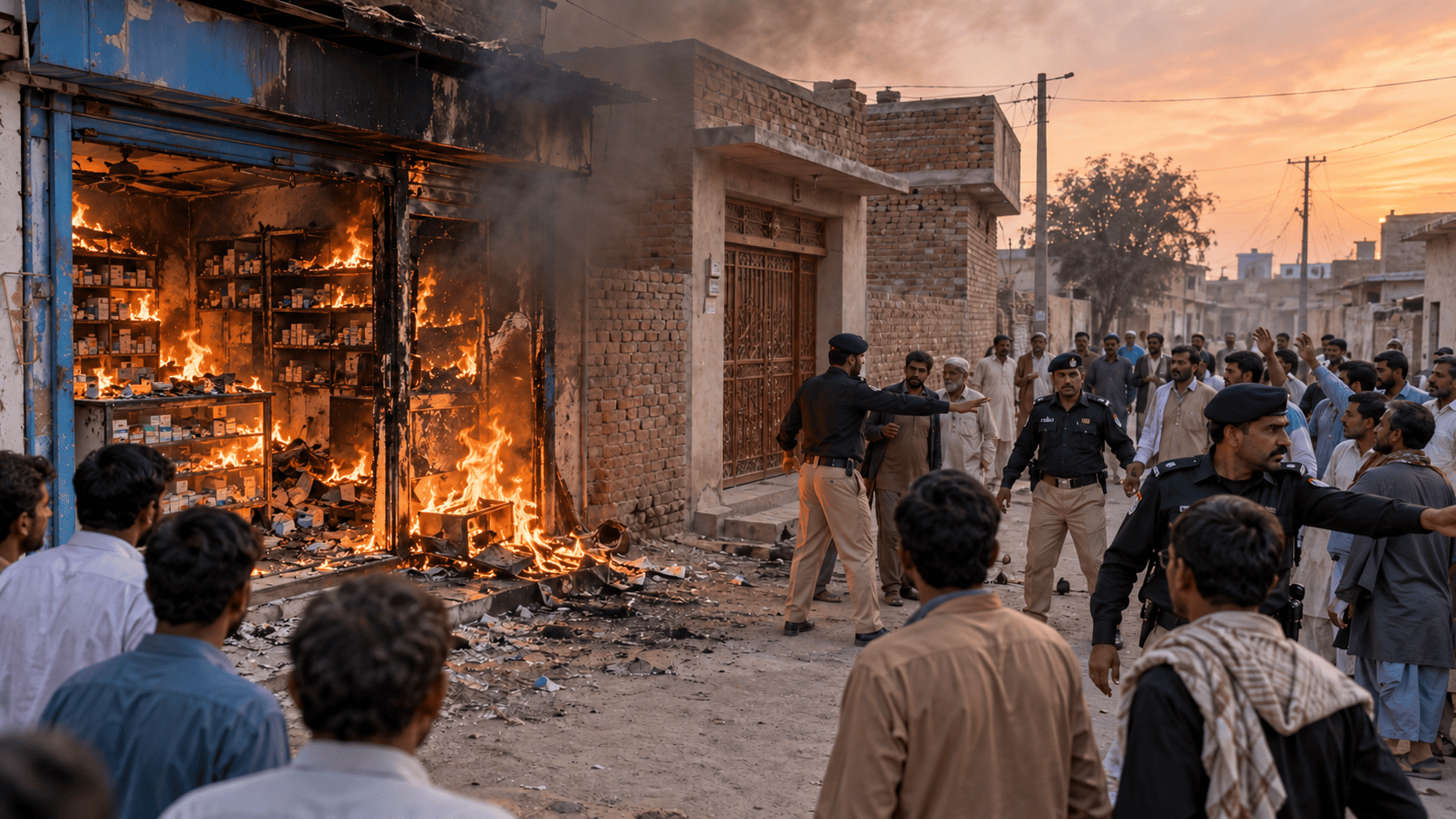
They locked him inside a nearby shop for protection.
The mob broke through the door.
And Maulana Nigar Alam was beaten to death before any police investigation, court hearing or judicial determination of the allegation against him could take place. Associated Press reported that the 40-year-old cleric was killed by demonstrators after words in his prayer were deemed blasphemous by members of the crowd.
Months later, a local jirga concluded that his lynching had been unlawful and un-Islamic, and his family later publicly described him as innocent of the accusation that had cost him his life.
His story is an important final case in this archive because it destroys one dangerous misconception:
Blasphemy-related mob violence is not only a minority problem. Once accusation replaces due process, even a Muslim religious leader can become the victim.
Who Was Maulana Nigar Alam?
Maulana Nigar Alam was a local Muslim cleric from the Mardan area in Khyber Pakhtunkhwa.
Associated Press, Voice of America and other contemporary reports identified him as approximately 40 years old.
He was known locally as a religious figure.
On 6 May 2023, he attended a political gathering in the village of Sawaldher, in Mardan District.
The event was connected with supporters of Pakistan Tehreek-e-Insaf and was held in the wider political context surrounding demands for elections and support for the judiciary.
His presence at the rally was religious rather than confrontational.
He was there to speak and offer prayer.
The Rally Was Nearly Over
According to police and contemporary media reporting, the event was approaching its conclusion when Maulana Nigar Alam delivered a prayer.
The crisis did not begin with a planned religious confrontation.
It emerged from words spoken at the end of a political gathering.
Associated Press quoted local police officer Iqbal Khan as saying that some words of Alam’s prayer were deemed blasphemous by a number of protesters.
That interpretation spread rapidly through the crowd.
What Exactly Did He Say?
Different reports paraphrased the alleged remarks differently.
Some advocacy sources claimed that Alam used a comparison involving a political figure and the Prophet Muhammad.
Other reliable contemporary sources avoided reproducing the exact words and simply stated that some people considered part of his prayer blasphemous.
For SFFP’s archive, the safest approach is therefore:
Do not present one disputed quotation as an established transcript.
The key historical fact is that members of the crowd interpreted his words as blasphemous.
Whether that interpretation was accurate was never determined by a court.
Anger Spread Almost Immediately
The reaction was rapid.
Hundreds of people were present around the rally.
Al Jazeera reported that Alam was attacked after allegedly making remarks that members of the crowd considered blasphemous.
RFE/RL likewise reported that an angry mob formed around him in Sawaldher.
The allegation did not move through:
complaint,
investigation,
evidence,
and court.
It moved directly from:
words
to
accusation
to
mob violence.
Police Tried to Protect Him
Police understood that Alam’s life was in danger.
Officers moved him into a nearby shop and locked the door in an effort to protect him from the crowd.
Voice of America reported that police placed him inside the shop for safety.
This was a preventive step.
But the protection was not strong enough.
The Crowd Broke Through the Door
The mob followed.
People forced their way into the shop.
Police were unable to keep them away from Alam.
Associated Press and Voice of America reported that the crowd broke through the shop door and attacked him.
The temporary refuge became another location where state protection failed.
Maulana Nigar Alam Was Killed
The crowd beat Alam to death.
Contemporary reports describe the use of fists, kicks, batons and sticks.
There is no need for SFFP to reproduce graphic detail.
The essential fact is enough:
A Muslim cleric was killed by a crowd because some people believed words he had spoken were blasphemous.
No court had heard the allegation.
No judge had determined intent.
No opportunity existed for clarification.
The punishment came before the investigation.
The Killing Was Recorded
Video of the attack circulated widely on social media.
RFE/RL reported that footage showed Alam being attacked by the mob.
As in the Mashal Khan, Priyantha Kumara and other modern cases, smartphones turned a local act of violence into a national record.
That creates both horror and evidence.
The same technology capable of spreading allegations can also document what happens afterward.
He Was Muslim
This point is fundamental.
Maulana Nigar Alam was a Muslim religious leader.
He was not accused because he belonged to Christianity, Hinduism or the Ahmadi community.
The accusation arose within a Muslim gathering involving a Muslim cleric.
That means the underlying problem cannot honestly be described simply as:
majority versus minority.
Minorities can face particular structural vulnerabilities.
But blasphemy vigilantism itself can become dangerous to anyone.
Even a Cleric Was Not Protected by His Religious Status
A person might assume that a religious scholar would be safer from accusations of insulting religion.
Nigar Alam’s case demonstrates the opposite.
When the emotional threshold becomes low enough, even someone recognized as a religious leader can suddenly be recast as an offender.
This makes the wider danger clearer.
Social standing does not guarantee protection.
Religious credentials do not guarantee protection.
The only reliable protection is rule of law.
The Allegation Was Never Tried
Because Alam was killed almost immediately, no court had the opportunity to determine:
what he actually said,
what he intended,
whether witnesses understood him correctly,
whether context changed the meaning,
or whether a criminal offence had occurred.
That is precisely what makes lynching irreversible.
A legal error can be appealed.
A misunderstanding can be clarified.
A false accusation can be dismissed.
A dead person cannot return to explain what they meant.
Language Can Be Misheard
This case also highlights the danger of spoken allegations.
Unlike a written document or digital post, spoken words may depend on:
tone,
context,
accent,
sentence structure,
and memory.
A listener may misunderstand.
A phrase may be incomplete.
A speaker may misspeak.
People may repeat different versions afterward.
That makes immediate violence even more irrational.
The less certain the evidence, the greater the need for careful investigation.
Political Gatherings Can Become Especially Volatile
The setting also mattered.
This was a political rally.
Large crowds already create:
emotion,
group identity,
slogans,
and rapid collective reactions.
When a religious accusation enters such a setting, the combination can become particularly dangerous.
Political organizers therefore need clear protocols for unexpected religious disputes.
Rally Organizers Have Responsibilities Too
A responsible event should have:
security personnel,
designated exits,
communication with local police,
crowd-control plans,
and a process for ending the event rapidly if violence begins.
In Alam’s case, the crowd transformed faster than the protection system could respond.
That is a lesson for political parties as well as law enforcement.
Police Protection Was Attempted — But Failed
This case should not be described as though police did absolutely nothing.
They did try to save him.
They moved him into a shop.
But the intervention was insufficient.
That nuance matters.
The failure was not absence of intention.
It was absence of enough capacity to keep the mob away.
Protection Must Match the Threat
Locking someone inside an ordinary shop is not enough when hundreds of people are outside.
Once the threat reached that level, effective protection required:
reinforcements,
a secure vehicle,
a controlled perimeter,
and rapid transfer out of the area.
This is the same operational lesson repeated across several cases in our archive.
A Local Jirga Later Revisited the Case
Months after the killing, local community leaders convened a jirga to resolve tensions surrounding the case.
The Nation reported that the jirga concluded that Alam’s lynching had been unlawful and un-Islamic.
That later judgment is important.
The community itself eventually recognized that what had happened should not have happened.
The Jirga Said He Should Have Been Handed to the Law
According to reporting on the jirga, members said that even if people believed Alam had made an inappropriate or offensive remark, he should have been handed over to law-enforcement authorities rather than tortured or killed.
This is exactly the principle our archive promotes.
People may disagree about the allegation.
They may believe an investigation is necessary.
But private punishment remains unlawful.
The Jirga Described the Lynching as Un-Islamic
The jirga’s religious conclusion is also significant.
It reportedly characterized the killing as both unlawful and contrary to Islamic principles.
That reinforces a recurring theme in several of these cases.
Mob actors may claim religion.
But Pakistani:
clerics,
courts,
community elders,
and government officials
have repeatedly rejected vigilantism as illegitimate.
Diyat Was Agreed for the Family
The jirga reached a financial settlement involving Rs4.5 million in diyat, or blood money, for Alam’s family.
The report stated that his family later forgave those involved as part of the community settlement.
This was a local reconciliation mechanism.
But it also raises a broader question.
Compensation Cannot Restore a Life
Diyat can support:
children,
widows,
and dependent family members.
It can help resolve community conflict.
But money cannot replace:
a father,
a husband,
a brother,
or a human life.
The best outcome would have been not a settlement after the killing.
It would have been a living cleric reaching a police station safely.
Cases Were Registered Against More Than 100 People
The Nation reported that cases had been filed against 104 residents of Sawaldher, with some suspects detained and others released on bail during subsequent proceedings.
That demonstrates the enormous collateral cost of mob violence.
One victim dies.
Then dozens or hundreds of others become criminal suspects.
Families on both sides suffer.
The entire community pays.
Mob Violence Produces More Victims Than the Person Killed
A lynching affects:
the victim’s children,
the attackers’ families,
police officers,
witnesses,
local businesses,
and community relations.
Some participants may spend years in court or prison.
Others carry trauma.
Neighbours become suspicious of each other.
A few minutes of collective anger can create years of consequences.
The Family Later Said His Innocence Had Been Established
The Nation reported that Alam’s brother thanked the jirga for helping establish the cleric’s innocence and restoring peace in the area.
However, SFFP should be precise.
A jirga determination is not the same as a formal judicial acquittal.
Therefore the safest wording is:
Local jirga proceedings later rejected the justification for his killing and his family described him as having been cleared of the accusation.
That is accurate without overstating the legal status.
This Story Is About How Fast a Life Can Be Lost
Some cases in this archive lasted years.
Asia Bibi spent years in prison.
Shagufta Kausar and Shafqat Emmanuel spent years on death row.
Other people never reached prison.
Nigar Alam’s case unfolded in minutes.
That shows two different human-rights dangers:
prolonged wrongful prosecution
and
instant extrajudicial punishment.
Both destroy lives.
An Allegation Is Not Evidence
The most important sentence in this archive remains simple:
An allegation is not proof.
A crowd cannot know everything a court has not yet investigated.
Rumour does not become evidence because many people repeat it.
Anger does not become certainty because a crowd is large.
Presumption of Innocence Exists for Difficult Moments
The presumption of innocence sounds easy when accusations are ordinary.
Its real purpose appears when allegations are emotionally explosive.
That is when societies need legal safeguards most.
If presumption of innocence disappears exactly when people are angry, it has little value.
Religious Respect and Due Process Are Not Opposites
People can deeply respect the Prophet Muhammad.
They can consider blasphemy morally offensive.
They can support investigation under Pakistani law.
And they can still reject lynching.
There is no contradiction.
In fact, the later local jirga’s conclusion that Alam’s killing was un-Islamic demonstrates that the two principles can coexist.
Political Parties Must Reject Religious Vigilantism
The case also shows why parties of every political ideology need clear boundaries.
A political rally cannot become a venue where accusations trigger instant violence.
Parties should publicly communicate:
no mob punishment,
no attack on speakers,
no incitement,
and immediate cooperation with police.
Human rights should not change according to which political party organized the gathering.
what happens when human dignity and due process collapse.
Persecution Can Begin With a Minority — But Vigilantism Spreads
Religious minorities may face particular vulnerability because they have less political and social power.
That remains an important part of our work.
But a culture that accepts extrajudicial punishment cannot be neatly contained.
Eventually, the same logic can be turned against members of the majority.
Maulana Nigar Alam’s death demonstrates exactly that.
The System Must Protect People Before Their Innocence Is Known
Protection cannot depend on first proving that the accused is innocent.
That would defeat the purpose.
Police must protect a person while the facts are still uncertain.
That is what due process means.
What Should We Learn From Sawaldher?
Political rallies need emergency security plans.
Religious allegations should trigger immediate police protection.
A person surrounded by hundreds cannot safely be protected inside an ordinary shop.
Police need rapid-response transport and reinforcements.
Religious leaders should publicly reject private punishment.
Political parties should discipline anyone encouraging mob violence.
Spoken allegations require careful investigation because words can be misunderstood or misquoted.
And communities should not need a jirga months later to conclude what should have been clear from the beginning:
No allegation gives a crowd the right to kill.
Justice After Death Is Always Incomplete
The jirga brought reconciliation.
The family received financial support.
Community leaders said the killing was wrong.
Cases were registered.
Those actions may help heal a community.
But they cannot restore Nigar Alam’s life.
This is why prevention must remain the central goal.
The Next Tragedy Is Not Inevitable
Every case in this archive contains warning signs.
A rumour.
A social-media post.
A workplace argument.
A political speech.
A Quran-desecration allegation.
A crowd beginning to gather.
Those are moments where intervention is still possible.
Once the victim is dead, human-rights work becomes documentation and accountability.
Before that moment, it can still be protection.
Help Us Prevent the Next Tragedy
Samaritan’s Fellowship Foundation builds integrated, community-led ecosystems that advance human rights, democratic participation, sustainable development, economic opportunity and local leadership.
We document these cases because forgetting them makes repetition easier.
But documentation alone is not enough.
Communities need:
rights awareness,
responsible leadership,
early-warning mechanisms,
stronger protection,
legal support,
and institutions capable of acting before anger becomes violence.
If you believe no person—Christian, Muslim, Hindu, Ahmadi, Sikh or anyone else—should die because of an allegation that has not been lawfully tested:
Help us strengthen awareness, protection and community leadership before the next accusation becomes another family’s tragedy.
Empowerment Beyond Aid — Advancing Freedom and Rights.
Editorial Note
Samaritan’s Fellowship Foundation documents publicly reported human-rights cases for education, historical record and awareness.
Maulana Nigar Alam, a Muslim cleric approximately 40 years old, was lynched in Sawaldher, Mardan District, on 6 May 2023 after some participants at a political rally interpreted words in his concluding prayer as blasphemous.
Contemporary sources vary concerning the precise wording attributed to Alam. This article therefore does not reproduce a disputed quotation as established fact.
Police attempted to protect him by placing him inside a nearby shop, but the crowd forced its way inside and killed him.
Months later, a local jirga reportedly determined that the lynching had been unlawful and un-Islamic, arranged Rs4.5 million in diyat for his family and facilitated reconciliation. His relatives subsequently described him as having been cleared of the accusation. A jirga determination is not equivalent to a formal judicial acquittal, and this article distinguishes between the two.
SFFP does not attribute the actions of the mob to Islam, Muslims generally, PTI supporters generally, residents of Mardan generally or the people of Pakistan.
We support religious respect, peaceful political participation, lawful investigation, due process and equal human dignity for all.
References
1. Associated Press — Rallygoers Kill Man Accused of Blasphemy, 7 May 2023
Contemporary report identifying Maulana Nigar Alam as a 40-year-old cleric killed after some participants considered words in his concluding prayer blasphemous.
7. The Nation — Blasphemy Accused Declared Innocent Months After Lynching, 3 August 2023
Reports the later local jirga, its finding that the killing was unlawful and un-Islamic, the Rs4.5 million diyat settlement, criminal cases involving 104 residents and reconciliation with the victim’s family.