Samaritan’s Fellowship Foundation Pakistan works with marginalized and minority communities to defend their rights, strengthen their voice, and create opportunities for lasting self-reliance.
Our work connects three pillars: Freedom, Rights & Empowerment; Economic Opportunity; and Peace & Fellowship.
We speak for the freedom of people from social differences, injustice, modern slavery, extremism, religious intolerance, persecution, and poverty.
Madyan 2024: Tourist Lynched Over Blasphemy Allegation
June 20, 2024
Madyan 2024: Tourist Lynched Over Blasphemy Allegation
Madyan, Swat District, Khyber Pakhtunkhwa | 20 June 2024
He was a tourist.
He had travelled from Punjab to the Swat Valley.
Then came an accusation that he had burned pages of the Quran.
Police took him into custody for his protection.
A crowd gathered outside the police station.
The mob attacked the station.
The accused man was taken from police custody.
Muhammad Ismail was killed, and his body was burned before any court could determine whether the allegation against him was true. Reuters reported that the mob also set the police station on fire and injured eight police officers.
The Madyan killing came only weeks after the fatal mob attack on Nazir Masih in Sargodha.
It showed again that blasphemy-related violence could move rapidly from:
The victim was identified as Muhammad Ismail, a Pakistani tourist from Punjab.
Reuters described him as a local tourist visiting Madyan in Swat, while Associated Press reporting said he was from Pakistan’s eastern Punjab province and was staying at a hotel in the town when the allegation was made.
Some reports linked him specifically to Sialkot.
Because the strongest contemporary reporting is more consistent on his being a tourist from Punjab than on his exact hometown, that is the safest wording for our archive.
He was Muslim.
That point matters.
Like Mashal Khan and Muhammad Waris, his case demonstrates that blasphemy-related vigilantism can also kill members of the majority religious community.
Madyan Was a Tourist Destination
Madyan is a well-known hill town in the Swat Valley.
It attracts visitors from across Pakistan because of its mountain landscape, river, and cooler climate.
Ismail had gone there as a visitor.
He was not a local political activist.
He was not leading a religious campaign.
He was reportedly staying at a hotel.
Yet within a short period, a religious accusation transformed a tourist visit into a fatal crisis.
The Allegation Began at a Hotel
Police said local people accused Ismail of burning pages of the Quran while he was staying at a hotel in Madyan.
The details surrounding the alleged incident were not judicially established before his death.
That distinction is essential.
The allegation may have been serious.
But an allegation is not evidence tested in court.
And it is certainly not a lawful death sentence.
Police Took Him Into Custody
Once tensions began rising, police took Ismail to the Madyan Police Station.
Authorities later said this was done for his protection.
That should have been the moment at which the danger decreased.
He was now inside a state institution.
Police could investigate the accusation.
Evidence could be collected.
Witnesses could be questioned.
A court could eventually decide whether any crime had occurred.
Instead, the danger followed him to the police station.
The Crowd Followed the Police
News of the accusation spread.
Hundreds of people reportedly gathered outside the station.
Reuters said the mob surrounded and attacked the police station where Ismail was being held.
The situation was now almost identical to the Nankana Sahib case one year earlier.
A blasphemy suspect was inside police custody.
A large crowd was outside demanding control of him.
The state had only one lawful option:
keep the detainee alive and maintain custody.
The Police Station Was Attacked
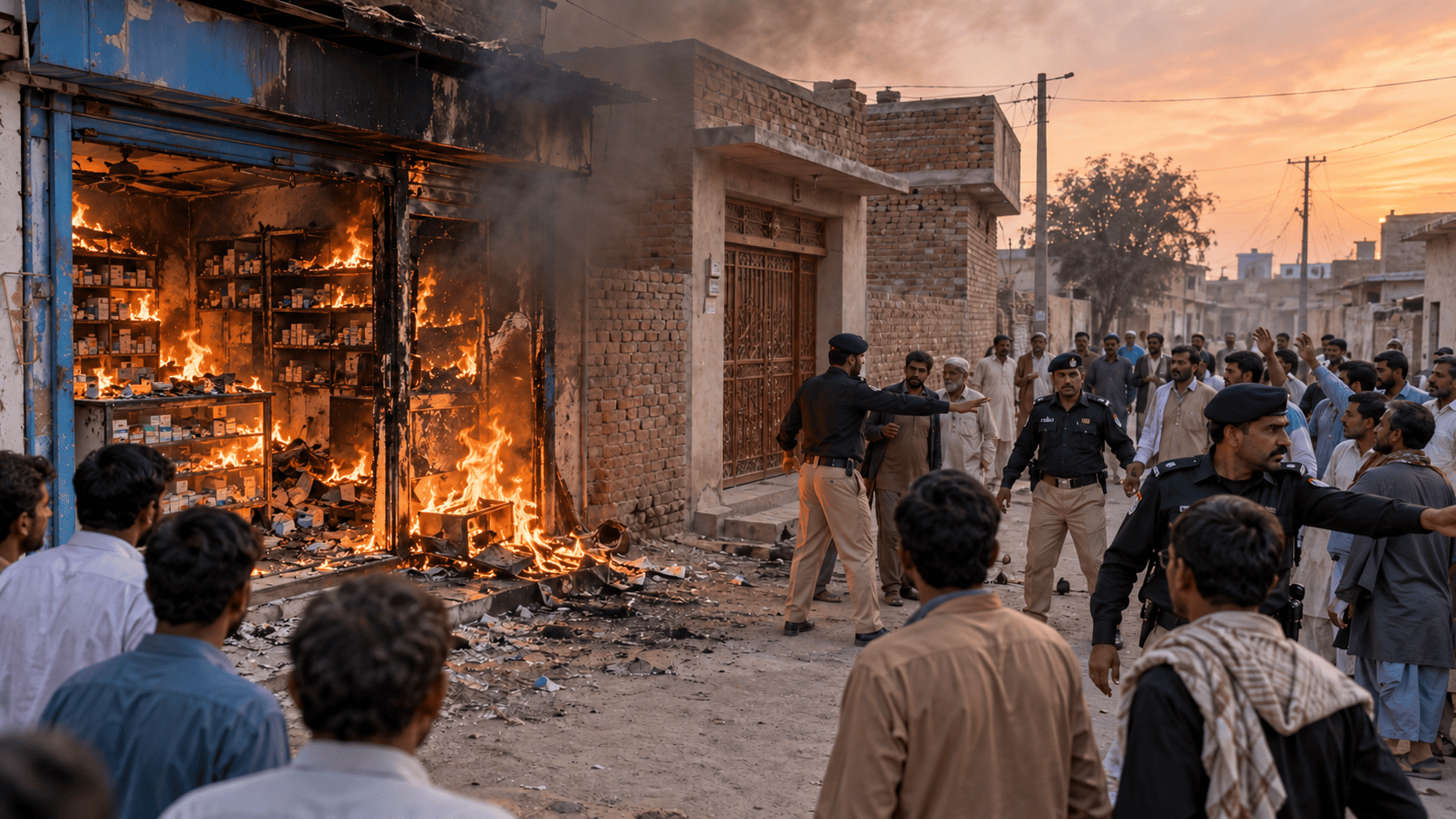
The mob attacked the Madyan Police Station.
Police officers tried to resist.
Reuters reported that eight policemen were injured, while the station itself was later set on fire.
Associated Press reporting similarly said the crowd clashed with police before overwhelming the station.
This was no longer a protest.
It was an attack on a state institution.
The Mob Took Ismail From Police Custody
The crowd succeeded in reaching Ismail.
He was taken from the station.
Police official Rahim Ullah told AP that the mob then beat him to death.
For SFFP’s archive, graphic details are unnecessary.
The central fact is sufficient:
A detainee who had been placed in police custody for protection was removed by a mob and killed before any trial.
His Body Was Burned
After killing Ismail, members of the crowd burned his body.
Reuters said verified videos showed the victim’s body being dragged through the streets and subsequently set on fire.
Al Jazeera reported that videos circulating online showed a large crowd surrounding a burning body while religious slogans were being chanted.
Again, the point is not to reproduce horrific imagery.
The point is to understand what had happened:
the crowd had completely replaced lawful process.
The Police Station Was Also Burned
The mob also set parts of the police station on fire.
Reuters documented damage to the station and the injuries suffered by officers.
This matters because the violence was not only directed against Ismail.
It was directed against the state’s attempt to keep him in custody.
The mob’s message was effectively:
The police cannot prevent us from imposing our own punishment.
That is a direct challenge to the rule of law.
Police Custody Failed Again
Only a year earlier, Muhammad Waris had been taken from a police station and lynched in Nankana Sahib.
Now the same fundamental failure had occurred in Madyan.
That repetition is especially concerning.
After the first case, authorities already knew that a rural or lightly defended police station could become a target if a blasphemy suspect were being held there.
The operational lesson should have been clear:
High-risk detainees may need immediate transfer to a more secure facility.
Was the Blasphemy Allegation Proven?
No.
Ismail never reached a court.
No completed judicial process established that he had desecrated the Quran.
The correct wording is therefore:
He was accused of Quran desecration.
We should not write:
“he burned the Quran”
as though that were a proven fact.
The crowd killed him while the accusation was still only an accusation.
Human Rights Protect the Accused Before We Know the Answer
This principle is easy to misunderstand.
Defending Ismail’s right to due process does not require us to declare him innocent.
It means the law—not a crowd—must determine guilt.
Suppose the allegation had been true.
He would still have been entitled to:
police protection,
legal representation,
evidence,
a trial,
and an appeal.
Suppose the allegation had been false.
Those safeguards would have been even more important.
Human rights exist for both possibilities.
The Mob Was Reportedly Mobilised Quickly
Contemporary reporting described the crowd growing rapidly after the accusation circulated.
As in several other cases, the speed of mobilisation left police with very little room for error.
This is why authorities need a predefined response rather than improvisation once hundreds of people are already outside the station.
Madyan’s Tourism Industry Was Put at Risk
The killing also carried consequences beyond one criminal case.
Madyan and the wider Swat Valley rely heavily on domestic tourism.
A tourist killed by a mob after a religious accusation sends a dangerous signal to visitors:
a person who does not understand local tensions may suddenly find themselves in an extremely volatile situation.
The incident therefore affected:
human rights,
public security,
and the reputation of a major tourist region.
Local Leaders Condemned the Killing
The killing generated outrage across Pakistan.
Political figures, rights advocates and journalists condemned what had happened.
The case was widely discussed as another example of growing mob vigilantism around blasphemy allegations.
This is important.
The mob did not represent all residents of Swat.
Many Pakistanis condemned the violence.
Police Registered Criminal Cases
Authorities opened criminal cases against people believed to have participated in the attack.
Reuters reported that police registered a case against organisers and participants in the mob.
The scale of the crowd meant that investigators again faced the challenge of determining:
who organised the mobilisation,
who attacked police,
who entered the station,
who assaulted Ismail,
and who burned property.
A Joint Investigation Team Was Formed
Khyber Pakhtunkhwa Police established a 10-member Joint Investigation Team to investigate the lynching.
Arab News reported that the JIT used CCTV and other evidence to identify suspects.
This was the correct kind of institutional response.
Mob violence requires specialized investigation.
Ordinary eyewitness testimony may not be enough.
Twenty-Three Suspects Were Arrested
Within days, authorities had arrested 23 suspects.
Officials said the arrests were based in part on CCTV footage from the incident.
That is important because it shows the practical value of video evidence.
A mob may create anonymity in the moment.
CCTV can later restore individual accountability.
CCTV Can Turn a Crowd Back Into Individuals
The criminal law does not prosecute “the mob” as a single human being.
It prosecutes individuals.
Video footage can help investigators distinguish:
the person who broke a door,
the person who incited the crowd,
the person who attacked police,
the person who assaulted the victim,
and the person who merely stood nearby.
That distinction is essential for credible justice.
Parliament Was Urged to Act
After the killing, Pakistan’s Defence Minister Khawaja Asif urged Parliament to address growing mob violence and protect vulnerable people. Arab News reported his remarks following the Madyan incident.
This is an important institutional response.
The issue was being framed not merely as a local police failure.
It was being recognized as a wider national problem.
The State Must Be Stronger Than the Crowd
Madyan illustrates a fundamental test of government authority.
A police officer may personally disagree with an accused person.
A community may be outraged.
Religious feelings may be deeply hurt.
But once the accused is in state custody, the government has an obligation to prevent private punishment.
If the crowd can simply take the detainee away, then the practical authority of the justice system disappears.
Mob Violence Damages Religion Too
The stated justification for the attack was religious anger.
But vigilantism creates its own moral contradiction.
An allegation of disrespect toward sacred material was answered through:
murder,
burning a body,
attacking police,
and destroying a police station.
Many Pakistani religious scholars have repeatedly argued in similar cases that private individuals have no authority to impose punishments themselves.
Respect for religion and respect for law do not have to compete.
This Case Again Shows Muslims Are Also Victims
Muhammad Ismail was Muslim.
So was Mashal Khan.
So was Muhammad Waris.
So was the unidentified victim in Channi Goth.
This is why our archive should never be reduced to:
minorities versus Muslims.
Minorities are disproportionately vulnerable in many contexts.
But the broader danger of blasphemy-related vigilantism can also consume people belonging to the majority.
The underlying problem is the collapse of lawful process.
Community Leadership Matters Before the Police Arrive
Local religious and civic leaders can sometimes calm a situation faster than formal authorities.
If respected leaders tell people:
do not gather,
allow police to investigate,
do not attack the accused,
and do not damage public property,
they can reduce the chance of violence.
Human-rights prevention therefore needs trusted local leadership as well as policing.
What Should We Learn From Madyan?
Blasphemy suspects in high-risk situations should be moved to secure facilities immediately.
Tourism authorities need crisis protocols.
Police stations should receive rapid reinforcement before crowds arrive.
Religious and civic leaders should publicly discourage vigilantism.
CCTV and phone footage should be preserved from the first moment.
Attacks on police stations should be prosecuted as attacks on the justice system itself.
And every accused person should remain alive long enough for the law to decide the case.
Most importantly:
Police custody must mean protection.
Nankana Sahib Should Have Been the Warning
The similarities between Warburton in 2023 and Madyan in 2024 are difficult to ignore.
Both involved:
a blasphemy accusation,
police custody,
a crowd surrounding the station,
the station being overrun,
and the detainee being lynched.
When the same pattern repeats, the problem is no longer unforeseeable.
It becomes a policy failure that can be planned against.
Help Us Advance Freedom, Dignity and Opportunity
Samaritan’s Fellowship Foundation builds integrated, community-led ecosystems that empower marginalized communities through human rights, healthcare, education, clean water, sustainable livelihoods, and local leadership.
We believe every accused person deserves lawful investigation and every person in police custody deserves protection.
If you believe no crowd should be able to break into a police station and impose its own sentence:
Together, we can strengthen communities where justice belongs to courts, protection belongs to institutions, and human dignity belongs to everyone.
Empowerment Beyond Aid — Advancing Freedom and Rights.
Editorial Note
Samaritan’s Fellowship Foundation documents publicly reported human-rights cases for education, historical record, and awareness.
Muhammad Ismail was a Pakistani tourist visiting Madyan in the Swat Valley when he was accused on 20 June 2024 of desecrating Quran pages.
Police detained him for protection and questioning. A mob later attacked the police station, removed him from custody, killed him, and burned his body. The police station was also set on fire, and eight officers were injured.
Ismail never received a trial, and this article therefore presents the Quran-desecration claim strictly as an allegation rather than a fact.
Khyber Pakhtunkhwa Police later formed a Joint Investigation Team and arrested at least 23 suspects using CCTV and other evidence.
SFFP does not attribute the actions of the mob to Islam, Muslims generally, residents of Madyan generally or the people of Pakistan.
We support lawful investigation, custodial protection, accountable policing, religious coexistence and evidence-based justice for every citizen.
References
1. Reuters — Pakistan Police Hunt Mob That Lynched Tourist Accused of Blasphemy, 21 June 2024
Contemporary report documenting the Quran-desecration allegation, attack on the police station, killing and burning of Muhammad Ismail, injuries to eight police officers and opening of a criminal investigation.
2. Associated Press / ABC Australia — Tourist Lynched After Mob Storms Madyan Police Station, 21 June 2024
Reports that Ismail was a tourist from Punjab staying at a Madyan hotel, that police detained him for protection and that the mob later removed him from custody and killed him.