Samaritan’s Fellowship Foundation Pakistan works with marginalized and minority communities to defend their rights, strengthen their voice, and create opportunities for lasting self-reliance.
Our work connects three pillars: Freedom, Rights & Empowerment; Economic Opportunity; and Peace & Fellowship.
We speak for the freedom of people from social differences, injustice, modern slavery, extremism, religious intolerance, persecution, and poverty.
Jaranwala 2023: Churches Burned After Blasphemy Claims
August 16, 2023
Jaranwala 2023: Churches Burned After Blasphemy Claims
Jaranwala, Faisalabad District, Punjab | 16 August 2023
It began with an allegation against two Christian men.
Pages of the Quran were reportedly found damaged.
Names and photographs began circulating.
Announcements were made.
Crowds gathered.
Then the accusation expanded far beyond the two men.
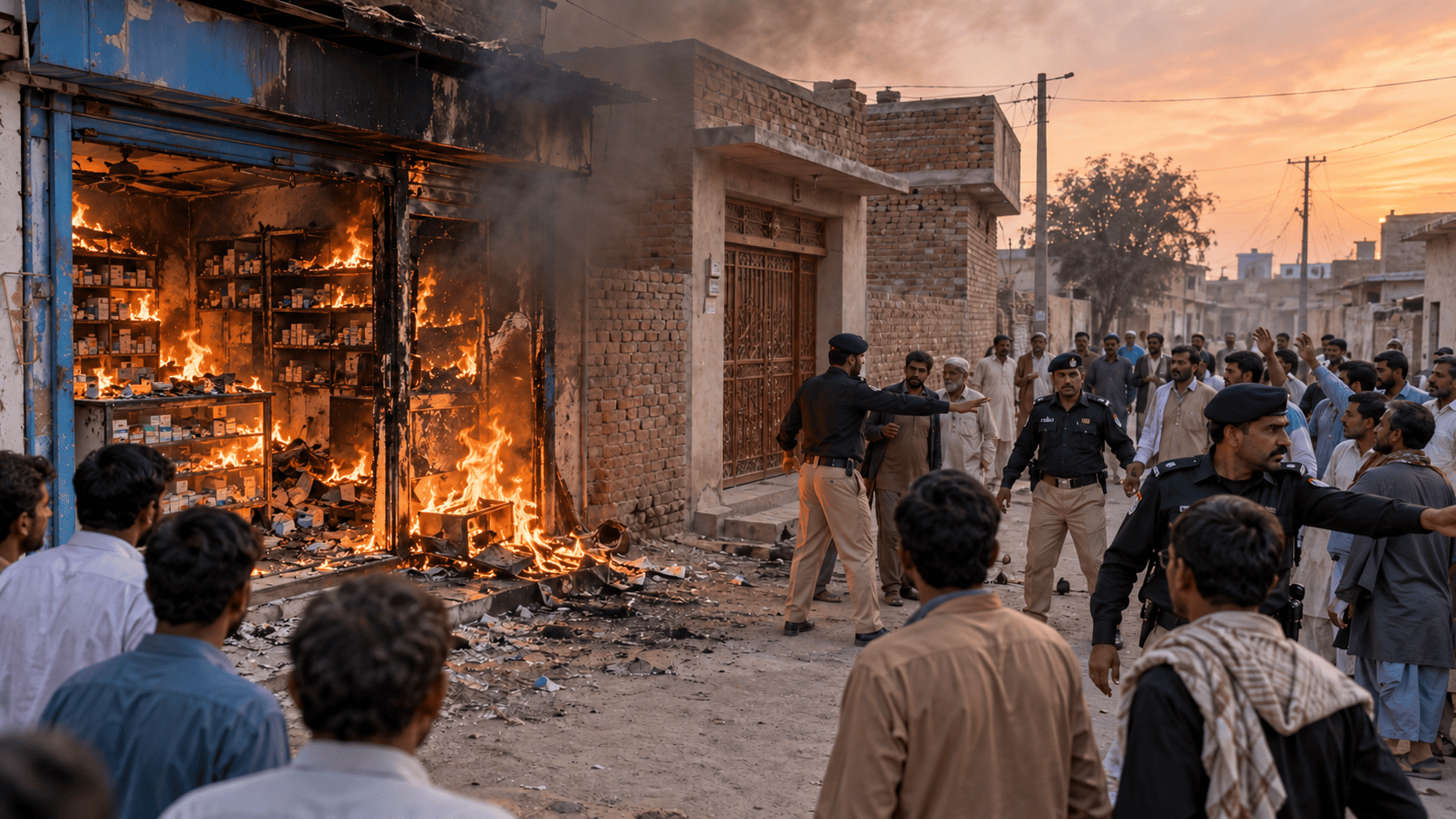
Churches were attacked.
Christian homes were looted and burned.
Families fled.
A Christian cemetery was vandalized.
And within hours, Jaranwala became the site of one of the largest attacks on Pakistan’s Christian community in recent years. Reuters reported that mobs vandalized churches and set scores of Christian homes on fire after accusing two Christians of Quran desecration.
No deaths were reported during the main attack.
That matters.
But the absence of fatalities should not obscure the scale of what happened.
By later official and community counts, more than 20 churches and scores of homes had been damaged or destroyed. AP later reported 26 churches affected, while Punjab officials said nearly 22 churches required government restoration.
Jaranwala demonstrates how quickly an accusation against individuals can become collective punishment against an entire religious community.
The Allegation
On the morning of 16 August 2023, allegations began circulating that two local Christian men had desecrated pages of the Quran.
Reuters reported that police identified the accused as two Christians from Jaranwala and that both men and members of their families fled as tensions escalated.
Associated Press later identified one of the accused as Raja Amir and reported allegations that Quran pages had been torn, marked with insulting words and discarded.
At that stage, these were accusations.
No court had determined guilt.
Yet the allegations spread rapidly through the town.
Mosque Loudspeakers and Public Mobilisation
One of the most serious findings came from the Human Rights Commission of Pakistan.
After conducting a fact-finding mission, HRCP said local Muslim religious leaders had played a role in mobilising crowds and that announcements through mosque loudspeakers contributed to the escalation.
Associated Press also reported allegations that mosque loudspeakers had been used to call people toward the Christian neighbourhoods.
This is a critical point.
Religious leaders have enormous influence during sensitive allegations.
That influence can be used to calm a community.
Or it can accelerate a crisis.
Crowds Moved Toward Christian Areas
As the allegation spread, crowds began moving toward Christian neighbourhoods and churches.
Reuters described a mob attacking the Christian community and burning homes.
Video footage later showed large groups moving through streets, attacking church buildings and destroying property.
Christian residents understood quickly that the danger was no longer limited to the two accused men.
Entire neighbourhoods were becoming targets.
Families Fled Their Homes
Many Christian families escaped before the mobs reached them.
Associated Press reported that residents fled to safer areas while attackers moved through the community.
Some families spent the night:
in fields,
with relatives,
in neighbouring villages,
or in other parts of Faisalabad.
The flight appears to have prevented a much larger loss of life.
But survival came at the price of abandoning homes, possessions and places of worship.
Churches Were Burned and Vandalized
The number of damaged churches varies depending on which stage of assessment is used.
Initial reports mentioned several churches.
Later counts grew significantly.
AP reported that 26 churches were attacked, burned or damaged, based on local Christian leaders.
Punjab officials later said nearly 22 churches were affected and restored through government work.
Wikipedia’s dedicated chronology currently records 26 churches as having been set on fire or damaged during the violence.
Because figures differ slightly, the safest formulation is:
More than 20 churches were attacked, damaged or burned during the Jaranwala violence.
Different Christian Denominations Were Targeted
The attacks were not directed at one denomination.
Churches belonging to different Christian traditions were affected, including:
Catholic,
Presbyterian,
Salvation Army,
and other local congregations.
That matters because the violence was not about a dispute with one particular church.
It was directed toward Christian presence in the area more broadly.
Christian Homes Were Looted and Burned
Homes were also attacked on a large scale.
Punjab government estimates later suggested that close to 100 homes were completely or partially destroyed.
Other humanitarian groups reported higher numbers depending on whether partially damaged properties were included.
Reuters described scores of houses being set on fire.
For affected families, the difference between 90 and 100 houses is secondary.
Each home represented:
savings,
documents,
furniture,
clothing,
school materials,
work equipment,
and family history.
Looting Came Before Fire in Many Homes
Victims reported that attackers did not merely burn buildings.
Property was also looted.
Furniture and belongings were removed.
Household goods were destroyed.
For poor families, that can turn a security crisis into a long-term economic disaster.
A family may survive the attack physically while losing the assets required to survive financially.
Bibles and Religious Objects Were Desecrated
Christian leaders reported destruction of Bibles, crosses and other religious materials during the attacks.
AP documented extensive destruction of churches and Christian property, while broader reporting showed religious objects damaged or burned.
This matters because the original outrage concerned alleged disrespect toward sacred material.
Yet the response itself involved desecration of another community’s sacred places and objects.
That contradiction should not be ignored.
Respect for one religion cannot be defended by destroying another religion’s holy objects.
A Christian Cemetery Was Also Vandalized
Associated Press reported that a Christian graveyard was also desecrated during the violence.
That extends the attack beyond living residents and active churches.
Cemeteries hold:
family memory,
identity,
history,
and dignity for the dead.
Their destruction communicates that even the community’s past is not safe.
No One Was Killed in the Main Attack
Despite the scale of the destruction, there were no reported fatalities during the main Jaranwala rampage.
This is an important fact and should not be exaggerated.
The story is serious enough without inventing deaths.
The absence of fatalities appears largely connected to the fact that residents fled before mobs entered many areas.
That escape should be understood as fortunate—not as proof that the attack was minor.
Local Muslims Also Helped Christian Neighbours
Jaranwala was not simply a story of Muslims attacking Christians.
That would be incomplete.
Reports documented local Muslims sheltering Christian neighbours and attempting to protect their homes.
Some reportedly placed Quranic verses outside Christian homes in an effort to signal to attackers that those houses should not be harmed.
This is one of the most important details for our archive.
A mob does not represent an entire community.
While some people participated in violence, others tried to protect their neighbours.
HRCP Investigated the Attack
The Human Rights Commission of Pakistan sent a fact-finding mission to Jaranwala.
Its findings were serious.
HRCP said there was evidence suggesting that local religious leaders had been involved in mobilising the attacks and raised questions about the adequacy of the police response.
That makes Jaranwala more than a spontaneous riot.
There were warning signs.
There was mobilisation.
And there were opportunities for earlier intervention.
Police Response Came Under Criticism
One of the central questions after the attacks was why police were unable to stop the destruction earlier.
The scale of mobilisation was visible.
Religious announcements were reportedly occurring.
Crowds were moving.
Christian communities were evacuating.
Yet churches and homes were still attacked over a wide area.
This is exactly the type of situation where preventive policing matters most.
Rangers and Additional Police Were Deployed
Once the scale of the crisis became clear, authorities deployed additional police and paramilitary Rangers to Jaranwala.
The situation was eventually brought under control.
Reuters and AP both documented the deployment and restoration of order.
Again, the question is not whether the state eventually responded.
It did.
The question is whether sufficient force could have been mobilised earlier.
More Than 100 Suspects Were Arrested
Authorities began arresting alleged participants quickly.
AP reported 129 arrests the day after the attack.
Within several days, that number had reportedly risen to around 160.
This demonstrated that the government intended to treat the attack as criminal violence rather than legitimate religious action.
The Two Christian Accused Were Also Arrested
Police also arrested the two Christian men accused of desecrating the Quran.
This is important.
The state pursued:
the original blasphemy allegation,
and
the mob violence
as separate legal matters.
That is how a justice system should operate.
An accusation against two people does not excuse criminal violence by others.
One Accused Man Was Later Sentenced to Death
The legal case concerning the original blasphemy accusation continued after the riots.
In April 2025, an anti-terrorism court sentenced one Christian defendant to death under Pakistan’s blasphemy provisions and imposed an additional prison term and fine. The defendant’s lawyer announced an appeal.
This development is important because the Jaranwala story should not be simplified into:
“The allegation was proven false.”
The judicial process concerning the alleged desecration produced a conviction against one defendant at trial level.
That conviction is subject to appeal.
Our archive should therefore use careful wording:
The allegations triggered the attacks before any court had determined guilt. A trial court later convicted one of the accused men, whose lawyer announced an appeal.
Even a Later Conviction Cannot Justify the Mob
This distinction is fundamental.
Suppose a court eventually convicts someone.
That does not retroactively legalize:
burning a neighbour’s house,
destroying churches,
looting shops,
or vandalizing a cemetery.
Criminal responsibility remains individual.
If one man commits a crime, prosecute that man.
His entire religious community does not become guilty.
The Government Promised Compensation
The Punjab government announced compensation for affected Christian families.
The official figure was Rs2 million for each household whose home was destroyed or seriously damaged. The decision was publicly announced after a cabinet meeting held in Jaranwala.
Caretaker Prime Minister Anwaar-ul-Haq Kakar later visited Jaranwala and personally distributed compensation to affected families.
Nearly 100 Families Received Compensation
AP reported that nearly 100 Christian families received Rs2 million each in compensation.
This was a significant state response.
Money cannot replace everything lost.
But compensation recognizes that the state has a responsibility toward citizens whose homes were destroyed in communal violence.
Not Every Family Said It Received Compensation
Later Amnesty International research found that some affected residents said they had not received the compensation they had been promised.
That illustrates another important lesson.
Announcing relief is different from ensuring that every eligible family actually receives it.
Human-rights recovery requires:
transparent eligibility,
documentation,
appeal mechanisms,
and follow-up.
Churches Were Repaired
The Punjab government also financed restoration of damaged churches.
By October 2023, Faisalabad officials said over 20 churches had been repaired, with more than Rs124 million spent on restoration.
This was a visible sign that the state rejected the attempt to erase Christian places of worship.
Some Community Leaders Questioned the Quality of Repairs
Not everyone was satisfied.
Christian leaders told AP that some repairs appeared superficial, with damaged structures painted rather than fully reconstructed.
That is also worth recording.
Reconstruction should not be evaluated only by whether a building looks repaired from outside.
Places of worship must also be:
structurally safe,
usable,
and adequately restored.
Prime Minister Kakar Condemned the Violence
Caretaker Prime Minister Anwaar-ul-Haq Kakar publicly condemned those responsible and pledged protection for Pakistan’s minorities.
During his Jaranwala visit, he said the state would protect Christians, Hindus, Sikhs and Ahmadis and promised accountability for attackers.
This is a strong example of the balanced position SFFP should maintain.
We can document a severe failure of protection while also documenting the state’s public rejection of the violence.
Chief Justice Qazi Faez Isa Visited Jaranwala
Then–Supreme Court judge Justice Qazi Faez Isa, who later became Chief Justice of Pakistan, visited Jaranwala after the attacks to express solidarity with the Christian community.
That visit became another important institutional gesture.
The message was that minority citizens were entitled to constitutional protection and dignity.
Justice Became the Next Question
Once homes were repaired and media attention faded, a harder question remained:
Would the people responsible actually be punished?
Amnesty International reported on the first anniversary that the Christian community was still waiting for meaningful accountability.
Many suspects had been arrested.
But arrests are only the beginning of a criminal case.
Amnesty Found Serious Accountability Gaps
In its August 2024 assessment, Amnesty International said that justice remained incomplete one year after the attack.
The organization reported that many suspects had received bail or had not been effectively prosecuted and that affected Christians continued to feel unsafe.
This exposes a recurring problem in mass-mob cases.
Large numbers can be arrested immediately.
Proving individual responsibility months or years later is much harder.
Ten Defendants Were Acquitted in One Church-Arson Case
In June 2025, an anti-terrorism court acquitted 10 defendants in a case concerning the burning of a church near Jaranwala.
That should not automatically be read as proof that the attack did not occur.
It means the prosecution did not establish guilt against those specific individuals to the court’s satisfaction.
Again:
A crime may be obvious.
Individual criminal responsibility still requires proof.
By 2026, Supreme Court Was Still Pushing the Cases Forward
The justice process had not fully concluded.
In March 2026, Pakistan’s Supreme Court reportedly directed that the trial concerning the Jaranwala violence be completed within six months.
That means almost three years after the attacks, key proceedings were still ongoing.
This is one of the most important updates for SFFP’s article.
The history is not yet legally finished.
Delayed Accountability Weakens Confidence
For victims, a criminal case lasting years can feel like another form of uncertainty.
Churches may be rebuilt.
Homes may be repaired.
But if people who participated in the violence are perceived to face no consequences, communities may continue to fear repetition.
Accountability is therefore not only about punishment.
It is about deterrence and trust.
Jaranwala Was Collective Punishment
At the centre of the case is a simple principle.
Two Christian men were accused.
Yet churches across Jaranwala were attacked.
Families unrelated to the allegation lost homes.
Christian graves were vandalized.
People who had never met the accused were forced to flee.
That is collective punishment.
And collective punishment is incompatible with individual criminal responsibility.
A Church Cannot Commit Blasphemy
This point should be stated directly.
A church building cannot be guilty of blasphemy.
A Christian child cannot inherit responsibility for an accusation against another person.
A neighbour cannot become guilty because they share the same religion.
The moment punishment moves from an accused individual to an entire religious community, justice has ended.
Religious Freedom Is Tested When Emotions Are High
Freedom of religion is easy to defend when no one is angry.
The real test comes during controversy.
A state committed to religious freedom must be capable of protecting:
an accused person,
their family,
their neighbours,
and their places of worship
even when public emotions are intense.
That is when constitutional protection matters most.
Police must secure nearby places of worship before crowds mobilize.
Religious announcements that may incite violence need rapid intervention.
Video and mobile evidence should be preserved from the first hours.
Families fleeing danger need organized emergency shelter.
Compensation systems need transparent follow-up.
Mob prosecutions need strong forensic investigation.
And religious leaders who promote peace should be engaged before violence begins.
Most importantly:
An accusation against individuals must never become punishment for a community.
The Goal Is Not to Hide Pakistan’s Problems
Responsible patriotism does not require pretending that Jaranwala never happened.
Nor does human-rights advocacy require portraying Pakistan as uniquely hateful.
The stronger position is to document:
what failed,
what worked afterward,
what remains unresolved,
and what should change.
That allows criticism without hostility.
It also gives institutions credit when they respond correctly.
Protecting Minorities Strengthens Pakistan
Christians are part of Pakistan.
Their churches are part of Pakistan.
Their homes are part of Pakistan.
Their cemeteries are part of Pakistan.
Protecting them is not an international favour.
It is a domestic obligation of equal citizenship.
At SFFP, that is why we continue to say:
Minority rights are Pakistani rights.
Help Us Advance Freedom, Dignity and Opportunity
Samaritan’s Fellowship Foundation builds integrated, community-led ecosystems that empower marginalized communities through human rights, healthcare, education, clean water, sustainable livelihoods and local leadership.
We believe every allegation should be investigated through law, every place of worship should be protected, and no family should lose its home because of someone else’s accusation.
If you believe minority communities should be safe before violence happens—not only compensated afterward:
Together, we can strengthen communities where freedom, dignity, equal citizenship and opportunity belong to everyone.
Empowerment Beyond Aid — Advancing Freedom and Rights.
Editorial Note
Samaritan’s Fellowship Foundation documents publicly reported human-rights cases for education, historical record and awareness.
The Jaranwala violence began after allegations that two Christian men had desecrated Quranic material. Those allegations had not been judicially determined when mobs attacked Christian homes and churches on 16 August 2023.
A trial court later convicted one Christian defendant in connection with the alleged blasphemy and sentenced him to death in April 2025; his lawyer announced an appeal. This article therefore does not describe the original allegations as conclusively false or conclusively proven.
Estimates of property damage vary. Reliable sources document more than 20 churches and scores of Christian homes damaged, burned or destroyed.
Pakistan’s federal and Punjab governments condemned the violence, deployed security forces, arrested large numbers of suspects, paid compensation to many affected families and funded church restoration. However, Amnesty International and Christian community representatives have continued to raise concerns about incomplete accountability.
As of 2026, proceedings connected to the mob violence remained active, with Pakistan’s Supreme Court directing that a relevant trial be concluded within six months.
SFFP does not attribute the actions of the mobs or individual religious leaders to Islam, Muslims generally or the people of Pakistan.
We support peaceful coexistence, freedom of religion, lawful prosecution, effective policing, due process and equal dignity for every citizen.
References
1. Reuters — Pakistani Christian Community Attacked After Blasphemy Accusation, 16 August 2023
Contemporary report documenting the allegation against two Christians, attacks on churches and the burning of Christian homes.