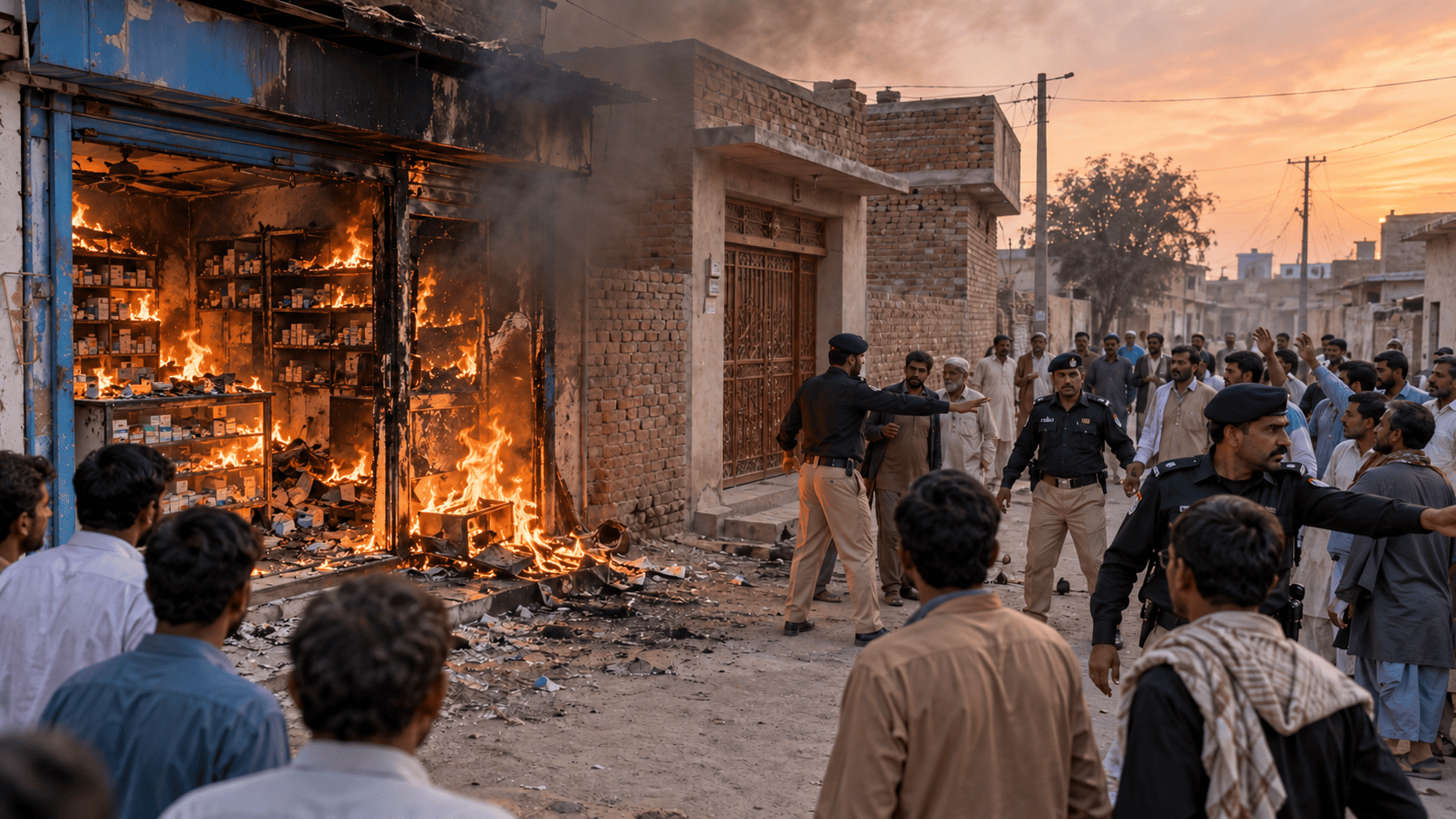
Gojra, Punjab | 1 August 2009
A rumor. An allegation that Christians had desecrated pages of the Quran. A crowd gathering. Homes set on fire. Families trapped. People burned to death.
The Gojra violence of August 2009 became one of the most widely reported attacks on Christians in Pakistan linked to a blasphemy allegation. Reuters reported at the time that Christian homes were torched after unsubstantiated allegations that members of the community had desecrated the Quran.
Later accounts differ on the exact death toll, but all agree on the central fact: Multiple Christians were killed, dozens were injured, and scores of homes were burned after an allegation that authorities themselves later said had not been proven.
The Allegation Began Before the Attack
The violence did not begin in Gojra itself. Reports of alleged Quran desecration first emerged from a nearby village following a Christian wedding ceremony.
The allegation was that several Christians had desecrated papers bearing Quranic verses. Police registered a case under Pakistan’s blasphemy provisions against named Christian residents. But at the time of the attack, guilt had not been established in court. The accusation nevertheless spread quickly through the area.
Rumour Became Mobilisation
Religious announcements and word-of-mouth helped turn the allegation into a public mobilization. Crowds began gathering in and around Gojra. Reuters reported that Christian residents feared violence after the accusations spread, and that militants or hardline religious activists were believed to have played a role in inciting the crowd. The situation escalated rapidly.
What had begun as a disputed allegation involving particular individuals was turning into collective anger against an entire Christian neighbourhood.
Christian Homes Were Attacked
On 1 August 2009, mobs entered a Christian locality in Gojra. Homes were looted. Buildings were set on fire. Television footage and later reporting showed burned houses, destroyed household belongings and streets filled with debris.
Later summaries generally report that dozens of Christian homes were burned. Associated Press later referred to the Gojra attack as one in which roughly 60 homes were burned. Wikipedia’s chronology cites around 40 houses and a church set ablaze. Because contemporary counts vary, the safest statement is: Dozens of Christian homes and at least one church were burned or destroyed.
People Died Inside Burning Homes
The most devastating part of Gojra was not the destruction of property. It was the loss of life. Reuters reported six Christians burned alive in the violence. Later accounts cited seven or eight Christian deaths, depending on the source and whether later fatalities were included.
Wikipedia’s historical summary lists eight Christian fatalities and 18 injuries. Associated Press later referred to six Christians killed in Gojra. Because casualty counts differ slightly, this article does not present one disputed number as absolute. What is beyond dispute is that Christians died in the fires and many others were injured.
A Child Was Among the Victims
Historical records identify children among those killed. Wikipedia’s summary names Musa, aged seven, among the victims.
This detail matters because communal violence rarely remains confined to the people originally accused. Children do not choose legal disputes. They do not file complaints. They do not control rumors. Yet they can become victims when an entire neighborhood is treated as responsible for the alleged actions of a few.
The Violence Was Collective, Not Individual
Even if a court had later established that one or more individuals had committed an offence, burning the homes of unrelated families would still have been unlawful.
- Criminal responsibility is individual.
- A family cannot be punished for the allegation against its neighbor.
- A church cannot be punished for the actions of one resident.
- A child cannot inherit criminal responsibility from an adult.
The Gojra violence represented collective punishment outside the law.
Authorities Later Said There Was No Proof of Desecration
One of the most important developments came after the violence. Punjab Law Minister Rana Sanaullah publicly stated that a preliminary investigation had found no desecration of the Quran and described the incident as a rumor exploited to create chaos. Reuters likewise reported officials saying there was no proof of blasphemy.
That fact dramatically changes how the attack must be understood.
- People had already died.
- Homes had already burned.
- Families had already lost everything.
- And only afterward did authorities publicly say the allegation had not been substantiated.
The State Responded After the Violence
The government condemned the attacks. President Asif Ali Zardari expressed concern and directed the federal minister for minorities to remain in Gojra and help stabilize the situation. Punjab Chief Minister Shahbaz Sharif visited Gojra, condemned the violence and announced support for affected families.
- Pakistan Rangers were deployed to restore order.
- Police also registered cases against hundreds of suspects.
- These actions matter.
- The violence should not be interpreted as the official policy of Pakistan.
- The attack was condemned by state institutions.
The question was whether accountability and prevention would be strong enough afterward.
Minority Affairs Minister Shahbaz Bhatti Became Involved
Federal Minister for Minorities Shahbaz Bhatti played a visible role after the Gojra attacks. According to contemporary and later reports, he remained involved with affected Christian families and called for stronger action against those responsible. He also publicly linked the violence to extremist networks. Two years later, Shahbaz Bhatti himself would be assassinated after speaking publicly about minority rights and blasphemy-law reform. That later story belongs to this same historical trajectory.
Questions Were Raised About Police Inaction
Christian residents and human-rights advocates alleged that police did not act quickly or effectively enough while the crowd was gathering and attacking homes. Wikipedia’s chronology records resident allegations that police stood aside while the mob rampaged. This issue matters because mass violence is rarely spontaneous in its final form.
There is often a period when: crowds gather, rumors spread, weapons appear, threats become visible, and authorities still have time to intervene. Those first hours can determine whether an allegation reaches a courtroom or becomes a massacre.
Accountability Became Difficult
Police registered cases against large numbers of people after the attacks. But mass-mob cases are notoriously difficult to prosecute.
- Witnesses may fear retaliation.
- Identifying individual attackers inside large crowds can be difficult.
- Political and religious pressure may affect testimony.
- And communities may lose confidence in the process if justice takes too long.
That is why prevention is so important. Once hundreds of people participate in violence, accountability becomes much harder than preventing the mobilization in the first place.
Christian Schools Closed in Protest
Following the killings, Christian schools across Pakistan reportedly closed temporarily in mourning and protest. Reuters reported that Christian institutions shut their doors after the Gojra violence. The protest reflected a wider fear: Gojra was not being experienced as an isolated local dispute. It was being seen as a warning to minority communities across the country.
Why Gojra Became a National Symbol
Gojra became significant because it showed how rapidly a blasphemy allegation could move through several stages:
Allegation → religious mobilization → mob violence → deaths → government intervention.
The order matters. By the time the state intervened fully, lives had already been lost. That is why the real lesson from Gojra is not simply that authorities should punish attackers afterward. It is that the system must be able to act before violence begins.
A Rumour Should Never Be Stronger Than an Investigation
The most disturbing element of Gojra is that authorities later said they found no proof supporting the original allegation. That means the violence ran ahead of the facts. This is precisely why religiously sensitive accusations need: rapid investigation, controlled public communication, police protection, and responsible religious leadership.
A rumor can spread in minutes. A legal investigation takes longer. The challenge is ensuring that the rumor does not destroy lives before the facts are known.
The Universal Declaration of Human Rights
The Gojra violence directly concerns principles contained in the Universal Declaration of Human Rights. These include:
- the right to life and security;
- equality before the law;
- freedom of religion and belief;
- protection of home and property;
- and the right to live without discrimination.
The victims were not only people who had been accused. Most were ordinary residents of a Christian neighborhood. Their religious identity became the reason they were targeted.
Minority Rights Are Pakistani Rights
- The Christian families of Gojra were Pakistani families.
- Their houses were Pakistani homes.
- Their children were Pakistani children.
- Their churches stood on Pakistani soil.
Protecting them was therefore not about giving special treatment to a minority. It was about equal citizenship.
At Samaritan’s Fellowship Foundation, this is the principle behind our Human Rights & Empowerment work. Minority rights are not foreign rights. They are Pakistani rights.
Why Recovery Requires More Than Compensation
When a family loses its home in communal violence, the crisis does not end when the fire is extinguished. The family may lose housing, income, documents, school materials, medical supplies, and access to community networks. Fear can also force families to relocate permanently.
That is why SFFP works through an integrated model. Through StartFish, marginalized families can build sustainable livelihoods and greater economic independence. Through Set Them Free, families affected by exploitation receive pathways toward freedom and reintegration. And through How We Work, rights, recovery, sustainable development and local leadership become part of one ecosystem. Because rebuilding a house is not enough. People also need to rebuild their future.
What Should Pakistan Learn From Gojra?
Gojra offers several practical lessons.
- Blasphemy allegations require immediate investigation.
- Police must protect both the accused and surrounding communities.
- Mosque announcements or public calls capable of mobilising violence must be handled responsibly and lawfully.
- Religious leaders should publicly reject collective punishment.
- Government officials must act before crowds become uncontrollable.
- And when allegations prove false or unsubstantiated, that fact should be communicated clearly.
The strongest defence against mob violence is a credible state that acts early.
Human Rights Also Protect Religious Harmony
Human-rights advocacy is sometimes presented as if it threatens religion. Gojra demonstrates the opposite. Rule of law protects religious harmony. If accusations are investigated through institutions rather than mobs, communities are less likely to turn against one another. If people know that police and courts will respond fairly, they are less likely to seek private punishment. And if leaders reject collective blame, neighbors are more likely to remain neighbors.
Help Us Advance Freedom, Dignity and Opportunity
Samaritan’s Fellowship Foundation builds integrated, community-led ecosystems that empower marginalized communities through human rights, healthcare, education, clean water, sustainable livelihoods and local leadership.
We believe human rights must become practical protection in everyday life.
If you believe no family should lose a child, a home or a future because of an allegation that has not been proven:
Your support helps us strengthen communities, expand opportunity and build pathways from vulnerability to resilience. Empowerment Beyond Aid — Advancing Freedom and Rights.
Editorial Note
Samaritan’s Fellowship Foundation documents publicly reported human-rights cases for education, historical record and awareness.
Historical sources differ on the exact number of people killed and homes destroyed in Gojra. This article therefore attributes specific figures rather than presenting a disputed count as definitive.
The blasphemy claims described here were allegations. Reuters reported them as unsubstantiated, and Punjab officials later stated that a preliminary investigation found no evidence of Quran desecration.
SFFP does not attribute the actions of individual attackers, extremist groups or mobs to an entire religion, community or the people of Pakistan. We support peaceful coexistence, due process, constitutional protections and equal dignity for all citizens.
References
- Reuters — Pakistani Christians Shutter Schools Over Killings, 3 August 2009 Contemporary Reuters reporting stating that Christian homes were torched following unsubstantiated allegations of Quran desecration and noting officials’ statements that there was no proof of blasphemy. https://www.reuters.com/article/2009/08/03/us-pakistan-christians-sb-idUSTRE5721JI20090803/ .
- Wikipedia — 2009 Gojra Riots Detailed chronology covering the allegations, attacks, fatalities, homes burned, injuries, government response, police cases and statements by Punjab officials that preliminary investigation found no Quran desecration. https://en.wikipedia.org/wiki/2009_Gojra_riots
- Associated Press — Later Jaranwala Reporting Referencing Gojra AP’s retrospective description of Gojra states that six Christians were killed and around 60 homes were burned following allegations of insults to Islam. https://apnews.com/article/bc671037bdd389af6b67e0292cc18582
- Dawn — Attacks on Christians in Punjab in Over a Decade Pakistani historical overview placing Gojra among major attacks on Christian communities in Punjab. https://www.dawn.com/news/1169844
- Amnesty International — The Impact of the Blasphemy Laws in Pakistan Amnesty’s later detailed report includes Gojra in its discussion of violence surrounding blasphemy allegations and contains historical imagery from the 2009 attack. https://d21zrvtkxtd6ae.cloudfront.net/public/uploads/2016/12/20184448/Blasphemy-Report-FINAL-VERSION-201216.pdf
- USCIRF — Pakistan: A Human Rights Update Background on violence and abuses connected to Pakistan’s blasphemy framework and risks faced by religious minorities. https://www.uscirf.gov/resources/pakistan-human-rights-update
- Anglican Communion News Service — Marking Gojra: A Year On Retrospective on the Gojra attack and its significance for Christian communities and interfaith relations. https://www.anglicannews.org/news/2010/08/marking-gojra-a-year-on.aspx
- Wikipedia — Persecution of Christians in Pakistan Broader background on attacks affecting Christian communities, including Gojra. https://en.wikipedia.org/wiki/Persecution_of_Christians_in_Pakistan
- Picture used for Illustration