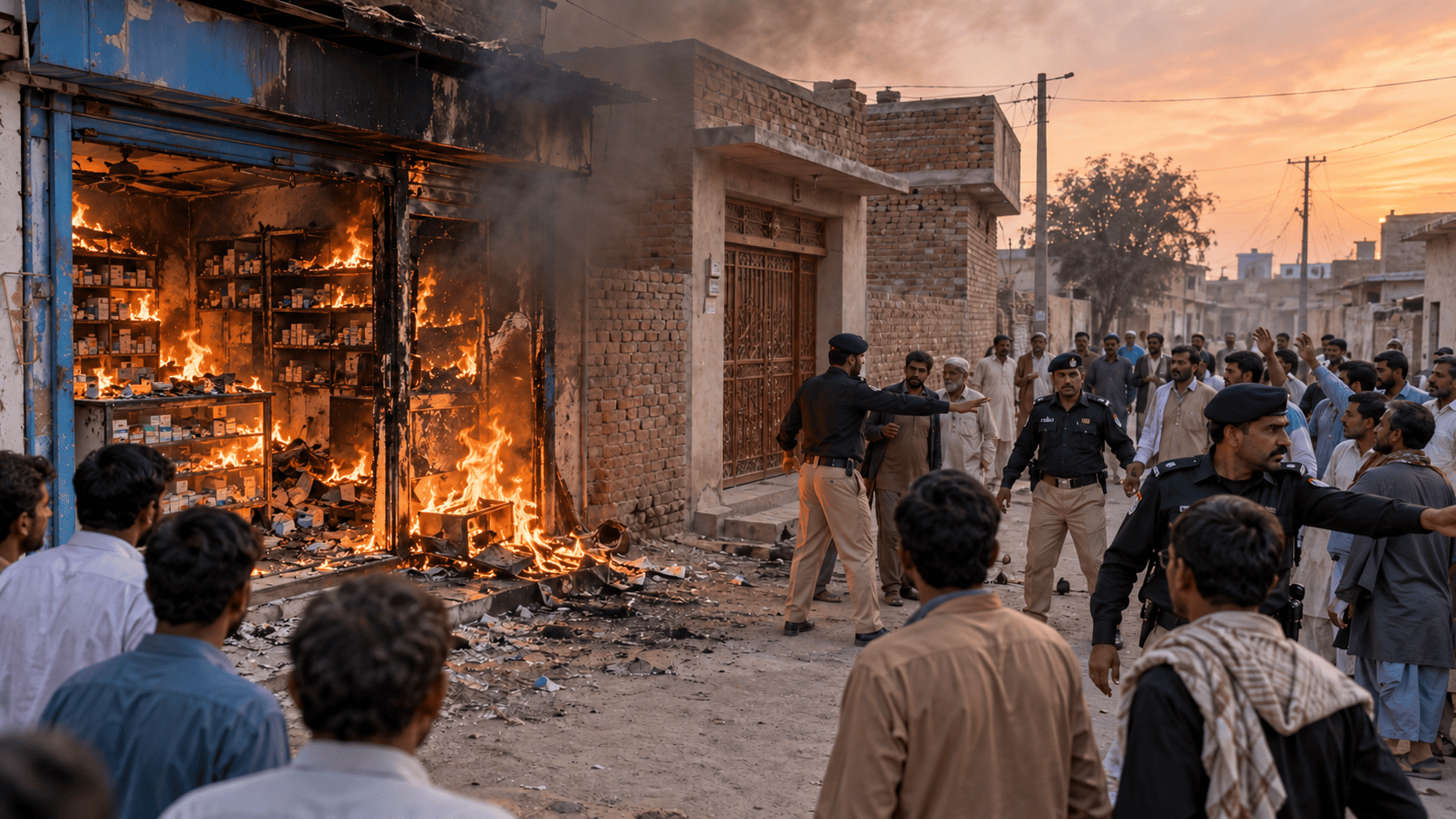
Punjab, Pakistan | October 2025–February 2026
Sexual harassment, rape and child abuse are grave crimes. Survivors deserve immediate protection, professional investigation and justice through courts empowered to impose the penalties prescribed by law.
But public anger at an alleged crime cannot replace evidence, investigation and trial.
In October 2025, human-rights journalism platform Voicepk reported a developing pattern involving Punjab’s Crime Control Department. Several suspects accused of sexual assault or harassment had reportedly sustained gunshot injuries to their genital areas during arrest operations.
In each reported case, authorities offered a broadly similar explanation: the suspect attempted to escape or resist arrest, reached for a weapon, and was injured when his own pistol discharged.
Any one such incident might be possible. When very similar injuries occur repeatedly under similar circumstances, however, legitimate questions arise. Were the shootings accidental? Was police force used? Was evidence independently examined? Were the weapons tested? Were witnesses interviewed? Did a magistrate or external authority investigate what occurred?
These questions do not defend sexual offenders. They defend the rule of law.
A person accused of a horrific crime must be lawfully arrested, investigated and prosecuted. If convicted, that person must face the punishment provided by law. But police officers cannot become investigators, judges and punishers at the same time.
The Crime Control Department’s Mandate
The Punjab government approved the establishment of the Crime Control Department in February 2025. It was formally constituted in April and incorporated into the province’s policing framework through amendments to the Police Order in May 2025.
The department was presented as a specialized force created to confront serious and organized crime and support the government’s “Safe Punjab” objectives.
Pakistan needs effective, professional and properly resourced law enforcement. Communities living under threats from organized crime, robbery, kidnapping, sexual violence and armed groups have a right to safety.
The debate surrounding the CCD is therefore not about whether serious crime should be confronted. It should.
The question is whether crime-control operations remain subject to the Constitution, criminal procedure, judicial supervision and independent accountability.
Law-enforcement effectiveness and human rights are not opposing objectives. Police institutions become stronger when their actions are lawful, evidence-based and trusted by the public.
A Series of Remarkably Similar Incidents
On 8 October 2025, Voicepk documented several incidents involving suspects accused of sexual offences or harassment.
The report described a case in Chunian, Kasur, involving a mosque cleric accused of attempting to sexually assault a 12-year-old seminary student.
According to the FIR described by Voicepk, the child attended Quran lessons at a local mosque. The complainant alleged that the cleric asked the child to remain behind after the other students had left and then attempted to assault him.
The child reportedly resisted, escaped and returned home in distress before informing his parents. His father subsequently approached the police, and a case was registered under a provision of the Pakistan Penal Code relating to sexual assault against a minor.
The allegation against the cleric was extremely serious and required an urgent, child-sensitive criminal investigation.
When police attempted to arrest the suspect, however, the official account stated that he tried to flee, pulled a pistol from his waistband and was injured in the genital area when the weapon accidentally discharged.
He was taken into custody in an injured condition and transported to a hospital.
Voicepk reported that this was not an isolated occurrence.
A Similar Account From Lahore
The same report described an incident in Lahore’s Ravi Road area on 6 October 2025.
A man accused of harassing and assaulting a woman was reportedly injured while police were taking him into custody.
Once again, the reported explanation was that the suspect’s own pistol discharged. Once again, the resulting gunshot injury affected his genital area.
Sexual harassment and assault must never be minimized. Women should be able to use streets, workplaces, educational institutions and public spaces without intimidation or violence.
But allegations of harassment must lead to lawful arrest, evidence collection and trial—not an unofficial punishment whose circumstances have not been independently established.
Another Reported Incident in Gujranwala
Voicepk also referred to an incident reported on 5 October 2025 in Gujranwala’s Satellite Town area.
A man had reportedly been captured on CCTV harassing women in the street. During an attempted arrest by the CCD, he was again reported to have sustained a gunshot injury to his genital area after his own weapon allegedly discharged.
CCTV evidence of harassment can be important evidence in a criminal case. It may assist investigators in identifying a suspect and prosecutors in establishing the alleged conduct before a court.
However, video evidence of the underlying alleged offence does not answer what happened later during the arrest.
Two different matters must be independently examined:
- Did the suspect commit the alleged harassment or sexual offence?
- Was the arrest conducted lawfully, and how did the suspect sustain the reported injury?
Evidence supporting the first allegation cannot automatically establish the official explanation for the second incident.
Similarity Does Not Prove Misconduct—but It Requires Scrutiny
Samaritan’s Fellowship Foundation Pakistan does not claim, without an independent investigation or judicial finding, that CCD officers deliberately inflicted these injuries.
The publicly available reporting does not allow SFFP to determine exactly what occurred during each arrest.
However, the similarity of the reported circumstances creates legitimate public-interest questions.
When multiple suspects:
- are accused of similar categories of offences,
- allegedly attempt to escape during arrest,
- reportedly carry pistols in comparable positions,
- are said to be injured by their own weapons,
- and sustain injuries to the same area of the body,
authorities should not expect repeated official statements alone to resolve public concern.
Independent verification is necessary to protect the rights of suspects, the credibility of investigators and the reputation of police officers who perform their duties lawfully.
If forensic evidence confirms the official versions, transparent investigations can help establish that conclusion. If the evidence contradicts those versions, those responsible must be held accountable.
Either way, independent scrutiny serves justice.
Wider Concerns About CCD Encounters
Concerns surrounding these specific injury reports exist within a much wider debate about CCD-led encounters across Punjab.
In February 2026, the Human Rights Commission of Pakistan published a fact-finding report examining the CCD’s role in the province.
HRCP stated that, based on press reports compiled through its knowledge-management system, it had documented at least 670 CCD-led encounters between 15 April and 15 December 2025.
According to the commission, these reported encounters resulted in the deaths of 924 suspects. During the same period, two police personnel were reportedly killed and 36 injured.
These figures are based on media reporting and should be understood within that limitation. Nevertheless, their scale, the disparity between civilian and police casualties and the similarity of official accounts led HRCP to examine whether encounter practices were complying with law.
HRCP said that the frequency of incidents—averaging more than two per day during the documented period—had raised concerns among journalists, lawyers, affected families and human-rights advocates.
The commission concluded that sustainable public safety could not be achieved through lethal shortcuts that bypass investigation, prosecution and judicial accountability.
CCD Has Denied Extrajudicial-Killing Allegations
Fair reporting requires the official position to be included.
The CCD has denied allegations that it carries out extrajudicial killings and has challenged critics to provide evidence supporting such claims.
Police accounts of encounter incidents commonly state that officers acted in self-defence or that suspects were struck by gunfire from their own associates during exchanges of fire.
Law-enforcement personnel may encounter genuinely dangerous situations. Armed suspects can resist arrest, attack officers or place members of the public at immediate risk. In such circumstances, police may lawfully use necessary and proportionate force to protect life.
The existence of disputed encounters does not mean that every encounter is staged or that every use of police force is unlawful.
But the police institution involved in an operation should not be the only institution responsible for determining whether its own use of force was lawful.
Independent investigation protects police officers from false allegations just as it protects citizens from abuse.
Questions About Independent Investigation
HRCP reported that it sought official data from the Punjab Police and CCD concerning:
- the number of encounters conducted,
- the number of suspects killed,
- procedures followed after the incidents,
- investigations into police use of force,
- and the existence of judicial or magisterial oversight.
The commission stated that it did not receive the information it requested before completing its report.
HRCP also reviewed samples of FIRs and police statements. It reported finding repeated similarities in descriptions of suspects being taken for the recovery of weapons or accomplices before armed associates allegedly attacked police teams.
According to the commission, the textual similarity between some FIRs and press statements raised questions about whether incident-specific, independent accounts were being prepared.
These findings represent HRCP’s assessment and should not be treated as judicial determinations against every officer or operation.
They do, however, strengthen the case for independent investigations that include forensic evidence rather than relying only on accounts produced by the same operational chain of command.
What Should Be Examined After a Disputed Shooting?
Every disputed police shooting should trigger a clear and credible process.
That process should examine:
- The identity and role of every officer present
- The original basis for arresting the suspect
- Whether the arrest was properly documented
- The time and location of the operation
- CCTV, body-camera and mobile-phone recordings
- The number and direction of shots fired
- The weapon from which each bullet was discharged
- Fingerprints and DNA recovered from weapons
- Gunshot residue on the suspect and relevant officers
- Ballistic examination of bullets and cartridge cases
- Medical evidence concerning the angle and distance of fire
- Statements from independent witnesses
- Police vehicle and station records
- Communications among participating officers
- Whether the suspect had previously been in police custody
- Whether a magistrate was immediately informed
- Whether the investigating officers were institutionally independent
An official narrative should be the beginning of an investigation—not its conclusion.
Sexual Violence Must Be Punished Through Law
Questioning the legality of an arrest does not minimize the suffering of survivors.
Sexual violence can cause severe and lasting physical, psychological and social harm. Children subjected to sexual abuse require immediate protection, sensitive medical care, trauma-informed interviewing and long-term support.
Women facing street harassment should not be expected to change their routes, clothing, education or employment to avoid offenders. The state has a responsibility to make public spaces safer and ensure that complaints receive serious attention.
Investigations into sexual offences should be:
- prompt,
- survivor-centred,
- confidential,
- professionally conducted,
- supported by forensic evidence,
- protected from political or social pressure,
- and brought before competent courts without unnecessary delay.
Extrajudicial punishment does not strengthen justice for survivors. It can damage the prosecution itself.
If a suspect is unlawfully injured, evidence may be challenged, official credibility weakened and attention diverted from the original offence. The survivor may then be left with public spectacle instead of a reliable conviction.
Justice requires a process capable of establishing the truth.
Public Approval Cannot Make Unlawful Violence Legal
People may feel satisfaction when someone accused of a cruel offence appears to suffer immediate punishment.
That reaction is understandable, particularly in a society where survivors often wait years for justice and conviction rates remain low.
But public anger cannot become a parallel criminal-justice system.
If police are permitted to punish people because an allegation is emotionally powerful or publicly unpopular, there is no principled limit on who may be punished next.
Today, the person may be accused of harassment. Tomorrow, someone may be targeted because of a false complaint, personal dispute, political pressure, mistaken identity or unverified social-media allegation.
Due process is not designed only for innocent people. It is the method through which guilt is reliably determined.
A system that bypasses courts because the accused appears undeserving of rights ultimately weakens the protection of everyone.
The Constitutional Principle of Equal Treatment
Pakistan’s Constitution recognizes the right of every person to be treated in accordance with law.
The principles relevant to these cases include:
- protection of life and liberty,
- dignity of the person,
- safeguards relating to arrest and detention,
- the right to a fair trial and due process,
- equality before the law,
- and equal protection of the law.
These constitutional protections are also connected to the rights set out in the Universal Declaration of Human Rights, including:
- the right to life, liberty and security,
- freedom from torture or cruel, inhuman or degrading treatment,
- recognition as a person before the law,
- equality before the law,
- access to an effective remedy,
- freedom from arbitrary arrest or detention,
- a fair and public hearing,
- and the presumption of innocence.
These protections do not prevent the state from arresting dangerous suspects. They define how a lawful state distinguishes justice from revenge.
Police Officers Must Also Be Protected by Clear Rules
Accountable policing protects officers as well as citizens.
Police personnel may be required to make urgent decisions in dangerous environments. Clear use-of-force rules, operational training, body-worn cameras and independent investigations help establish when an officer acted lawfully.
Without reliable documentation, an officer who acted in genuine self-defence may face public suspicion. At the same time, an officer who used unlawful force may be protected by institutional uncertainty.
Both outcomes damage the police service.
Transparent evidence allows courts, oversight bodies and the public to distinguish between:
- lawful self-defence,
- an accidental discharge,
- negligent use of a firearm,
- disproportionate force,
- torture,
- and a staged encounter.
Professional police officers should not be expected to work within a system where truth depends on institutional loyalty or public speculation.
Equal Accountability Must Apply to Government Officials
The rule of law cannot operate through separate standards for citizens and state officials.
If an ordinary citizen is accused of sexual harassment, the allegation must be investigated and tried according to law.
If a police officer is accused of sexual harassment, custodial violence, torture or an unlawful shooting, that allegation must be investigated according to the same standard.
Departmental suspension is not equivalent to criminal accountability. Nor should institutional affiliation shield an official from evidence-based prosecution.
At the same time, police officers must not be presumed guilty merely because they were present during a disputed operation.
Equal justice requires the same essentials in every case:
- independent investigation,
- preservation of evidence,
- protection of witnesses,
- due process for the accused,
- and determination by a competent court.
No civilian should be subjected to unofficial punishment. No government official should receive unofficial immunity.
The Death of Hania Ahmed Demonstrated the Risks
The need for strict use-of-force safeguards was further illustrated in June 2026, when nine-year-old Hania Ahmed, an Australian Pakistani child, was killed during a CCD response to an armed robbery in Chakwal.
According to police reporting, armed robbers had stopped the family’s vehicle. During the confrontation, a CCD officer allegedly misidentified the family’s vehicle as belonging to escaping suspects and opened fire.
Hania was killed, while her father and ten-year-old brother were seriously wounded.
In that case, police suspended and arrested the officer, registered a murder case and secured the weapon and spent cartridges for forensic examination. The CCD described the officer’s conduct as a grave departure from its procedures and legal standards.
The action taken in Hania’s case demonstrates that police use of force can and must be investigated through criminal and judicial processes.
It also reinforces a larger principle: firearm decisions made within seconds can permanently destroy innocent lives. Training, identification, restraint, supervision and accountability are therefore not administrative formalities. They are protections for life.
Samaritan’s Fellowship Supports Lawful and Effective Policing
At Samaritan’s Fellowship Foundation Pakistan, our position is not against the police, the Punjab government or efforts to control serious crime.
Pakistan needs capable institutions that can protect women, children, families and communities from violence.
We recognize that many police officers perform difficult and dangerous duties with integrity. The conduct of particular personnel or disputed operations should not be attributed to every officer serving the public.
Our concern is with any practice that may replace investigation and trial with unofficial punishment.
Through our Human Rights & Empowerment work, we promote human dignity, constitutional awareness, peaceful civic participation, equal accountability and respect for lawful institutions.
We believe that supporting state institutions also means helping them become more transparent, professional and accountable.
Public trust does not weaken law enforcement. It makes law enforcement more effective.
How SFFP Responds to Human-Rights Concerns
Samaritan’s Fellowship Foundation documents publicly reported human-rights cases to preserve memory, educate communities and support evidence-based advocacy.
Depending on the verified circumstances of a case, consent, safeguarding requirements, available resources and professional partnerships, our approach may include:
- listening to affected individuals and families,
- documenting publicly available information,
- helping people understand lawful complaint mechanisms,
- referring vulnerable individuals to qualified legal or psychosocial professionals,
- promoting constitutional and human-rights awareness,
- supporting peaceful petitions and responsible advocacy,
- encouraging institutions to preserve evidence and provide public updates,
- and following reported cases to prevent them from disappearing after public attention ends.
Our role is not to decide guilt or replace police investigators, prosecutors and courts.
Our role is to help communities access lawful institutions and advocate for those institutions to work fairly.
SFFP’s broader How We Work approach recognizes that vulnerability is rarely limited to one incident. Families seeking justice may also face poverty, intimidation, unemployment, disability, social exclusion or limited access to healthcare and education.
Lasting protection therefore requires accountable institutions, informed communities and families with the resilience to participate in decisions affecting their lives.
What Authorities Should Do
Samaritan’s Fellowship Foundation Pakistan respectfully calls upon the Government of Punjab, Punjab Police, relevant judicial authorities and independent human-rights institutions to:
- Establish an independent investigation mechanism for every death or serious injury occurring during a police encounter or arrest operation.
- Ensure investigators have no operational or command connection to the officers involved.
- Preserve and independently examine weapons, bullets, cartridge cases, CCTV recordings, communications and medical evidence.
- Require immediate notification to the appropriate judicial authority after every encounter-related death or serious injury.
- Publish non-confidential findings while protecting witnesses and ongoing proceedings.
- Introduce mandatory body-worn cameras for operations involving a foreseeable risk of force.
- Create secure systems preventing deletion or alteration of recorded footage.
- Protect witnesses, survivors and affected families against intimidation or retaliation.
- Investigate the entire operational chain of command where evidence indicates systemic wrongdoing.
- Prosecute officials where sufficient admissible evidence establishes unlawful force, evidence tampering, torture or fabrication.
- Protect officers from unsupported accusations where independent evidence establishes lawful action.
- Strengthen investigation and prosecution of sexual offences so that survivors receive justice through courts rather than public spectacle.
- Establish an independent civilian police-oversight body with meaningful investigative authority.
- Release accurate, regularly updated data on encounters, casualties, investigations and judicial outcomes.
What Should We Learn From These Cases?
The reported incidents leave several important lessons:
- Sexual harassment and child abuse require urgent and effective prosecution.
- The seriousness of an accusation does not remove the accused person’s legal rights.
- Similar official accounts across multiple incidents require independent examination.
- Police institutions should not be solely responsible for investigating their own disputed use of force.
- Medical, ballistic, digital and witness evidence must be preserved.
- Public approval cannot make an unlawful punishment lawful.
- Survivors benefit from credible convictions—not from actions that undermine prosecutions.
- Police officers also benefit when independent evidence confirms lawful conduct.
- Government officials and ordinary citizens must be accountable under the same law.
- Sustainable public safety requires functioning courts, professional investigations and public trust.
A state demonstrates strength not by exercising power without limits, but by remaining faithful to law even when confronting people accused of the most unpopular crimes.
Justice for Survivors and Due Process for the Accused
Society should not be forced to choose between protecting survivors and protecting due process.
Both are necessary.
A child reporting sexual abuse deserves safety, medical care and justice.
A woman reporting harassment deserves to be believed, protected and treated with dignity.
An accused person must be investigated and tried before punishment is imposed.
A police officer using a firearm must be able to demonstrate that the action was lawful, necessary and proportionate.
An institution facing credible allegations must accept independent scrutiny.
This is not weakness toward crime. It is the foundation of legitimate justice.
Help Us Advance Freedom, Dignity and Equal Justice
Samaritan’s Fellowship Foundation Pakistan works to build integrated, community-led ecosystems that advance human rights, education, healthcare, clean water, sustainable livelihoods and local leadership.
We believe real protection requires more than reacting after harm has occurred. It requires informed citizens, accountable institutions, accessible justice and communities capable of defending rights peacefully.
Your support helps us:
- document human-rights concerns,
- educate people about constitutional protections,
- connect vulnerable families with appropriate support,
- promote evidence-based advocacy,
- preserve stories that might otherwise be forgotten,
- and strengthen peaceful community participation.
If you believe survivors deserve justice, accused persons deserve due process and no institution should be placed above the law:
Together, we can help build a Pakistan where public safety and human rights strengthen one another.
Empowerment Beyond Aid — Advancing Freedom and Rights.
Editorial Note
Samaritan’s Fellowship Foundation Pakistan documents publicly reported human-rights cases for historical record, education, public awareness and evidence-based advocacy.
The allegations concerning sexual offences described in this article have not necessarily resulted in final convictions. The persons accused remain entitled to the presumption of innocence and a fair trial.
Similarly, SFFP does not assert that CCD personnel deliberately caused the reported genital injuries or that every CCD encounter is unlawful. The official accounts, allegations by affected families and conclusions presented by human-rights organizations are identified according to their respective sources.
SFFP does not attribute disputed actions by particular officers or units to every member of Punjab Police, the Government of Punjab or the people of Pakistan. We support lawful policing, survivor protection, constitutional safeguards, independent investigation and equal accountability.
This article avoids graphic descriptions and does not identify child survivors.
References
- Voicepk, Accidental Shootings? How Are Sex Offenders Getting Shot by Their Own Guns During Arrest by the CCD?, 8 October 2025. The report documents similar official accounts concerning suspects injured during arrest operations in Chunian, Lahore and Gujranwala.
Read the report
- Human Rights Commission of Pakistan, The CCD’s Role in Punjab: An HRCP Fact-Finding Report, February 2026. The report examines encounter patterns, official documentation, judicial oversight, allegations from families and recommendations for independent investigation.
Read the report
- Dawn, Injured Harasser Arrested After CCD “Encounter” in Multan, 16 October 2025. The report describes a separate arrest in which a harassment suspect reportedly sustained injuries in a motorcycle accident while attempting to flee.
Read the report
- Express Tribune, Alarm as CCD Encounter Killings Cross 100, 10 December 2025. The report discusses growing scrutiny of CCD encounter deaths during 2025.
Read the report
- Arab News Pakistan, Pakistan Books Cop for Killing of Minor Australian Girl in Police Shooting, 14 June 2026. The report documents the death of nine-year-old Hania Ahmed, injuries to members of her family and the arrest of the CCD officer involved.
Read the report
- Excerpt: Repeated reports of sexual-offence suspects sustaining similar “own gunfire” injuries during CCD arrests have raised serious questions about due process, police use of force and independent accountability in Punjab.
- Featured Image: Image used for illustration. It does not depict an actual CCD officer, suspect, police facility or reported encounter.