Shahdara, Lahore, Punjab | February 2018–August 2022
A dispute connected to cricket.
A broken mobile phone taken for repair.
A family’s allegation that a young man had been framed.
Then a blasphemy accusation, threats against a Christian neighbourhood and an investigation that left his cousin critically injured.
The case of Patras Masih and Sajid Masih connects religious persecution with digital vulnerability, personal disputes and accountability in custody.
The background matters. Patras’s lawyer linked the case to an earlier cricket-related confrontation. His family alleged that his phone had been misused after being taken for repair. Authorities maintained that he had shared the material himself.
These were competing accounts. They required investigation through evidence.
They did not justify threats against a neighbourhood or mistreatment of people in custody.
Who Was Patras Masih?
Patras Masih was a young Christian resident of Shahdara in Lahore.
In February 2018, he was accused of sharing allegedly blasphemous material through Facebook. A case was registered at Shahdara Town Police Station under Section 295-C of the Pakistan Penal Code.
Historical sources give different ages for Patras. This account therefore describes him as a young man without treating any single reported age as settled.
His cousin, Sajid Masih, was subsequently called for questioning in connection with the same investigation.
Sources: Digital Rights Foundation, USCIRF.
A Cricket Dispute Before the Accusation
The background did not begin with the police case.
In its report of 28 February 2018, Deutsche Welle interviewed Patras’s lawyer, Aneeqa Maria. She said Patras had told her about a confrontation with local Muslim boys during a cricket match approximately three months earlier.
Maria connected the subsequent accusation to personal hostility and local politics.
This was the defence lawyer’s account of the background, rather than a judicial finding establishing the motive of the accuser.
Nevertheless, it is important to the record. It raises the possibility that an earlier disagreement contributed to what later became a religious accusation.
The available reporting does not conclusively establish that a Christian team won against a Muslim team or that anger over the result caused the confrontation.
Source: Deutsche Welle — Pakistan: “Torture and sexual abuse” of Christian youths.
A Broken Phone and an Alleged Threat
According to Sajid’s account in The Independent, a repairman demanded excessive payment for Patras’s broken phone and threatened a blasphemy accusation.
That allegation introduces another important part of the background: access to a personal device by someone outside its owner’s control.
It does not, by itself, establish what happened to the phone or prove who shared the disputed material.
Source: The Independent — The troubled history of Pakistan’s blasphemy law.
The Family Alleged Digital Framing
The United States Department of State’s religious-freedom reporting records the family’s allegation that Patras had been framed on social media after taking his mobile phone to a repair shop.
The report also mentions the cricket-related dispute described in media coverage.
This supports including the alleged framing in the historical account. It must, however, remain clearly attributed to the family.
The sources cited here do not independently establish who accessed the phone, whether content was deliberately inserted or sent by another person, or the precise sequence of any alleged manipulation.
Source: US Department of State — International Religious Freedom Report excerpts.
Authorities Presented a Different Account
FIA officials disputed the defence account.
Deutsche Welle reported that the agency’s cybercrime leadership maintained that Patras had shared the material and had confessed. His lawyer challenged the agency’s statements and said the case would be contested in court.
A responsible account must preserve that distinction.
The family and defence alleged personal hostility and framing.
Investigators alleged that Patras was responsible for sharing the material.
Neither public anger nor an official allegation substitutes for a court’s examination of evidence.
Source: Deutsche Welle.
The Accusation Put a Neighbourhood at Risk
As the accusation spread, demonstrators gathered and demanded action against Patras.
USCIRF records threats to burn his neighbourhood. Digital Rights Foundation reported that Christian residents in the Shahdara settlement faced intimidation and that some fled their homes.
The consequences extended beyond the accused.
Families who had no responsibility for the alleged online activity faced fear because they belonged to the same religious community.
Sources: USCIRF, Digital Rights Foundation.
Collective Punishment Is Never Justice
An allegation against one person cannot justify threatening an entire settlement.
Neighbours do not inherit criminal responsibility.
Relatives do not lose their right to protection.
A community’s homes do not become legitimate targets because of an accusation involving one of its residents.
Individual allegations require individual investigation. They never justify collective punishment.
Protecting the accused and protecting the surrounding community are both essential responsibilities.
Sajid Was Called to the FIA Office
On 23 February 2018, Sajid Masih attended the FIA’s Lahore office for questioning connected to his cousin’s case and examination of his mobile phone.
During the questioning, he jumped from a fourth-floor window.
He survived but suffered serious injuries and required hospital treatment.
The incident was subsequently reported by Digital Rights Foundation, which described him as recovering in hospital.
Sajid’s fall must not be described as a completed suicide. He survived the incident.
Source: Digital Rights Foundation.
Allegations of Torture and Sexual Coercion
Sajid alleged that investigators had beaten him and attempted to force him into a sexual act with his cousin.
He said he jumped to escape the treatment. FIA officials denied the allegations.
Civil-society organizations condemned the reported abuse and demanded accountability.
The allegations must be recorded accurately, while distinguishing the survivors’ accounts from findings established through an independent investigation or judicial process.
Sources: Digital Rights Foundation, Deutsche Welle.
An Inquiry Was Announced
Dawn reported that FIA leadership ordered an inquiry into the alleged mistreatment and Sajid’s fall.
A subsequent Dawn report said the committee recommended departmental action against four officials for negligence.
That recommendation should not be described as a criminal conviction or a judicial finding proving every allegation.
Sources: Dawn — Inquiry announced, Dawn — Departmental action recommended.
Calls for Independent Accountability
The case also attracted international concern.
A motion tabled in the UK Parliament called for an independent judicial inquiry into the treatment of Patras and Sajid.
The parliamentary motion is evidence of concern and a demand for scrutiny. It is not a court judgment determining the facts.
The central question remained whether the investigation itself had respected the rights and safety of those being questioned.
Source: UK Parliament — Treatment of Patras and Sajid Masih by Pakistani Authorities.
Patras Was Released on Bail in 2022
USCIRF records that the Supreme Court granted Patras bail in August 2022 and that he was reportedly released on 27 August.
By then, more than four years had passed since his arrest.
The Centre for Legal Aid, Assistance & Settlement also reported the bail decision. Its account stated that the court questioned whether the image justified prosecution under Section 295-C.
These developments are important to include.
Release on bail is not the same as acquittal. This article does not claim a final verdict beyond the documented developments cited here.
Sources: USCIRF, CLAAS — Three Pakistani Christians accused of blasphemy granted bail.
Digital Evidence Must Be Examined Carefully
The alleged repair-shop involvement makes digital evidence an essential part of this story.
An investigation should distinguish between:
- ownership of a device;
- control of an account;
- access by other people;
- receipt of content;
- and deliberate sharing of content.
These are different questions.
A name attached to an account is not a substitute for examining access, records and the circumstances of the alleged activity.
Where manipulation is alleged, that allegation must be investigated rather than assumed true or dismissed without examination.
Digital accusations require technical evidence and lawful procedure.
Why Digital Safety Matters
A mobile phone can contain private conversations, photographs, account access and identifying information.
Giving someone access to a device may expose more than the owner expects.
Digital-safety education can help people understand:
- account passwords and two-factor authentication;
- privacy and device-access controls;
- precautions before handing over a phone;
- suspicious links and unfamiliar content;
- and ways to preserve records of threats.
These measures can reduce some risks.
They cannot guarantee protection from malicious accusations or abuse. Responsibility for those harms remains with the perpetrators.
Digital safety must therefore work alongside legal protection, institutional accountability and community support.
The Universal Declaration of Human Rights
The case raises concerns connected to several principles of the Universal Declaration of Human Rights:
- Article 3: life, liberty and security of person;
- Article 5: protection against torture and degrading treatment;
- Article 7: equality before the law;
- Article 10: a fair hearing by an independent and impartial tribunal;
- Article 11: presumption of innocence;
- Article 12: protection against arbitrary interference with privacy;
- Article 18: freedom of thought, conscience and religion.
Accused people retain these rights.
So do their relatives and neighbours.
Minority Rights Are Pakistani Rights
The Christian residents of Shahdara were members of Pakistan’s own communities.
Their safety was a matter of equal citizenship.
Protecting them did not require accepting or rejecting a religious allegation. It required preventing violence and allowing the legal process to examine the evidence.
At Samaritan’s Fellowship Foundation Pakistan, we support rights awareness, peaceful coexistence and constructive participation across religious and social boundaries.
No person should have to choose between their religious identity and their safety.
Why Human Rights and Development Must Work Together
Threats, displacement and prolonged detention can disrupt work, education and family stability.
A rights violation can therefore become an economic crisis as well.
SFFP’s wider approach connects human rights awareness with education, healthcare, clean water, sustainable livelihoods and community leadership.
Through StartFish, we support pathways toward economic independence. Through Set Them Free, we work toward freedom and reintegration for families affected by bonded labour.
These are descriptions of our broader programmes. SFFP does not claim to have represented Patras or Sajid or provided direct assistance in their case.
What Should We Learn From This Case?
- Personal disputes must not become permission for persecution.
- Allegations of digital manipulation require proper investigation.
- Online content must be examined through reliable evidence.
- Communities must be protected from collective threats.
- People in custody must be protected from abuse.
- Institutional allegations must remain open to independent scrutiny.
- Bail and acquittal must be reported as different legal developments.
The story of Patras and Sajid shows why religious freedom, digital rights and accountability belong in the same conversation.
The consequences of an online accusation can reach a home, a neighbourhood and a family’s future.
Help Us Advance Freedom, Dignity and Opportunity
Samaritan’s Fellowship Foundation Pakistan works alongside marginalized communities to strengthen rights awareness, community participation and opportunities for independent lives.
We believe people need both protection from exploitation and practical pathways toward education, livelihoods and local leadership.
If you believe accusations should be examined through evidence, communities should be protected from violence and every person deserves dignity:
Support Our Mission →
Empowerment Beyond Aid — Advancing Freedom and Rights.
Editorial Note
Samaritan’s Fellowship Foundation documents publicly reported human-rights cases for education, historical record and awareness.
The cricket-dispute background is attributed to reporting that includes Patras’s lawyer’s account. The broken-phone and repair-shop account is attributed to Sajid and family statements recorded in published sources.
These accounts do not establish as undisputed fact that a Christian team defeated a Muslim team, that the phone broke during that confrontation, or that a particular individual deliberately planted the disputed material.
Investigators presented a different account of the alleged online sharing. Allegations of custodial abuse are attributed to Sajid and reporting organizations; FIA officials denied them.
Sajid survived his fall. Patras’s reported release on bail in August 2022 is not presented as an acquittal.
Historical sources differ on Patras’s age and some details of the chronology. This article avoids presenting disputed details as settled facts.
SFFP does not attribute the conduct of individuals, crowds or officials to an entire religion, community or the people of Pakistan. We support peaceful coexistence, due process and equal dignity for all.
References
- Deutsche Welle — Pakistan: “Torture and sexual abuse” of Christian youths, 28 February 2018
Includes the defence lawyer’s account of an earlier cricket dispute, allegations of personal hostility, community threats and the FIA’s response.
https://amp.dw.com/en/uproar-in-pakistan-over-torture-and-sexual-abuse-of-christian-youths/a-42771495
- The Independent — The troubled history of Pakistan’s blasphemy law
Includes Sajid’s account of the broken phone, repairman’s demand and alleged threat.
https://www.independent.co.uk/independentpremium/long-reads/pakistan-blasphemy-laws-asia-bibi-persecution-violence-hope-a9333091.html
- US Department of State — International Religious Freedom Report excerpts
Records the family’s allegation of framing after the phone was taken for repair and mentions the reported cricket dispute.
https://2021-2025.state.gov/report/custom/3878719ef8/
- Digital Rights Foundation — Civil Society Strongly Condemns Behaviour of Law Enforcement Authorities in Alleged Blasphemy Case
Contemporary statement on community intimidation, alleged custodial abuse and Sajid’s injuries.
https://digitalrightsfoundation.pk/statement-civil-society-strongly-condemns-behaviour-of-leas-in-blasphemy-case/
- Dawn — FIA officials face probe over alleged torture of Christian suspect
Reports the inquiry announcement.
https://www.dawn.com/news/1391841
- Dawn — Departmental action recommended against four FIA officials
Reports the committee’s recommendation.
https://www.dawn.com/news/1392006
- UK Parliament — Treatment of Patras and Sajid Masih by Pakistani Authorities
Parliamentary motion calling for independent judicial scrutiny.
https://edm.parliament.uk/early-day-motion/51544/treatment-of-patras-and-sajid-masih-by-pakistani-authorities
- USCIRF — Patras Masih
Case record documenting arrest, threats and reported release on bail.
https://www.uscirf.gov/religious-prisoners-conscience/forb-victims-database/patras-masih
- CLAAS — Three Pakistani Christians accused of blasphemy granted bail, 7 September 2022
Reports Patras’s bail decision and the court’s reported assessment of the image.
https://claas.org.uk/2022/09/07/three-pakistani-christians-accused-of-blasphemy-granted-bail/
- Featured image
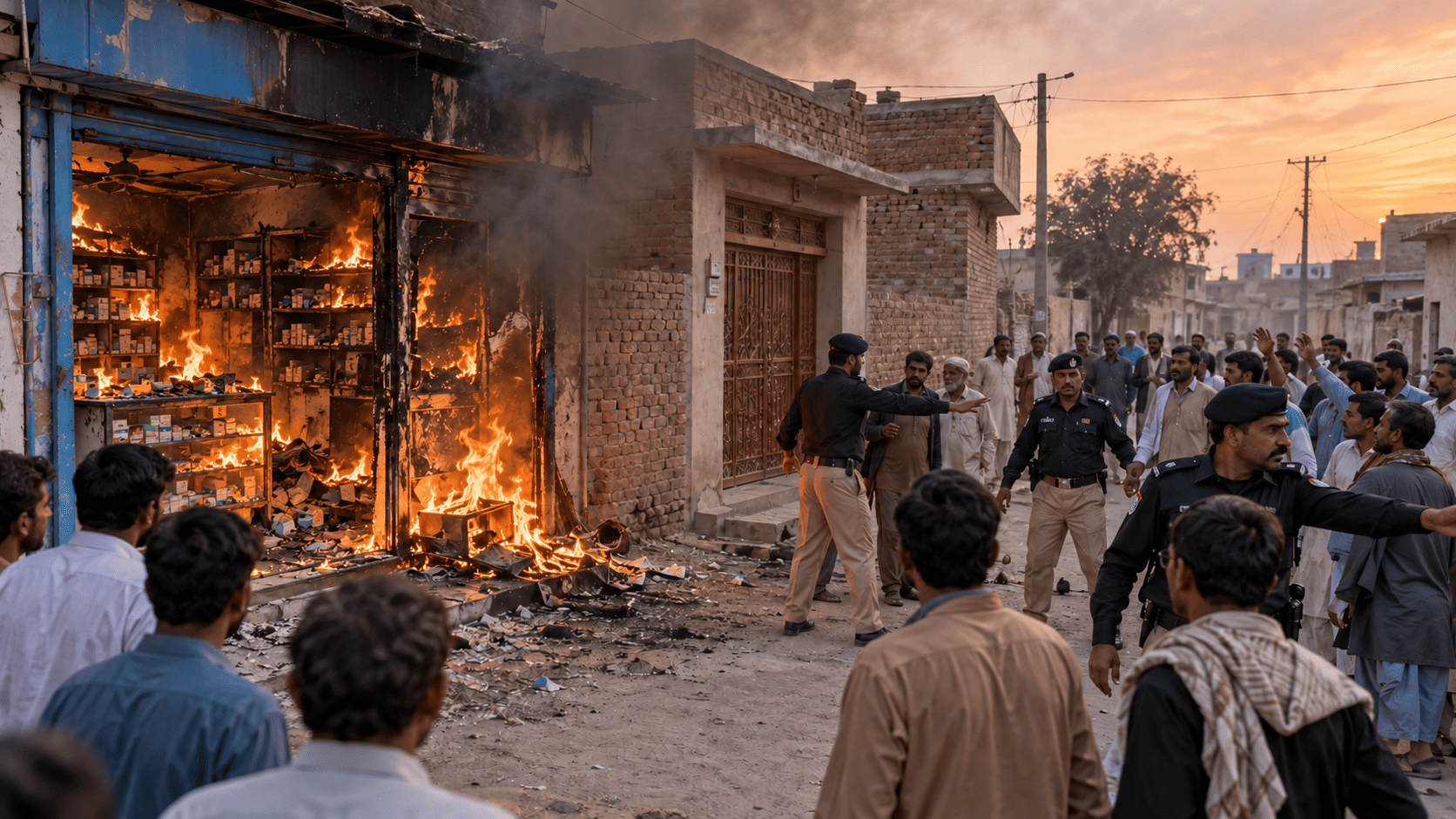
AI-generated symbolic illustration. It does not depict Patras’s actual phone, the actual neighbourhood or the incident itself.