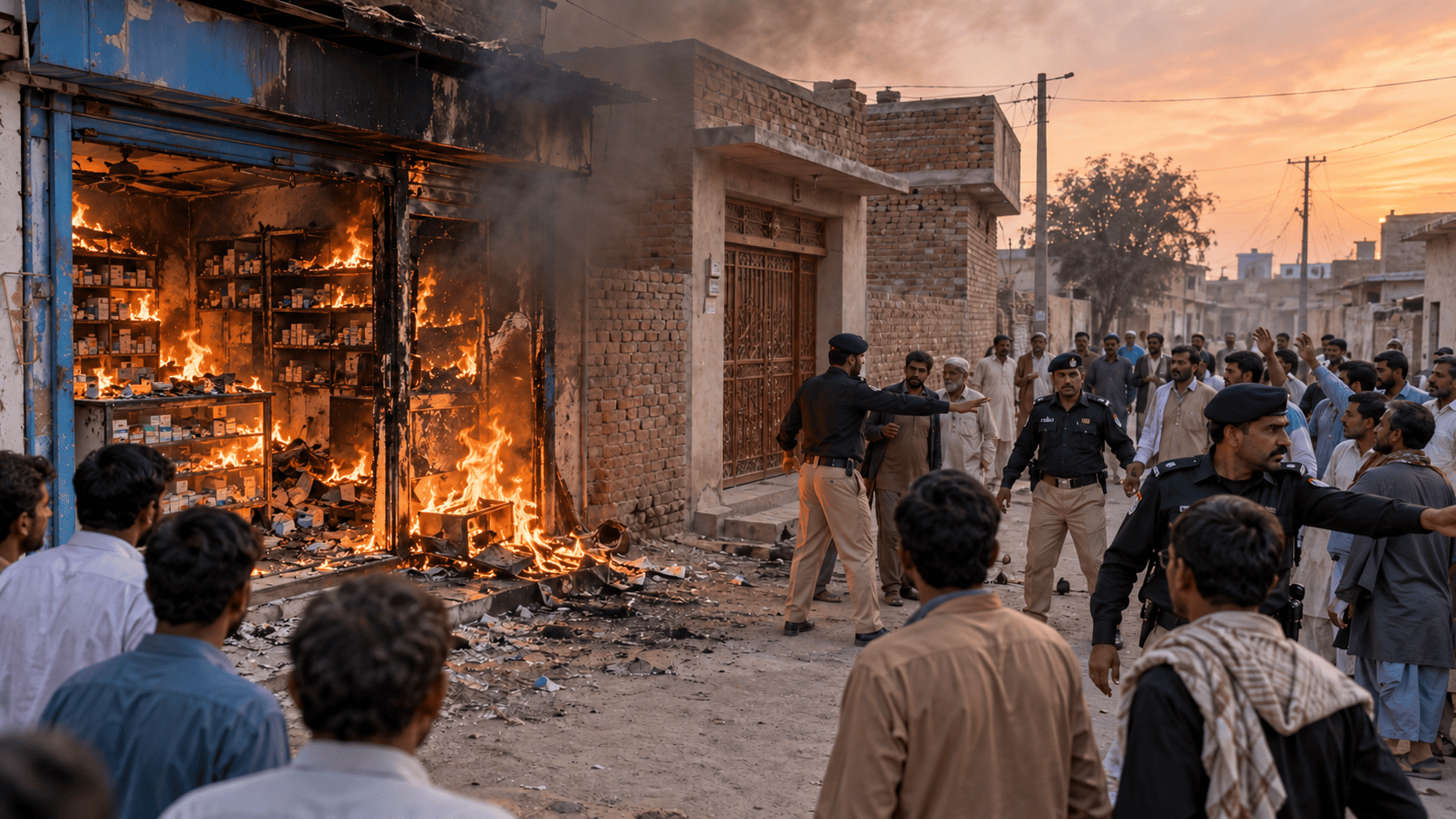
Upper Kohistan, Khyber Pakhtunkhwa | April 2023
A workplace argument. An accusation of blasphemy. Angry workers surrounded an office. A crowd gathered. People later moved toward the police station searching for the accused man. Pakistan had seen this sequence before. In other cases, it ended with a body. This time, it did not.
The accused was a Chinese engineer working on the Dasu Hydropower Project in Upper Kohistan. Police removed him from danger, transferred him to a secure location, and ultimately sent him to a high-security prison away from the crowd. He denied committing blasphemy. Less than two weeks later, a Pakistani court granted him bail after finding that the alleged offence appeared to have resulted from a misunderstanding.
No church was burned. No neighbourhood was destroyed. No accused person was lynched. That is precisely why this case belongs in our archive. It shows what can happen when police maintain custody, move quickly and refuse to hand a suspect to a crowd.
The Accused Was Working on the Dasu Hydropower Project
The man was a Chinese national employed at the Dasu Hydropower Project, a major infrastructure development in Upper Kohistan. Reuters reported that he worked with the China Gezhouba Group Company on the project and was accused by Pakistani workers of insulting the Prophet Muhammad during a workplace dispute.
Voice of America identified him publicly only as “Mr. Tian”, describing him as the head of heavy transport at the Chinese company working on the project. For SFFP’s archive, there is no need to expand his identity further. The human-rights significance lies in what happened after the allegation.
The Dispute Appears to Have Started Over Work
Contemporary reporting linked the accusation to disagreement between the Chinese supervisor and local labourers concerning the pace of work and prayer breaks. Dawn reported that the accusation arose after an argument with workers over long prayer breaks at the project site.
Other contemporary accounts similarly described a workplace dispute concerning productivity during Ramadan before religiously offensive remarks were alleged. That context matters. A disagreement that began as a workplace management issue quickly became something far more dangerous once blasphemy entered the accusation.
Workers Accused Him of Insulting the Prophet Muhammad
Local workers alleged that the Chinese engineer had used insulting language concerning the Prophet Muhammad. He denied doing so. Reuters reported that after his arrest, he rejected the accusation while appearing before judicial authorities.
This distinction is essential: He was accused of blasphemy.
He was not convicted of blasphemy. And at the moment the crowd began mobilizing, no court had yet examined the evidence.
Angry Workers Surrounded His Office
The allegation spread rapidly among workers. Reuters reported that angry labourers surrounded the engineer’s office at the Dasu project. The situation had now moved beyond an internal workplace dispute. Crowd dynamics were beginning. And authorities had to make a decision quickly.
- Would they leave the accused where he was?
- Would they allow workers to confront him?
- Or would they take control of the situation?
Police Took Him Into Protective Custody
Police intervened. The engineer was removed from the project area and taken into custody. This step is significant because police did not wait for the confrontation to become fatal. They separated the accused from the angry crowd. That simple act is one of the most important preventive measures in any high-risk blasphemy case.
The Crowd Then Went Looking for Him
Removing the engineer from the workplace did not immediately end the danger. Reuters reported that angry people later stormed or surrounded a police station while trying to locate him.
This demonstrates how serious the threat had become. The crowd was no longer demanding only that authorities register a case. People wanted physical access to the accused. Pakistan’s later experiences in Warburton and Madyan show how dangerous that stage can become.
Police Did Not Hand Him Over
This is the crucial difference. Authorities maintained control of the accused. The crowd did not receive him. The station was not allowed to become a courtroom. And the accused remained alive. That should sound obvious. But several stories in this archive demonstrate that it is not always what happens.
He Was Moved Again for His Safety
Police concluded that keeping the engineer near the project area remained dangerous. Reports stated that he was transferred away from Dasu toward Komila and ultimately moved to a much more secure facility. Later reporting said he was flown by helicopter and held in a high-security prison far from the original crowd because authorities feared an attack.
This is exactly the type of security escalation that earlier cases show can save lives. A local police station is not automatically the safest location merely because it is a police building. Security has to match the threat.
Authorities Still Registered the Case
Protecting the engineer did not mean police simply ignored the allegation. An FIR was registered against him under Pakistan’s blasphemy law and anti-terrorism provisions. Dawn reported that the case included Section 295-C of the Pakistan Penal Code and provisions of the Anti-Terrorism Act.
That distinction is important. The state did two things simultaneously: it investigated the allegation, and it protected the accused from extrajudicial violence. Those responsibilities are not contradictory. That is how due process is supposed to work.
The Engineer Denied the Charge
When produced before the legal system, the Chinese national denied committing blasphemy. Reuters reported that he rejected the accusation and was remanded into judicial custody while the matter proceeded. The question had now moved where it belonged: away from the crowd, and into legal procedure.
There Was No Mob Trial
The Dasu case provides a useful comparison with several tragedies already documented in this archive. Mashal Khan never reached trial. Muhammad Waris was taken from a police station. Muhammad Ismail was removed from custody in Madyan. Abdul Ali was killed inside police custody.
Dr Shahnawaz Kunbhar was later found by an official inquiry to have been killed in a staged encounter. The Chinese engineer reached the next stage: a court. That is the difference due process makes.
27 April 2023: The Court Granted Bail
Less than two weeks after the accusation, an anti-terrorism court granted the Chinese national bail. Dawn reported that the court ordered his release after he furnished a bond of Rs 200,000. Reuters reported the decision the following day. Bail in a blasphemy case attracted attention because such cases can often remain unresolved for long periods.
The Court Referred to a “Misunderstanding”
The most important part of the bail decision was the court’s assessment of the available allegation. Reuters reported that the court said the alleged offence appeared to be the result of a misunderstanding.
That does not necessarily mean a complete final acquittal. Bail is not the same thing as a final judgment. But it demonstrates why the crowd could not be allowed to decide the case. If police had lost control during the first night, the man could have been killed over a matter a court later regarded as potentially resulting from misunderstanding.
Imagine the Alternative
Suppose the crowd had reached him. Suppose he had been lynched. The headlines would then say: Chinese engineer killed over blasphemy allegation. Later evidence might still have suggested misunderstanding. But it would no longer matter. There is no appeal from a lynching. There is no bail after death. There is no correction once the crowd has imposed an irreversible sentence. That is why due process is not bureaucracy. It is a life-saving system.
The Police Response Is the Story
There are many reasons to document failures. But a serious human-rights archive should also document what worked.
In Dasu, police: removed the accused from the immediate crowd, maintained custody, prevented people from reaching him, moved him again when the original location remained unsafe, placed him in a high-security facility, and allowed the judicial system to examine the case. Those decisions changed the outcome.
Security Was Escalated Instead of Waiting for Failure
One lesson is particularly important. Authorities did not appear to assume that a normal local police station was automatically adequate. Once threats intensified, the accused was moved further away. That is exactly the kind of risk-based policing needed in cases where community mobilisation can grow within hours.
This Was Not Preferential Treatment for a Foreigner
It would be easy to interpret the police response as special treatment because the accused was Chinese. Pakistan has major diplomatic and economic ties with China, and Chinese personnel on infrastructure projects receive substantial security attention. That context undoubtedly mattered.
But the correct human-rights conclusion is not: foreigners deserve this protection. It is: every accused person should receive this level of protection when the threat requires it. A poor Pakistani labourer deserves the same right to survive until trial.
The Standard Should Be Universal
If police can: transfer a foreign engineer, deploy extra security, move him out of the district, and secure his custody, then similar protocols can be developed for: Christians, Muslims, Hindus, Ahmadis, Sikhs, and anyone else facing a credible mob threat. Human rights improve when good practice becomes standard practice.
The Case Also Protected the Crowd
Protecting the accused does more than save one life. It also prevents hundreds of other people from becoming murder suspects, arson defendants, prisoners, or participants in communal violence. Early intervention protects both: the intended victim and the wider community from the consequences of collective rage.
Police Strength Can Create Time
The most valuable thing police created in Dasu was time. Time for emotions to cool. Time for evidence to be examined. Time for lawyers to act. Time for a judge to read the case. Time for the accusation to become a legal question instead of a public emergency. That is what effective institutions do.
Courts Can Only Work If the Accused Reaches Court Alive
Judicial independence means little if mobs kill defendants before judges can hear them. The Dasu case demonstrates the full chain that must remain intact: allegation, police custody, protection, investigation, court, bail or trial. Break that chain at any point and due process collapses.
Bail Did Not Mean Blasphemy Was Approved
The court’s decision should also not be misunderstood. Granting bail did not mean disrespect toward Islam. It meant the evidence and circumstances had to be evaluated according to law.
A justice system can simultaneously: respect religious sensitivities, investigate alleged offences, and protect an accused person’s legal rights. Those principles can coexist.
Respect for Religion and Due Process Are Compatible
One of the most harmful assumptions in blasphemy-related violence is that demanding due process means defending religious insult.
It does not. A Muslim police officer can sincerely honour the Prophet Muhammad and still protect a blasphemy suspect from a crowd. A judge can take an allegation seriously and still require evidence.
A community can feel offended and still wait for lawful investigation. That is what institutional maturity looks like.
The Universal Declaration of Human Rights
The Dasu case relates to several principles reflected in the Universal Declaration of Human Rights:
- the right to life and security of person;
- equality before the law;
- protection from arbitrary punishment;
- the right to a fair hearing;
- and the presumption of innocence.
The difference from many stories in this archive is that these protections were not completely lost. The accused remained alive long enough for a court to act.
This Is What Prevention Looks Like
Human-rights work often becomes visible only after tragedy. Burned homes. Funerals. Compensation. Trials. Memorials. But prevention is less dramatic. It may look like: a police vehicle, a secure room, a helicopter transfer, extra officers, and a judge hearing a bail application. There is no viral photograph of the person who was not lynched. But that is success.
Good Policing Is Sometimes Invisible
When police prevent violence, there may be no dramatic headline. No grieving family. No burned neighbourhood. No international condemnation. That can make prevention seem less important than response. In reality, preventing one lynching is more valuable than successfully prosecuting a hundred people afterward.
Why This Story Belongs Beside the Tragedies
SFFP should not build an archive containing only evidence of failure. That could create the impression that mob violence is inevitable.
It is not.
The Dasu case shows that institutions have choices. Police can lose control. Or police can maintain control. The accused can be handed to a mob. Or the accused can be moved to safety. The story can end in a funeral. Or it can end with a court hearing.
This Also Makes Our Archive More Credible
At Samaritan’s Fellowship Foundation, our Human Rights & Empowerment work should recognize progress as well as abuse.
If we criticize authorities when protection fails, we should also acknowledge cases where authorities successfully prevent a lynching. That demonstrates that our purpose is not to attack Pakistan. Our purpose is to strengthen the practices that protect Pakistani society.
Pakistan Already Has Examples of What Works
The solution does not need to be imported entirely from somewhere else. Pakistan’s own institutions have demonstrated useful practices: protective custody, rapid transfer, high-security detention, court supervision, and evidence-based bail decisions. The challenge is consistency.
A Poor Pakistani Should Receive the Same Protection
The most important policy lesson is equality. Would Muhammad Waris have survived if he had been moved from Warburton Police Station as aggressively as the Dasu engineer was moved?
Would Muhammad Ismail have survived Madyan if police had transferred him immediately to a secure district facility?
We cannot know.
But those comparisons show why good practice should not depend on: nationality, wealth, diplomatic importance, or social status.
Protection Should Follow Risk, Not Influence
The deciding question should be: How serious is the threat?
Not: Who is this person?
If the threat is severe, security should escalate. That is the institutional standard worth promoting.
This Fits SFFP’s Approach to Human Rights
SFFP’s broader How We Work model focuses not only on responding to vulnerability but on strengthening the systems that prevent it.
For human rights, that means: community awareness, responsible religious leadership, strong local institutions, police preparedness, legal assistance, and early intervention. Human-rights protection is strongest when people never become victims in the first place.
What Should We Learn From Dasu?
- Blasphemy allegations should trigger immediate risk assessment.
- Crowds must never receive access to the accused.
- Local police stations should not hold high-risk suspects if they cannot be defended.
- Secure transfers should happen early.
- Foreign nationals and Pakistani citizens should receive the same protection standard.
- Police should investigate allegations while simultaneously protecting the accused.
- Courts should examine evidence without public pressure determining outcomes.
And communities should understand: protecting an accused person is not the same as approving the alleged offence.
Most importantly: Prevention works.
The Best Human-Rights Story Is the One Without a Funeral
The Chinese engineer’s case could easily have become another entry in a list of people killed after blasphemy allegations.
Instead, police protected him. A court heard the case. He received bail. Whatever happened afterward in the wider legal process, the central human-rights achievement had already occurred: He remained alive. That should be the minimum standard.
Help Us Advance Freedom, Dignity and Opportunity
Samaritan’s Fellowship Foundation builds integrated, community-led ecosystems that advance human rights, healthcare, education, clean water, sustainable livelihoods and local leadership.
We believe Pakistan does not only need stronger responses after violence. It needs systems capable of preventing violence before it begins. If you believe every accused person should reach a courtroom alive—and every community should be protected from the consequences of mob justice:
Together, we can strengthen institutions and communities where accusations are investigated through evidence, disputes are handled through law, and human dignity is protected before tragedy occurs.
Empowerment Beyond Aid — Advancing Freedom and Rights.
Editorial Note
Samaritan’s Fellowship Foundation documents publicly reported human-rights cases for education, historical record, and awareness.
In April 2023, a Chinese national working at the Dasu Hydropower Project was accused by local workers of making blasphemous remarks during a workplace dispute. He denied the allegation. Police removed him from the area as crowds mobilized, maintained protective custody, and transferred him to a high-security facility.
Authorities also registered a formal criminal case, allowing the allegation to proceed through the justice system rather than leaving it to the crowd.
On 27 April 2023, an anti-terrorism court granted the accused bail. Reuters reported that the court considered the alleged offence to appear to have resulted from a misunderstanding. Bail is not equivalent to a final acquittal, and this article therefore does not state that a completed trial conclusively determined the allegation to be false.
SFFP includes this case because it demonstrates an important positive principle: police can investigate religiously sensitive allegations while simultaneously protecting accused persons from extrajudicial violence. We support respect for religion, lawful investigation, professional policing, due process and equal protection for every accused person.
References
- Reuters — Chinese Man Charged With Blasphemy After Angry Crowds Gather, 17 April 2023. Documents the accusation, angry workers surrounding the engineer’s office and crowd mobilisation at police facilities. https://www.reuters.com/world/asia-pacific/chinese-man-charged-with-blasphemy-pakistan-after-angry-crowds-gather-police-2023-04-17
- Reuters — Chinese Man Denies Blasphemy, Sent to Jail, 18 April 2023. Reports the accused engineer’s denial of the allegation and his transfer into judicial custody. https://www.reuters.com/world/asia-pacific/chinese-man-denies-blasphemy-pakistan-sent-jail-police-2023-04-18
- Reuters — Chinese Man Accused of Blasphemy Unusually Released on Bail, 28 April 2023. Reports the court’s bail decision and statement that the alleged offence appeared to result from a misunderstanding. https://www.reuters.com/world/asia-pacific/chinese-man-accused-blasphemy-pakistan-unusually-released-bail-2023-04-28
- Dawn — ATC Grants Bail to Chinese National Arrested on Blasphemy Charge, 28 April 2023. Pakistani reporting on the Rs200,000 bail bond and workplace dispute involving prayer breaks at the Dasu Hydropower Project. https://www.dawn.com/news/1749688
- Voice of America — Chinese Engineer Arrested for Alleged Blasphemy, 17 April 2023. Identifies the accused as a Chinese engineer working at the Dasu project and reports police intervention after public protests. https://www.voanews.com/a/chinese-engineer-arrested-in-pakistan-for-alleged-blasphemy/7053411.htm
- Voice of America — Pakistan Releases Chinese National Charged With Blasphemy, 28 April 2023. Follow-up coverage of his release after the court granted bail. https://www.voanews.com/a/pakistan-releases-chinese-national-charged-with-blasphemy-/7071022.html
- Al Jazeera — Chinese Engineer Charged With Blasphemy in Pakistan, 17 April 2023. Contemporary international coverage of the accusation, crowd mobilisation and police protection. https://www.aljazeera.com/news/2023/4/17/chinese-engineer-charged-with-blasphemy-in-pakistan
- The Express Tribune — Chinese Engineer in Police Protection After Blasphemy Accusation, 17 April 2023. Pakistani coverage discussing the workplace dispute and steps taken to protect the accused. https://tribune.com.pk/story/2412364/chinese-engineer-in-police-protection-after-blasphemy-accusation
- Wikipedia — List of Blasphemy Cases in Pakistan. Broader chronology that includes the 2023 Dasu Chinese engineer case and his transfer for safety, followed by bail. https://en.wikipedia.org/wiki/List_of_blasphemy_cases_in_Pakistan