Samaritan’s Fellowship Foundation Pakistan works with marginalized and minority communities to defend their rights, strengthen their voice, and create opportunities for lasting self-reliance.
Our work connects three pillars: Freedom, Rights & Empowerment; Economic Opportunity; and Peace & Fellowship.
We speak for the freedom of people from social differences, injustice, modern slavery, extremism, religious intolerance, persecution, and poverty.
Shama & Shahzad Masih: Killed After Blasphemy Claim
November 4, 2014
Shama & Shahzad Masih: Killed After Blasphemy Claim
Kot Radha Kishan, Kasur District, Punjab | 4 November 2014
She was pregnant.
They had three young children.
They worked at a brick kiln.
Then came an accusation that pages of the Quran had been desecrated.
A crowd gathered.
The couple was beaten.
And Shama Bibi and Shahzad Masih were killed at the brick kiln where they worked.
Their deaths became one of Pakistan’s most internationally reported blasphemy-related killings. Contemporary and later sources document that a large mob attacked the Christian couple after accusations of Quran desecration spread through the area.
The legal story continued for more than a decade.
Five men were sentenced to death in 2016, two of those convictions were later overturned by the Lahore High Court, and in July 2026 Pakistan’s Supreme Court acquitted the remaining three death-row defendants after finding that the prosecution had not proved their guilt beyond reasonable doubt.
That final development makes this case especially important for a human-rights archive.
Shama and Shahzad were unlawfully killed by a mob. But accountability for that killing still had to meet the same evidentiary standard that should protect every accused person.
Who Were Shama and Shahzad?
Shama Bibi and Shahzad Masih were a young Christian married couple working at a brick kiln near Kot Radha Kishan in Kasur District, Punjab.
Contemporary reporting described Shahzad as approximately 26 and Shama as approximately 24.
They were parents of three children.
Later Pakistani reporting documented what happened to those children after the killings, including the traumatic experience of one child who witnessed what happened to his parents.
Shama was also reported to be pregnant at the time of her death. Later reporting and legal commentary described her as approximately five months pregnant.
This was not an abstract legal dispute.
It was a family.
They Worked at a Brick Kiln
The couple worked at a brick kiln in Chak 59, near Kot Radha Kishan.
Dawn’s reporting on the later criminal trial identified both Shama and Shahzad as brick-kiln workers.
That detail is particularly significant.
Brick-kiln workers in Pakistan can occupy an extremely vulnerable economic position, especially where employment, housing, advances and debt are connected to the kiln owner.
For SFFP, this case sits at the intersection of two issues we already work on:
human rights
and
economic exploitation of brick-kiln families.
It is one of the clearest examples in this archive of why those issues cannot always be separated.
The Allegation Followed the Death of Shahzad’s Father
Reports indicate that the controversy began after the death of Shahzad’s father.
While clearing belongings from his home, Shama reportedly disposed of papers or other material.
Some of those papers were later alleged to contain pages or verses from the Quran.
The couple was subsequently accused of desecrating the holy book.
The exact circumstances surrounding those papers became disputed.
What is essential is that the allegation had not been tested or established through a judicial proceeding before the violence began.
The Accusation Spread Quickly
News of the allegation circulated through the area.
Dawn later reported that announcements from local mosques helped mobilize people against the couple.
As the accusation spread, a large crowd gathered around the brick kiln.
Later court reporting described the mob as numbering roughly 400 people, although estimates differ between accounts.
For Shama and Shahzad, the danger was no longer simply an allegation that might lead to a police investigation.
They were surrounded.
The Couple Was Prevented From Escaping
Accounts of the final hours differ in some details, but several sources report that the couple was unable to leave the kiln area safely.
Later investigations and advocacy reports alleged that the kiln owner or other individuals had restricted their movement because of outstanding financial obligations.
Because the exact degree of restraint and responsibility was contested in subsequent proceedings, this point should not be overstated.
What is clear is that the couple remained at or near the kiln as the crowd gathered and the threat escalated.
4 November 2014
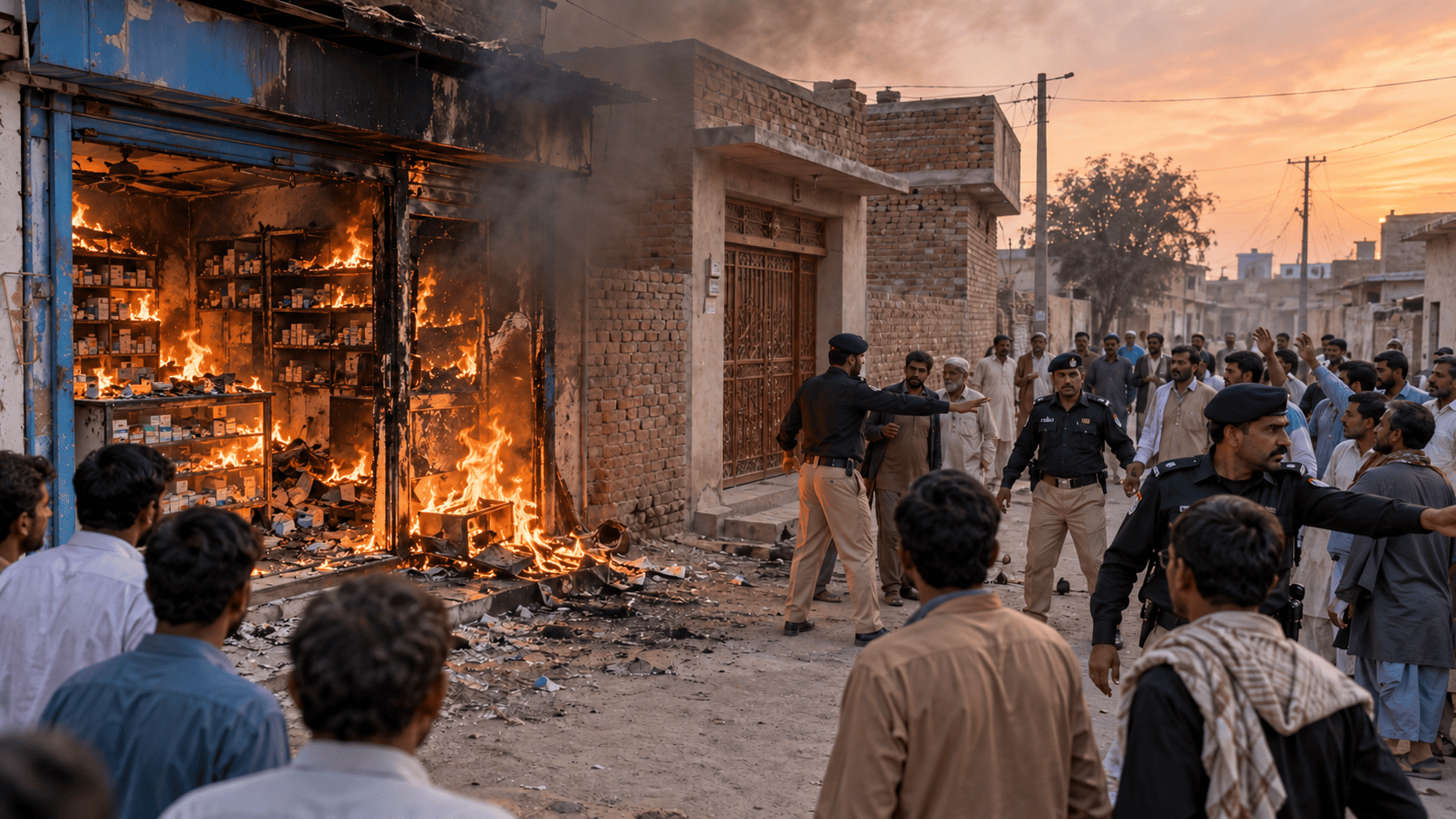
On 4 November 2014, the mob attacked.
Al Jazeera reported that Shama and Shahzad were beaten by a crowd before being killed at the brick kiln.
Dawn’s later criminal-trial report described the couple as having been lynched by a mob of around 400 people and burned at the kiln.
The brutality of the killing attracted immediate national and international attention.
For our archive, graphic detail is unnecessary.
The essential fact is enough:
Two people who had not been convicted of blasphemy were killed by a crowd before any court could determine the allegation against them.
Shama Was Pregnant
Later reporting repeatedly noted that Shama was pregnant.
Fides’ 2026 retrospective described her as approximately five months pregnant when she was killed.
That means the violence destroyed not only two lives and left three children without parents.
It also ended a pregnancy.
The human cost extended across an entire family.
Their Children Were Left Behind
Shama and Shahzad left behind three children.
Dawn’s detailed 2019 investigation examined their lives after the murders and the trauma surrounding the killings.
One of the most painful dimensions of communal violence is that its effects continue long after media attention disappears.
Children may inherit:
trauma,
poverty,
loss of parental care,
social stigma,
education disruption,
and insecurity.
The parents die once.
The consequences can remain with the children for decades.
The Killings Triggered National Condemnation
The murders caused widespread outrage inside Pakistan and internationally.
The incident was condemned by political leaders, religious figures, civil-society organizations and human-rights advocates.
Amnesty later highlighted the case in its wider research on the dangers surrounding blasphemy allegations.
The killings should therefore not be interpreted as representing Pakistan, Islam or Pakistani Muslims collectively.
The attack was an act of mob violence.
Many Pakistanis condemned it.
Police Arrested Large Numbers of Suspects
Following the killings, authorities opened a major criminal investigation.
Hundreds of people were initially named or investigated in connection with the mob attack.
The sheer size of the crowd created an enormous evidentiary problem:
Who actually did what?
Being present near a mob is not automatically proof of murder.
Criminal responsibility still has to be established individually.
That principle would become increasingly important as the case moved through Pakistan’s courts.
2016: Five Men Were Sentenced to Death
On 23 November 2016, an anti-terrorism court sentenced five men to death for their role in the killings.
Another eight defendants were given shorter prison sentences.
The judgment was initially viewed as a significant accountability measure in a country where prosecutions following large mob attacks can be difficult.
But criminal convictions are not the final stage of a justice system.
The defendants appealed.
2018: Twenty Other Defendants Were Acquitted
In March 2018, a Pakistani court acquitted another 20 people accused of participating in the mob attack.
Again, this is an important due-process point.
The horror of the underlying crime cannot lower the legal standard for proving an individual defendant’s guilt.
Justice for victims does not mean convicting whoever happens to be available.
It means identifying and proving responsibility against the actual perpetrators.
2019: Lahore High Court Acquitted Two Death-Row Defendants
The five death sentences also came under appellate review.
In May 2019, the Lahore High Court acquitted two of the five men who had received death sentences.
At the same time, it upheld the convictions of the remaining three.
This left three defendants on death row.
For several more years, those convictions remained in place.
July 2026: Supreme Court Acquitted the Remaining Three
The case reached its final major judicial stage in July 2026.
Pakistan’s Supreme Court overturned the death sentences of the remaining three defendants and acquitted them.
Reporting on the judgment stated that the Court found inconsistencies in witness testimony and weaknesses in the prosecution evidence and concluded that guilt had not been proved beyond reasonable doubt.
With that decision, all remaining convictions connected to the killing had effectively been overturned or otherwise ended.
This latest development must be included if we want this archive to remain credible.
Does That Mean the Lynching Did Not Happen?
No.
This distinction is essential.
The killing of Shama and Shahzad is extensively documented.
They were attacked and killed by a mob at the brick kiln.
The Supreme Court’s 2026 judgment concerned a different question:
Had prosecutors proved that the particular three men before the Court were criminally responsible beyond reasonable doubt?
The Court concluded that they had not.
Those are two different propositions.
A crime can unquestionably have happened while prosecutors still fail to prove the identity or role of particular defendants.
This Is Exactly Why Due Process Matters
It would be inconsistent to defend people falsely or weakly accused of blasphemy while ignoring due-process rights when someone is accused of mob violence.
The same principle must operate in both directions.
Shama and Shahzad should never have been treated as guilty simply because they were accused of blasphemy.
Likewise, people accused of murdering them could not lawfully be executed unless their individual guilt was reliably proven.
Human rights are not selective.
That is what makes them human rights.
Accountability for Mob Violence Is Extremely Difficult
The eventual collapse of the convictions also reveals a serious institutional problem.
A mob may contain hundreds of people.
Individual attackers may be difficult to identify.
Witnesses may change statements.
People may fear retaliation.
Investigations may be poorly conducted.
Evidence may be contaminated or incomplete.
Years may pass before appeals are decided.
By then, proving who committed a particular act can become extraordinarily difficult.
Fides’ 2026 retrospective described the case as emblematic of the difficulty of prosecuting mob violence in Pakistan.
That is an important lesson.
The answer is not weaker evidence standards.
The answer is better investigation from the beginning.
Police Need the Capacity to Investigate Mobs Properly
Protecting Christian families does not require hostility toward Muslims.
Protecting accused Muslims does not require ignoring Christian victims.
Justice must be capable of doing both.
Protection Must Come Before the Funeral
Many human-rights responses begin after someone has already died.
Condemnation.
Compensation.
Inquiry.
Trial.
Memorial.
Those things matter.
But the strongest human-rights system prevents the killing in the first place.
When authorities know that a blasphemy allegation is spreading, they need mechanisms to:
secure the accused,
protect family members,
control crowd formation,
deploy sufficient police,
identify instigators,
and move vulnerable people to safety.
The real goal is not a better prosecution after a lynching.
It is no lynching at all.
From Vulnerability to Independence
This case also illustrates why SFFP works through an integrated ecosystem.
Through Set Them Free, families affected by bonded labour and exploitation pursue freedom, protection and reintegration.
Through StartFish, marginalized families build sustainable livelihoods and greater economic independence.
And through How We Work, we connect human rights, development, economic empowerment and community leadership.
Because a family that is economically stronger, socially connected and aware of its rights has more options when a crisis begins.
What Should We Learn From Shama and Shahzad?
A blasphemy allegation requires immediate protection and investigation.
Brick-kiln workers and other economically dependent families may need special protection.
Religious announcements capable of mobilizing crowds must be handled responsibly.
Police must intervene before a crowd reaches an accused person.
Mob investigations need strong forensic evidence from the first hours.
And criminal courts must still require proof against every individual defendant.
The murder of Shama and Shahzad demonstrates the cost of mob justice.
The 2026 Supreme Court acquittals demonstrate the cost of weak prosecution.
Pakistan needs neither.
It needs stronger rule of law.
Help Us Advance Freedom, Dignity and Opportunity
Samaritan’s Fellowship Foundation builds integrated, community-led ecosystems that empower marginalized communities through human rights, healthcare, education, clean water, sustainable livelihoods and local leadership.
Our work with vulnerable brick-kiln families has taught us that poverty, exploitation and human-rights vulnerability often reinforce one another.
If you believe no family should face violence because of an unproven allegation—and no worker should be too powerless to seek protection:
Together, we can help vulnerable families move from exploitation to freedom, from dependence to opportunity, and from exclusion to dignity.
Empowerment Beyond Aid — Advancing Freedom and Rights.
Editorial Note
Samaritan’s Fellowship Foundation documents publicly reported human-rights cases for education, historical record and awareness.
Shama Bibi and Shahzad Masih were accused of desecrating Quranic material but were killed before any court established guilt.
The killing itself is extensively documented.
Subsequent prosecutions resulted in several convictions, including five death sentences in 2016. Two death-row defendants were acquitted by the Lahore High Court in 2019. In July 2026, Pakistan’s Supreme Court acquitted the remaining three death-row defendants after finding that the prosecution had not established their individual guilt beyond reasonable doubt.
Those acquittals do not mean the lynching did not occur. They mean the courts concluded that the evidence was insufficient to sustain criminal liability against the particular defendants before them.
SFFP does not attribute the actions of the mob to Islam, Muslims generally, brick-kiln owners generally or the people of Pakistan.
We support peaceful coexistence, protection of vulnerable workers, reliable investigation, due process and equal human dignity for all.
References
1. Al Jazeera — Pakistani Christian Couple Killed by Mob, 5 November 2014
Contemporary report documenting the killing of Shahzad and Shama Masih at a brick kiln near Kot Radha Kishan following accusations of desecrating the Quran.
2. Amnesty International — How the Blasphemy Laws Enable Abuse
Amnesty’s analysis of misuse of blasphemy accusations in Pakistan includes the killing of Shama and Shahzad within its broader human-rights documentation.
4. Dawn — ATC Sentences Five to Death Over Burning Christian Couple Alive, 23 November 2016
Reports that a mob of roughly 400 people lynched the brick-kiln couple and that five defendants were sentenced to death while eight others received prison terms.
10. Fides — Christian Couple Lynched: An Emblematic Case, 29 July 2026
Retrospective following the final acquittals, emphasizing both the original killing and difficulties in successfully prosecuting large-scale mob violence.