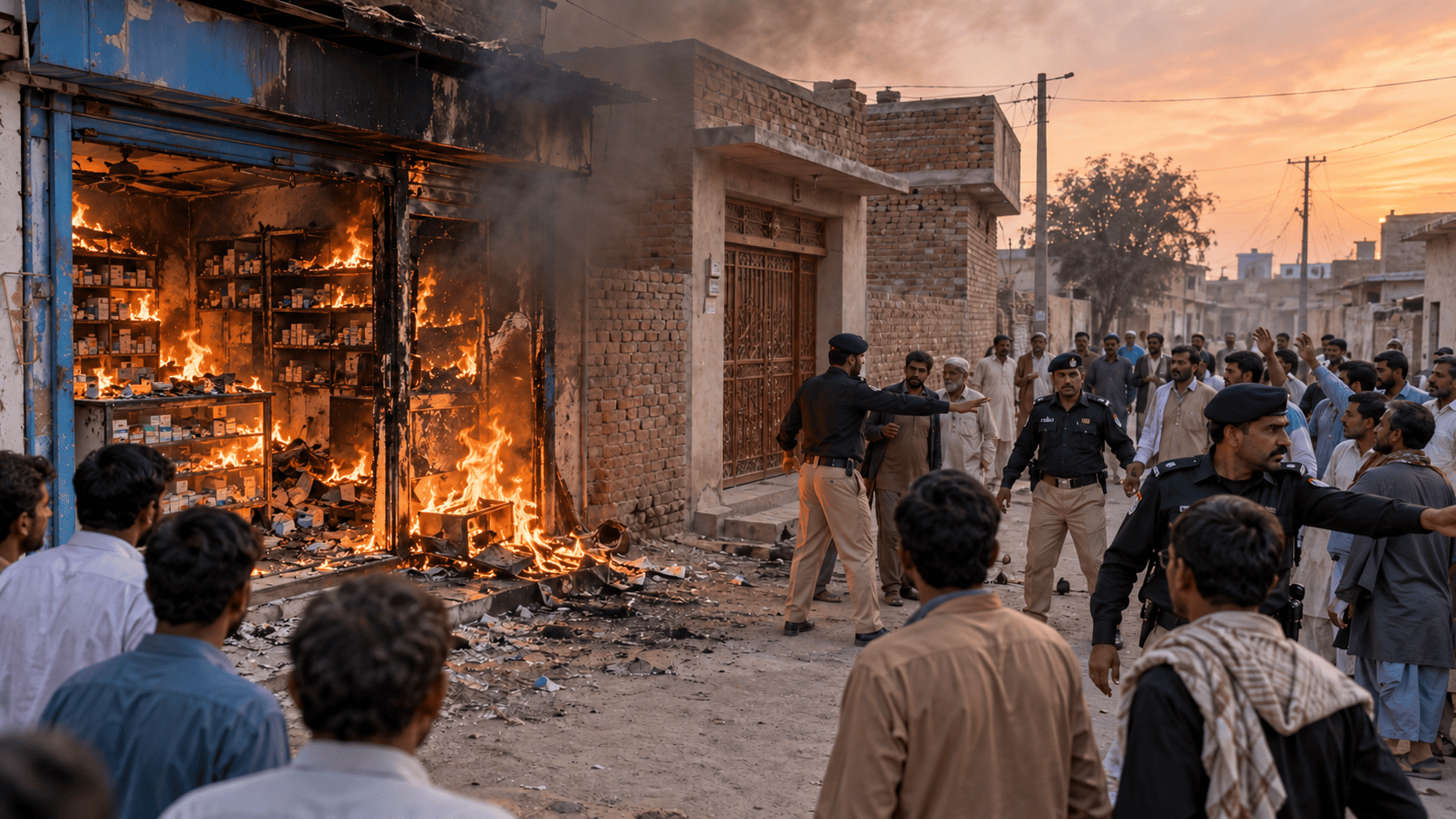
Khanewal District, Punjab | 6–7 February 1997
It began with an allegation. Within hours, thousands of people were moving toward a Christian settlement. Families fled. Homes were looted and burned. Churches were attacked. Schools and community buildings were damaged. And an entire community discovered how quickly a rumour connected to blasphemy could turn into collective punishment.
The attack on Shanti Nagar and nearby Christian localities in Khanewal District in February 1997 became one of the most significant episodes of anti-Christian violence in Pakistan during the 1990s. Contemporary parliamentary records, later Pakistani reporting and human-rights documentation all describe destruction on a massive scale.
What makes the case especially important is that the accusation concerned particular individuals. The violence did not. An entire community paid the price.
A Christian Settlement in Punjab
Shanti Nagar was a predominantly Christian settlement in Khanewal District, Punjab. For the families living there, it was not simply a cluster of houses. It was home. Churches, schools, neighborhoods and extended families had developed there over generations.
On 6 February 1997, that sense of security collapsed. Reports circulated alleging that pages of the Quran had been desecrated and that offensive writing had been added to them. The allegations were linked to local Christians. No judicial process had established guilt. But the allegation itself was enough to mobilize a huge crowd.
Loudspeakers Turned an Allegation Into a Public Call
Later summaries of the attack describe mosque loudspeakers being used to spread accusations that Christians had desecrated the Quran.
Wikipedia’s documented chronology, citing historical sources, describes a crowd estimated at around 30,000 people gathering during the attack on Shanti Nagar and nearby Tibba. The exact size of the crowd varies across historical accounts. What does not appear seriously disputed is the scale. This was not a confrontation involving a handful of people. It was a mass mobilisation against a minority community.
Families Fled Before the Attack Reached Them
As the crowd approached, many Christian residents fled. Some left with almost nothing. Homes were abandoned. Families sought shelter wherever they believed they would be safe. Later accounts record thousands of Christians being displaced. Wikipedia’s chronology, drawing from historical reporting, states that more than 2,500 Christians fled the affected area. For many residents, survival meant leaving everything behind. Furniture. Documents. Clothing. Businesses. Churches.
Family possessions accumulated over decades. A blasphemy allegation directed at individuals had become a threat to an entire population.
Shanti Nagar Was Attacked
The crowd entered Shanti Nagar and surrounding Christian areas on 6 and 7 February 1997. Homes were looted and set on fire. Churches were damaged or destroyed. Schools and other Christian institutions were also attacked.
The precise destruction figures differ substantially between sources. A motion tabled in the UK Parliament on 19 February 1997 stated that 1,500 homes and 13 churches had been destroyed and that approximately 1,500 families had been left homeless.
Other historical accounts record approximately 775–785 homes destroyed along with churches and schools. Because the contemporary estimates vary, the safest conclusion is not to insist on one exact figure. It is this:
Hundreds of Christian homes and multiple churches were destroyed or severely damaged, and thousands of people were displaced.
Even the lowest commonly cited estimates describe an enormous attack.
It Was More Than Property Damage
Numbers can make an event seem abstract. But each destroyed house belonged to a family. Each burned room held someone’s life. Schoolbooks. Wedding photographs. Identity documents. Savings. Furniture. Children’s belongings. Religious items. Tools used for work.
When hundreds of homes are destroyed, the harm does not end when the fire goes out. Families must find shelter. Children lose access to school. Income disappears. Medical needs become harder to meet. Communities lose places of worship and gathering. The consequences can last for years.
Three Christian Men Were Accused
Contemporary UK parliamentary documentation referred to three Christian men who were detained because their names were allegedly found in or associated with the desecrated religious material.
The allegations against individuals formed the stated trigger for the wider violence. But even if an allegation concerns a specific person, collective punishment has no place in law. A neighbourhood cannot be guilty.
A church cannot be guilty. A child cannot inherit the criminal responsibility of another person. A family cannot lawfully be punished because it shares the religion of someone who has been accused. That distinction is fundamental to justice.
An Allegation Became Collective Punishment
Shanti Nagar matters because the attack demonstrated one of the most dangerous transformations possible in a blasphemy case:
Individual accusation → community accusation → mass retaliation.
Once the allegation was framed not merely as something an individual may have done but as an offence associated with a religious community, the entire Christian population became vulnerable.
That is precisely why responsible policing, accurate information and religious leadership are so critical during sensitive allegations. The first hours can determine whether a dispute enters a courtroom or becomes a riot.
Where Were the Authorities?
The scale of the violence also raised serious questions about the state’s ability to protect the community.
The UK parliamentary motion called for investigation and assistance to displaced families and expressed concern about the scale and organisation of the attack. Later reporting and community testimony continued to raise questions about whether authorities acted effectively enough to prevent the destruction.
Two decades later, when the Human Rights Commission of Pakistan conducted a mission in southern Punjab, residents of Shanti Nagar were still discussing the 1997 attack.
HRCP recorded testimony that the event had weakened social bonds between Muslims and Christians, that many residents remained traumatised, and that people continued to live with fear. An incident lasting hours had shaped community relations for decades.
Justice Questions Did Not Disappear With Time
In its later field research, HRCP recorded a Shanti Nagar resident saying that a proposed inquiry—referred to by the interviewee as the Justice Tanveer Commission—had not materialised in a way that uncovered the truth.
The community’s perception was that accountability remained incomplete. That is important because rebuilding walls is not the same as rebuilding trust. After communal violence, justice has several dimensions:
- identifying those responsible;
- prosecuting criminal acts;
- compensating affected families;
- restoring homes and places of worship;
- correcting misinformation;
- protecting communities from retaliation;
- and rebuilding relationships between neighbors.
Without those steps, physical reconstruction can happen while fear remains.
Twenty Years Later, the Memory Remained
On the twentieth anniversary of the attack, Dawn described Shanti Nagar as one of the country’s worst episodes of violence against Christians. Almost three decades later, community members were still publicly recalling the attack and asking for justice.
UCA News reported in 2026 that survivors continued to remember the violence as a defining event in the history of Pakistan’s Christian community. This is why documenting historical cases matters. An event does not become irrelevant because it is old. Sometimes the long-term consequences are visible only years later.
What the Story Does Not Mean
Shanti Nagar should not be used to claim that Muslims and Christians in Pakistan are naturally enemies. That would be both inaccurate and harmful.
HRCP’s later field research recorded residents in the same broader region saying that many everyday relationships between Muslims and Christians remained amicable. That distinction matters.
A violent mob is not an entire religious community. Extremists do not represent every believer. And the actions of particular officials cannot automatically be attributed to the entire state. The purpose of documenting Shanti Nagar is not to deepen division. It is to understand how division becomes dangerous so that it can be prevented.
Minority Rights Are Pakistani Rights
Religious minorities are not outsiders to Pakistan. They are citizens.
Their churches, temples, homes, businesses and schools are part of Pakistan. Protecting those communities is therefore not a concession to a foreign agenda. It is a matter of equal citizenship, constitutional protection and rule of law.
The destruction at Shanti Nagar demonstrates what happens when that principle temporarily collapses. A community can lose in a few hours what took generations to build.
The Universal Declaration of Human Rights
The Shanti Nagar attack touches several principles contained in the Universal Declaration of Human Rights. These include:
- the right to life and security;
- equality before the law;
- freedom of thought, conscience and religion;
- protection of home and property;
- and the right to live without discrimination based on religious identity.
These rights apply to individuals. But when an entire neighborhood is targeted because of the religion of its residents, the violation becomes collective in scale.
From Rights on Paper to Protection in Practice
At Samaritan’s Fellowship Foundation, our human-rights work is based on a simple belief:
- Rights should not exist only in constitutions, treaties and court judgments.
- People must be able to experience those rights in everyday life.
Our Human Rights & Empowerment work seeks to strengthen awareness, peaceful participation, local leadership and community resilience.
But Shanti Nagar also demonstrates why human rights cannot be separated from development. When families are suddenly displaced, they need more than legal language.
They may need: housing, healthcare, education, clean water, income, and a way to rebuild their lives. That is why SFFP works through an integrated model rather than isolated interventions.
Why Sustainable Livelihoods Matter After Persecution
A family whose home or business is destroyed can become economically dependent overnight. That dependency can deepen vulnerability.
Through StartFish, SFFP works to help marginalized families develop sustainable livelihoods and greater economic independence. Through our broader How We Work model, protection is connected to recovery, sustainable development, economic empowerment and local leadership. And through Set Them Free, we address another form of vulnerability in which poverty and power can trap families in exploitation.
Different crises can have different triggers. But the pathway out often involves the same principles: safety, dignity, opportunity and independence.
What Should Pakistan Learn from Shanti Nagar?
The lesson is not simply that violence happened. The more useful question is how similar violence can be prevented.
- Sensitive allegations need rapid and credible investigation.
- Police must protect accused persons and communities before crowds gather.
- Religious leaders must discourage vigilantism.
- Political leaders must speak clearly against collective punishment.
- False or unverified information must not be amplified.
- Victims must receive justice and reconstruction.
- And communities need long-term opportunities for dialogue after violence.
The objective should not merely be to stop the next riot. It should be to prevent the conditions that make the riot possible.
A Community Is Not Guilty Because One Person Is Accused
Perhaps the most important principle from Shanti Nagar is also the simplest:
Criminal responsibility is individual.
- If one person is accused, investigate that person.
- If evidence exists, present it before a court.
- If the allegation is false, establish that through law.
But a family cannot be punished for its neighbor. A neighborhood cannot be punished for a resident. And a religious community cannot be punished because someone sharing its faith has been accused. When society loses that distinction, innocent people become targets.
Help Us Advance Freedom, Dignity and Opportunity
Samaritan’s Fellowship Foundation builds integrated, community-led ecosystems that empower marginalized communities through human rights, healthcare, education, clean water, sustainable livelihoods and local leadership.
We believe protecting human rights means helping people remain safe before a crisis, recover after a crisis and build enough resilience to shape their own future.
If you believe that no family should lose its home, dignity or future because of an accusation directed at someone else:
Your support helps us strengthen communities, expand opportunity and turn human rights into practical pathways toward resilience and independence. Empowerment Beyond Aid — Advancing Freedom and Rights.
Editorial Note
Samaritan’s Fellowship Foundation documents publicly reported human-rights cases for education, historical record and awareness.
Historical sources differ significantly on the exact number of homes, churches and other buildings destroyed during the Shanti Nagar attacks. This article therefore attributes specific figures to their sources rather than presenting one disputed number as definitive. References to blasphemy are descriptions of allegations that preceded the attack and should not be understood as findings of guilt against any person.
SFFP does not attribute the conduct of a mob, extremist actors or particular officials to an entire religion, community or the people of Pakistan. We support peaceful coexistence, constitutional protections, due process and equal dignity for all citizens.
References
- UK Parliament — Persecution of Christians in Pakistan, Early Day Motion 607, 19 February 1997
Contemporary parliamentary record describing the 6 February attack, allegations that triggered the violence, destruction estimates, displaced families and concerns over detained Christian men. https://edm.parliament.uk/early-day-motion/13719/persecution-of-christians-in-pakistan
- Dawn — 20 Years After Shanti Nagar, 7 February 2017 Pakistani retrospective marking the twentieth anniversary of the attack and examining its place in the history of violence against Christian communities. https://www.dawn.com/news/1313096
- Human Rights Commission of Pakistan — Faith-Based Discrimination in Southern Punjab, 2019 HRCP field mission documentation from Shanti Nagar and surrounding areas. Residents described the lasting trauma of the 1997 attack, deterioration in interfaith trust and continuing concerns about accountability. https://hrcp-web.org/hrcpweb/wp-content/uploads/2020/09/2019-Faith-based-discrimination-in-southern-Punjab.pdf
- Anglican Communion News Service — Christian Villages Destroyed, 14 February 1997 Contemporary account of tensions and violence affecting Shanti Nagar and surrounding Christian communities. https://www.anglicannews.org/news/1997/02/christian-villages-destroyed.aspx
- UCA News — 29 Years On, a Cry for Justice from Pakistan’s Shanti Nagar, 7 February 2026 Recent retrospective documenting survivors’ memories and continuing demands for accountability nearly three decades after the attack. https://www.ucanews.com/news/29-years-on-a-cry-for-justice-from-pakistans-shanti-nagar/111820
- AsiaNews — Christians of Shanti Nagar Remember the Massacre of 1997 Retrospective account based on memories of members of the local Christian community. https://www.asianews.it/en/south-asia/pakistan/christians-of-shanti-nagar-remember-the-massacre-of-1997
- Wikipedia — List of Blasphemy Cases in Pakistan Contains a chronological Shanti Nagar entry summarizing the allegation, estimated crowd size, destruction of homes and churches, and displacement of Christian residents. https://en.wikipedia.org/wiki/List_of_blasphemy_cases_in_Pakistan
- Wikipedia — Shanti Nagar Includes a dedicated section on the 1997 Khanewal attack and cites historical figures for destruction documented by the Human Rights Commission of Pakistan. https://en.wikipedia.org/wiki/Shanti_Nagar