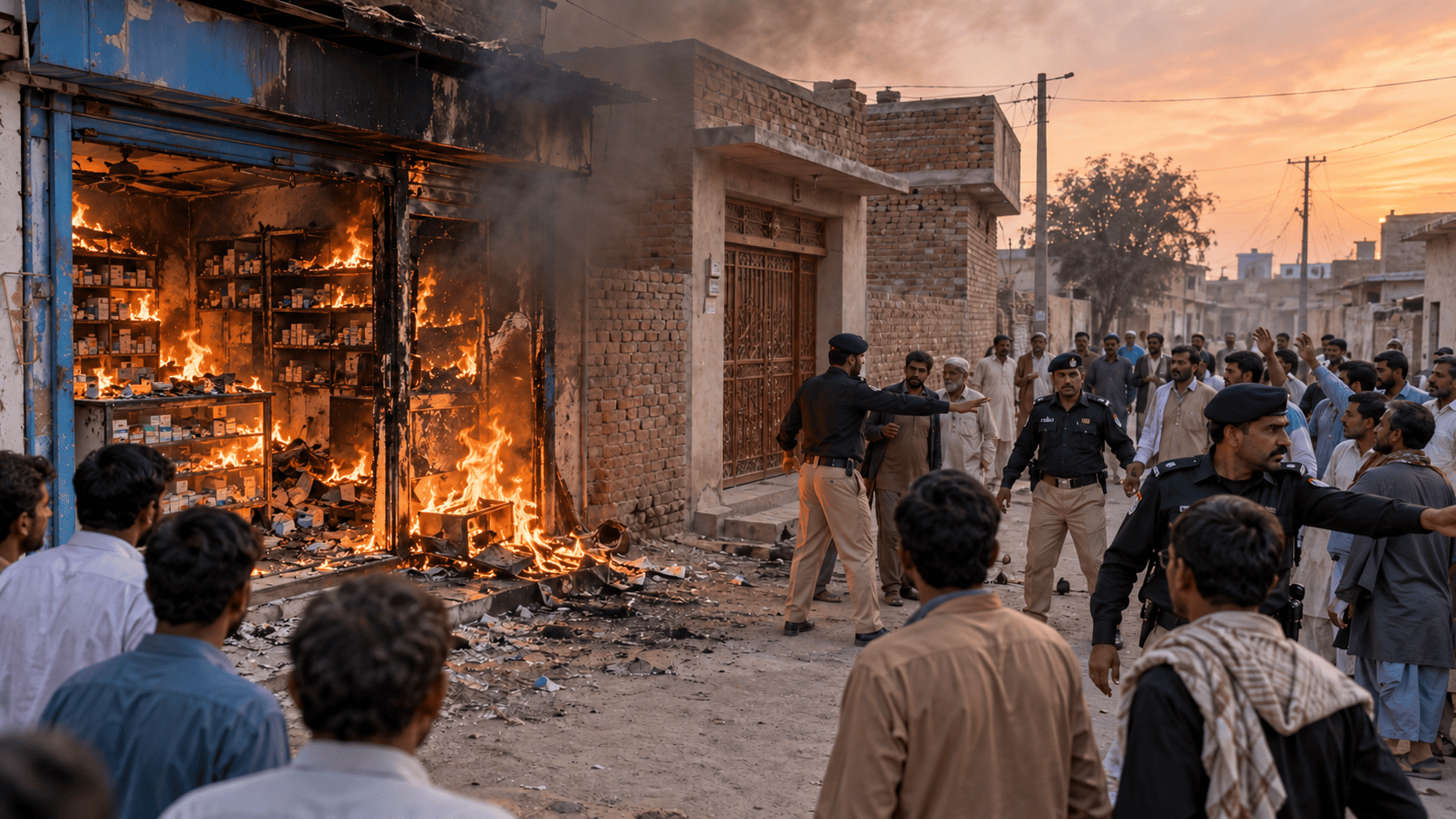
Lahore, Punjab | 1992
He had been accused of blasphemy.
He was taken to a police station for questioning.
His accuser was there too.
And inside the very place where the law was supposed to protect him, Bantu Masih was stabbed repeatedly.
According to Amnesty International, Bantu Masih, a Christian man, was stabbed eight times in a Lahore police station by the young man who had accused him of blasphemy. He later died from his injuries.
The case remains one of the starkest early examples of a broader human-rights problem: what happens when an accusation becomes more powerful than legal protection itself?
Who Was Bantu Masih?
Historical sources differ on his exact age.
Amnesty International’s 1994 report described Bantu Masih as 65 years old, while later Pakistani press retrospectives described him as being in his seventies or around 80. Because contemporary documentation is inconsistent, the safest description is simply:
Bantu Masih was an elderly Christian man from Lahore.
What is clear is that he became the subject of a blasphemy accusation in 1992 and was brought to a police station for questioning. He had not been convicted. His case had not reached a final judicial determination. Yet he would not survive the accusation.
The Accusation
The surviving human-rights documentation does not provide a sufficiently detailed or independently verified account of the exact words or conduct alleged against Bantu Masih. That limitation is important. We should not fill gaps in the historical record with assumptions.
What Human Rights Watch does establish is that Bantu Masih had been accused of blasphemy and that both he and the man who accused him were present in the police station for questioning. The purpose of the police station should have been straightforward:
- to investigate an allegation according to law.
- Instead, violence occurred inside it.
Attacked Inside the Police Station
According to Amnesty International, Bantu Masih was stabbed eight times by the young man who had accused him. The attack happened inside a Lahore police station.
Human Rights Watch independently records that Bantu Masih was stabbed by his accuser while the two men were at the police station for questioning.
Dawn later referred to the incident as a killing that occurred while Bantu Masih was in police custody and noted that he was attacked by the person who had accused him.
The setting is what makes this case especially disturbing. A person inside a police station should be safer than someone facing an angry crowd outside. Instead, the accused was attacked while already under the eyes of law-enforcement authorities.
The Reported Compromise
What happened after the stabbing raises even more serious questions. Amnesty International reported that, while Bantu Masih was hospitalized, police officers persuaded him to enter into a compromise with his attacker.
The reported arrangement was extraordinary: if Bantu Masih did not pursue a criminal case against the man who stabbed him, he would not be arrested on the blasphemy allegation.
Human Rights Watch reported essentially the same sequence: police convinced him not to press charges against his attacker in exchange for not arresting him on the blasphemy charge.
If accurately reported, this meant an injured victim was effectively placed in a position where he had to choose between: seeking justice for being stabbed or risking arrest on an unproven religious accusation.
That is not an ordinary compromise. It raises fundamental concerns about coercion, equal protection and the duty of police to investigate serious violence.
He Died Shortly Afterwards
Bantu Masih later died from his injuries. Amnesty International reported that he died shortly after the attack. Human Rights Watch similarly recorded that after his death, the outstanding matters connected to the case were dropped.
The man who had entered the police station as an accused person never lived to see a court determine whether the allegation against him had any legal basis.
And the surviving historical record does not establish that his attacker was ultimately held criminally accountable. That absence is itself part of why the case continues to be cited in human-rights reporting.
Why the Location Matters
Many blasphemy-related cases involve mob attacks in streets, villages or neighbourhoods. Bantu Masih’s case was different. He was attacked inside a police station. That makes the issue larger than vigilantism alone. It raises the question of state protection.
Once a person enters police custody or comes under police supervision, authorities have an enhanced responsibility to protect that person’s life and physical safety. The accusation against Bantu Masih did not remove that responsibility. An allegation does not suspend the law.
An Accusation Is Not a Verdict
The Bantu Masih case illustrates a principle that must remain central in every human-rights discussion:
An accused person remains entitled to protection.
Whether the allegation concerns blasphemy, theft, violence, or any other criminal offence, punishment is not determined by an accuser. It is determined through investigation, evidence, and a competent court.
This distinction is essential because religious accusations can carry extraordinary social consequences before any judge ever hears the case.
Human Rights Watch’s broader documentation from this period found that blasphemy allegations sometimes arose in contexts involving personal disputes, economic rivalries and other non-religious conflicts, while accusations themselves could trigger vigilante violence.
That is why due process matters. Not because allegations should be ignored. But because justice requires allegations to be tested.
A Wider Pattern of Vulnerability
Bantu Masih’s case did not occur in isolation.
Amnesty International’s 1994 report identified at least four Christians accused of blasphemy who had already died: Tahir Iqbal, Naimat Ahmar, Bantu Masih and Manzoor Masih.
Human Rights Watch similarly documented how religious accusations could expose accused people to violence even before courts determined guilt or innocence. The problem therefore was not simply the existence of criminal charges. It was the environment surrounding them:
- fear,
- social pressure,
- vigilante action,
- and insufficient protection for accused persons.
Bantu Masih’s death brought all of those concerns together in one place.
The Universal Declaration of Human Rights
The principles raised by Bantu Masih’s story are reflected in the Universal Declaration of Human Rights. Among them are:
- the right to life and security of person,
- equality before the law,
- protection against discrimination,
- the right to a fair hearing,
- and the presumption that guilt must be established through lawful process.
A person does not lose these protections because someone has accused them of an offence. In fact, that is precisely when those protections matter most.
Human Rights Must Protect Everyone
The purpose of documenting this case is not to blame an entire religion, community or country. It is to defend a simple legal principle:
No citizen should be attacked because of an accusation that has not been proven in court.
At Samaritan’s Fellowship Foundation, we believe human dignity and equal protection must extend to everyone—Christian, Muslim, Hindu, Sikh, Ahmadi or any other citizen. Through our Human Rights & Empowerment work, we seek to strengthen rights awareness, peaceful participation, community resilience and access to lawful institutions. Our goal is not confrontation. It is to help create communities where disputes are resolved through law rather than fear or violence.
Protection Is Stronger When Communities Are Stronger
Human-rights vulnerability is often intensified by poverty, social isolation, limited education and economic dependence. That is why SFFP does not treat rights as a separate issue from development. Through Set Them Free, vulnerable families affected by bonded labour and exploitation receive pathways toward freedom and reintegration. Through StartFish, families move toward sustainable livelihoods and greater economic independence. Our broader How We Work approach connects protection, development, opportunity and leadership into one integrated ecosystem.
Because a community that is informed, economically stronger and connected to lawful institutions is better equipped to protect its dignity and rights.
What Can We Learn From Bantu Masih?
The lesson is not complicated.
- A police station must be a place of protection.
- An accusation must be investigated.
- An injured person should never have to choose between pursuing justice and avoiding another criminal allegation.
- And no private individual has the right to impose punishment.
Bantu Masih’s story reminds us that the rule of law is tested most severely when the accused person is unpopular, vulnerable, or socially isolated. That is when institutions matter most.
Help Us Advance Freedom, Dignity and Opportunity
Samaritan’s Fellowship Foundation builds integrated, community-led ecosystems that empower marginalized communities through human rights, healthcare, education, clean water, sustainable livelihoods, and local leadership.
We believe lasting change means more than helping people survive a crisis. It means helping people become safer, informed, economically independent and capable of participating in decisions that shape their lives.
If you believe every person deserves protection under law—regardless of religion, poverty or accusation:
Together, we can help build stronger communities where dignity, freedom and opportunity belong to everyone. Empowerment Beyond Aid — Advancing Freedom and Rights.
Editorial Note
Samaritan’s Fellowship Foundation documents publicly reported human-rights cases for historical record, education and awareness.
Allegations described in this article are treated as allegations unless established through a competent judicial process.
Historical sources differ on Bantu Masih’s exact age. This article therefore identifies him as an elderly Christian man rather than presenting a disputed age as fact.
SFFP does not attribute the actions of individual attackers, officials or groups to an entire religion, community or the people of Pakistan. We support peaceful coexistence, due process, constitutional protection and equal human dignity for all.
References:
- Amnesty International. Pakistan: Use and Abuse of the Blasphemy Laws. Amnesty records that Bantu Masih was a Christian man accused of blasphemy who was stabbed eight times inside a Lahore police station by his accuser. It also documents the reported police-brokered compromise and his subsequent death.
- Human Rights Watch. Pakistan – Human Rights Developments. HRW independently reports that Bantu Masih was stabbed by his accuser while both men were in a police station for questioning and that police persuaded him not to prosecute the attacker in exchange for avoiding arrest on the blasphemy charge.
- Dawn. Timeline: Accused Under the Blasphemy Law. Dawn retrospectively lists Bantu Masih among major blasphemy-related cases from 1992.
- Dawn. ‘Ordeal’ of Minority Prisoners. The newspaper later discussed Bantu Masih’s death in the context of the security of Christian blasphemy accused and described him as having been stabbed by his accuser while at a police station.
- UCA News. The Legal Oppression of Minorities in Pakistan. A contemporary 1992 report records the attack on Bantu Masih inside a Lahore police station in the presence of police.
- Contemporary source/article URL:
https://www.ucanews.com/story-archive/?post_id=291&post_name=%2F1992%2F10%2F20%2Fthe-legal-oppression-of-minorities-in-pakistan
- Excerpt: Bantu Masih entered a Lahore police station as a man accused of blasphemy. While there for questioning, he was stabbed eight times by his accuser and later died from his injuries.
- Amnesty International / Refworld:
https://www.refworld.org/reference/countryrep/amnesty/1994/en/96407
- Human Rights Watch:
https://www.hrw.org/reports/1993/pakistan/
- UCA News contemporary archive:
https://www.ucanews.com/story-archive/?post_id=291&post_name=%2F1992%2F10%2F20%2Fthe-legal-oppression-of-minorities-in-pakistan
- Dawn timeline:
https://www.dawn.com/2012/09/19/timeline-accused-under-the-blasphemy-law/
- Dawn retrospective:
https://www.dawn.com/news/396437/ordeal-of-minority-prisoners
- Image used for illustration