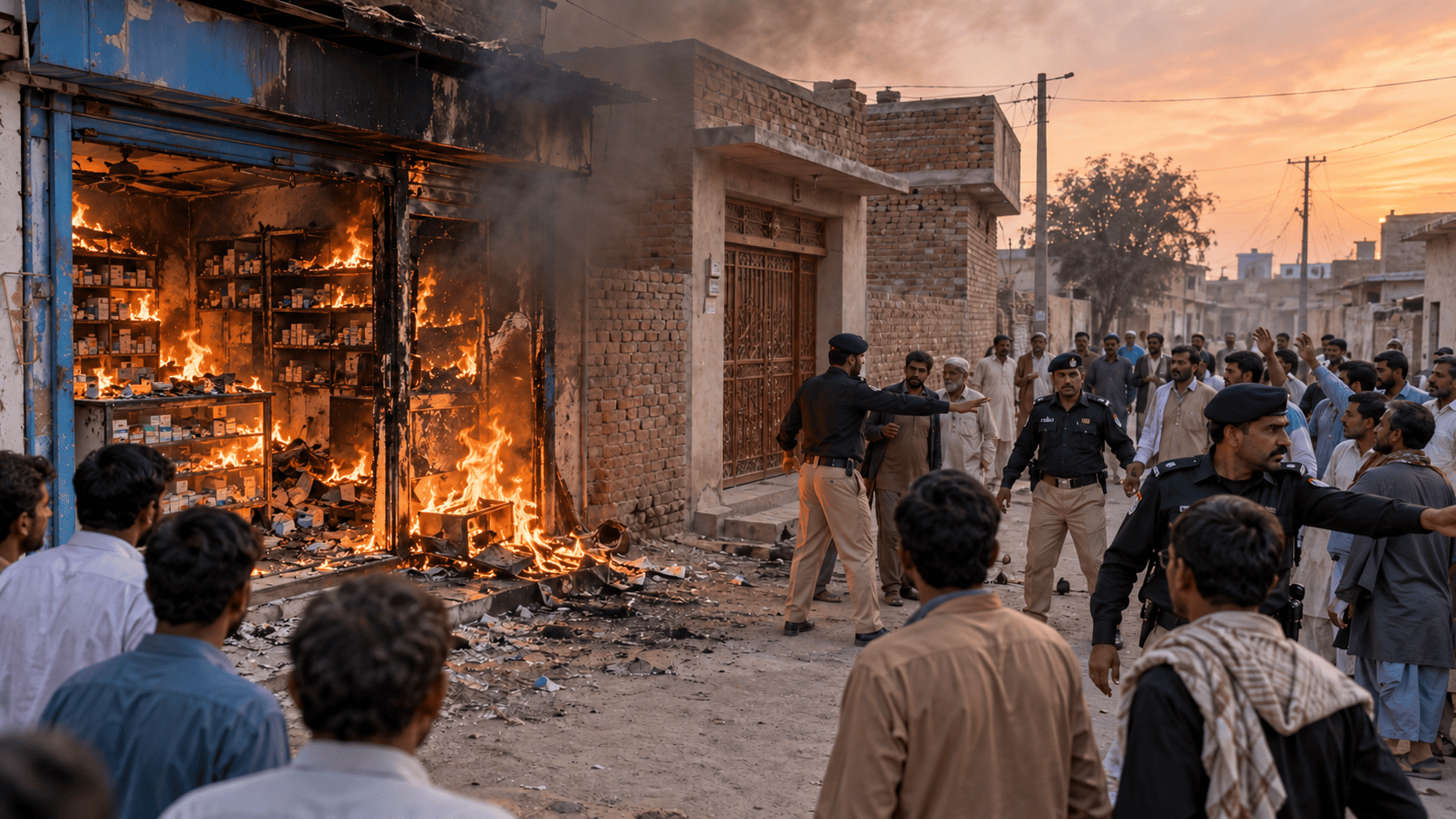
Lahore, Pakistan | 1990–1992
A man confined to a wheelchair. A blasphemy allegation he never lived long enough to answer at trial. Repeated warnings that his life was in danger. And, after 19 months in detention, a death inside one of Lahore’s prisons whose precise cause was never conclusively established.
The story of Tahir Iqbal is one of the earliest internationally documented cases showing how a blasphemy accusation in Pakistan can become a human-rights crisis long before any court determines guilt or innocence.
His case was not only about freedom of religion. It raised fundamental questions about due process, the protection of an accused person, equality before the law, humane treatment in detention, and the state’s responsibility to protect a person in its custody.
More than three decades later, those questions remain relevant.
Who Was Tahir Iqbal?
Tahir Iqbal was approximately 35 years old when he died in Kot Lakhpat Jail, Lahore, on 19 July 1992.
According to Amnesty International, he had previously served as an engineer in the Pakistan Air Force. An illness in 1982 left him partially paralysed and dependent on a wheelchair. Afterward, he repaired watches and gave private tuition to children in his neighbourhood without charge.
Amnesty reported that Iqbal, who had been born into a Muslim family, converted to Christianity in 1988 after studying religious texts. His conversion would later become inseparable from the criminal case brought against him.
The Allegation
In 1990, a local mosque imam filed a complaint against Tahir Iqbal. According to Amnesty International’s detailed account of the case, the complainant alleged that Iqbal had desecrated a copy of the Quran by underlining passages and writing in its margins. His defence maintained that the book found in his possession was an English translation.
Human Rights Watch separately reported that the First Information Report accused him of desecrating the Quran and making derogatory remarks about the Prophet Muhammad.
These were allegations. Tahir Iqbal was never convicted after a completed trial. He died while still an under-trial prisoner. That distinction is essential.
Arrested Before His Case Was Decided
The complaint was filed on 7 December 1990. Human Rights Watch reported that Iqbal was arrested shortly afterward and charged under Sections 295-B and 295-C of the Pakistan Penal Code.
For months, he reportedly had no lawyer willing to represent him.
Eventually, lawyers associated with the Human Rights Commission of Pakistan, including prominent human-rights defenders, became involved in his defence. Human Rights Watch reported that members of the defence team received threats, while religious activists attended hearings and attempted to intimidate those participating in the proceedings.
A criminal accusation had begun affecting not only the accused, but also those trying to ensure that he received a legal defence.
A Bail Decision Raised an Extraordinary Question
One of the most troubling aspects of the Tahir Iqbal case concerned his applications for bail.
Amnesty International documented that a sessions court refused bail while referring to Iqbal’s conversion from Islam to Christianity as though conversion itself constituted a cognizable criminal offence.
But, as Amnesty noted, conversion was not an offence under the Pakistan Penal Code.
His lawyers subsequently argued before the Lahore High Court that there was no legal basis for treating conversion itself as a crime and that his serious physical disability should also weigh in favour of bail.
The application was again rejected.
Human Rights Watch similarly documented that the court’s reasoning included concern over Iqbal’s conversion even though conversion itself was not prohibited by Pakistani criminal law. The issue goes to the heart of the principle of the rule of law:
A citizen can only be punished or deprived of liberty according to law—not according to assumptions about what the law ought to prohibit.
A Disabled Man in Prison
Tahir Iqbal’s physical condition made his detention particularly serious. A prison medical officer described him as suffering from significant paralysis, loss of sensation and an inability to control basic bodily functions.
Yet Amnesty International reported that he was at one stage placed in solitary confinement without toilet facilities, electricity or water.
After protests, he was moved to a regular cell. Amnesty further reported that during hot weather, electricity and water to his accommodation were again cut for an extended period. Human Rights Watch also documented the interruption of water and electricity and reported that complaints were made to senior prison officials.
For someone with severe physical disabilities, these were not minor inconveniences. They concerned basic dignity and humane treatment.
“I Fear for My Life”
As the case continued, Tahir Iqbal reportedly became convinced that he would not survive detention. According to Amnesty International, a prison warden had made threatening remarks toward him. Iqbal communicated his fears to his lawyer and wrote to senior federal and provincial authorities seeking protection.
Human Rights Watch reported that on 1 July 1992, Iqbal sent letters addressed to senior government officials expressing fear that people connected to the case were plotting to kill him inside prison. At his final court appearance on 13 July 1992, Amnesty reported that he again told his lawyer that he feared for his life. Six days later, he was dead.
19 July 1992
Tahir Iqbal died during the night of 19 July 1992 inside Kot Lakhpat Jail. What precisely killed him remains one of the most disturbing unresolved elements of the case. Amnesty International described the circumstances as suspicious and stated that the exact cause of death had not been established.
Human Rights Watch reported that Iqbal was found dead in his cell and that poisoning was suspected.
Accounts cited by Amnesty stated that shortly before his death he had developed a high fever and was vomiting blood. Members of the Christian community and his lawyers subsequently raised concerns that he may have been poisoned.
But suspicion is not proof. For that reason, it would be inaccurate to state as a fact that Tahir Iqbal was murdered by poisoning. What can safely be stated is this:
He died in state custody while awaiting trial; he had previously reported threats to his life; serious questions were raised about the circumstances of his death; and no conclusive public determination of the precise cause emerged from the inquiries described by human-rights organisations.
The Post-Mortem That Did Not Happen
The events after his death deepened the controversy. According to Amnesty International, a magistrate ordered a post-mortem examination. However, the body was released to members of Iqbal’s family before an autopsy was completed and was buried according to Islamic rites.
His lawyers sought an inquiry and attempted to have the body exhumed so that a post-mortem could be conducted.
Amnesty documented a prolonged sequence of court proceedings and administrative delays surrounding the investigation. By the time of its 1994 report, the organisation said the cause of death remained unascertained.
Human Rights Watch likewise reported that a judicial inquiry had been ordered but that, as of its reporting, no findings had been made public and nobody had been charged in relation to his death. The absence of a definitive forensic determination means that the final moments of Tahir Iqbal’s life remain unresolved.
Why This Case Still Matters
It is easy to reduce cases like Tahir Iqbal’s to a debate about one law or one religion. That would miss the larger human-rights issue. Whatever accusation is made against a person, an allegation is not a conviction. Every accused person remains entitled to:
- a fair hearing;
- legal representation;
- protection from intimidation;
- humane treatment in detention;
- protection from violence;
- and an impartial determination of guilt or innocence according to law.
Tahir Iqbal never received a final judgment. His life ended before his trial did. That is why his story belongs not only in the history of religious freedom in Pakistan, but also in the history of due process and the rule of law.
The Universal Declaration of Human Rights
The principles at stake in this case are reflected in the Universal Declaration of Human Rights. Among them are the principles that every person is entitled to equality before the law, freedom of thought, conscience and religion, protection from arbitrary interference, and a fair and public hearing before an independent tribunal.
Human rights do not require us to agree with another person’s religion, beliefs or choices. They require us to protect that person’s humanity and legal rights. That principle applies to Muslims, Christians, Hindus, Sikhs, Ahmadis and people of every belief or no belief.
Protecting Minority Rights Is Not an Attack on Pakistan
Cases of religiously motivated violence or misuse of allegations should not be used to condemn an entire country, religion or community. Pakistan’s own constitutional framework recognizes fundamental rights and religious freedom. The challenge is ensuring that those protections are experienced in everyday life—especially by poor people, marginalized, socially isolated, or unable to defend themselves.
At Samaritan’s Fellowship Foundation, our approach is rooted in this principle. We believe sustainable change requires more than responding after a tragedy has occurred. It requires stronger communities, rights awareness, access to institutions, economic independence, and local leadership. Our Human Rights & Empowerment work seeks to strengthen those pathways while promoting peaceful coexistence, dignity, and equal citizenship.
From Vulnerability to Empowerment
A person who lacks income, education, social protection, or access to legal institutions is often far more vulnerable when a crisis begins. That is one reason SFFP works through an integrated model rather than treating human rights and poverty as unrelated problems.
Through initiatives such as Set Them Free, we work with vulnerable families affected by bonded labour and exploitation. Through StartFish, we help families move toward sustainable livelihoods and economic independence. Through our broader How We Work model, humanitarian support, sustainable development, rights awareness and community leadership become part of one journey: from vulnerability to resilience, from dependence to opportunity, and from exclusion to participation. This is what we mean by:
Empowerment Beyond Aid — Advancing Freedom and Rights.
What Can We Learn From Tahir Iqbal?
- Tahir Iqbal’s story should not be remembered merely because he died. It should challenge us to ask what must happen before the next accusation becomes another tragedy.
- Communities need confidence in lawful institutions.
- Police and prison authorities must be able to protect accused persons.
- Courts and lawyers must be able to perform their duties without intimidation.
- Religious communities must reject vigilantism.
- Minorities must know their rights.
- And every allegation must remain an allegation until evidence is examined through due process.
- Human dignity cannot depend on whether a person is popular. Human rights matter most precisely when protecting someone becomes difficult.
Help Us Advance Freedom, Dignity and Opportunity
Samaritan’s Fellowship Foundation works with marginalized communities across Pakistan to build pathways toward human rights, healthcare, education, clean water, sustainable livelihoods and local leadership. We believe communities become safer when people are not only protected from immediate harm, but empowered to understand their rights, support their families, participate in society and shape their own future.
If you believe that no person’s dignity should disappear because of poverty, religious identity or an accusation that has not been proven, stand with our work.
Your support helps us build stronger, more resilient and self-reliant communities where freedom, dignity and opportunity can become a reality for all.
Editorial Note
Samaritan’s Fellowship Foundation documents publicly reported human-rights cases for education, historical record and awareness. Allegations described in this article are identified as allegations unless established through a competent judicial process.
SFFP does not attribute the actions of particular individuals, officials or groups to an entire religion, community or the people of Pakistan. We support peaceful coexistence, constitutional protections, due process and equal human dignity for every citizen.
References
-
- Amnesty International. Pakistan: Use and Abuse of the Blasphemy Laws. 26 July 1994. Amnesty’s detailed case history states that Tahir Iqbal was approximately 35, had previously served as an air-force engineer, had become paralysed, converted to Christianity in 1988, was charged under Sections 295-B and 295-C, spent approximately 19 months in detention and died in suspicious circumstances in Kot Lakhpat Jail. It also documents the bail proceedings, detention conditions, threats reported before his death, and the unsuccessful effort to establish a definitive cause of death.
- Wikipedia: https://en.wikipedia.org/wiki/Blasphemy_in_Pakistan, https://en.wikipedia.org/wiki/Apostasy_in_Islam_by_country
- Human Rights Watch. Pakistan — Human Rights Developments, 1993. HRW’s detailed account records Iqbal’s conversion, the FIR filed against him, the difficulties securing legal representation, threats against defence lawyers, the bail proceedings, prison conditions, letters expressing fear for his life and the circumstances surrounding his death and proposed post-mortem.
- Amnesty International. Pakistan: Use and Abuse of the Blasphemy Laws — Tahir Iqbal Case History. Amnesty records that the precise cause of death was not established and that questions surrounding the post-mortem and subsequent inquiry remained unresolved at the time of publication.
Case Series: Blasphemy & Mob Violence in Pakistan
Themes: Religious Freedom · Minority Rights · Due Process · Freedom of Belief · Human Rights
Location: Lahore, Punjab, Pakistan
Period: 1990–1992
Image: Image used for illustration